
Parasites du dieu
Comptables, financiers et commerçants dans la Délos hellénistique
By (author) V. Chankowski
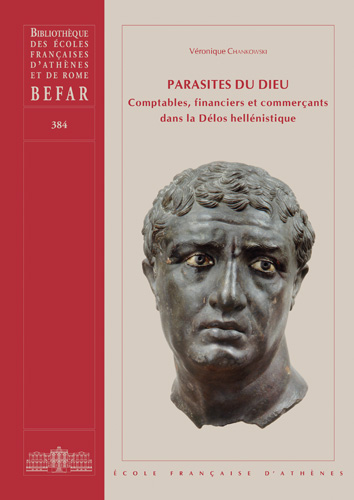
Freed from Athenian guardianship in 314 BCE, at a time of geopolitical changes which marked the beginnings of the Hellenistic period in the Aegean world, Delos gradually built up its political and economic independence. The Delian community redefined, during the third and second centuries, the central place that the island had constantly occupied in the economic, financial and cultural flows of the Mediterranean. This study is mainly based on epigraphic accounting sources, including more than five hundred accounts and engraved inventories that were visible in the sanctuary of Apollo, but also on numismatic sources and archaeological remains on the seafront, in order to re-consider the question of Delos’ place in the Hellenistic economy. Far from being an exception to be excluded from serialized comparisons, the Delian documentation is indicative of Aegean economic situations and demonstrates the capacities of the Greek communities to adapt to change in troubled times. Behind the figures engraved on the stone appear human communities and societies whose economic activities shed new light on the history of this part of the Mediterranean.
Freed from Athenian guardianship in 314 BCE, at a time of geopolitical changes which marked the beginnings of the Hellenistic period in the Aegean world, Delos gradually built up its political and economic independence. The Delian community redefined, during the third and second centuries, the central place that the island had constantly occupied in the economic, financial and cultural flows of the Mediterranean. This study is mainly based on epigraphic accounting sources, including more than five hundred accounts and engraved inventories that were visible in the sanctuary of Apollo, but also on numismatic sources and archaeological remains on the seafront, in order to re-consider the question of Delos’ place in the Hellenistic economy. Far from being an exception to be excluded from serialized comparisons, the Delian documentation is indicative of Aegean economic situations and demonstrates the capacities of the Greek communities to adapt to change in troubled times. Behind the figures engraved on the stone appear human communities and societies whose economic activities shed new light on the history of this part of the Mediterranean.
- By (author) V. Chankowski
Other Titles in this Series


 La cité des Delphiens
Une communauté politique à l'ombre d'Apollon (VIe-Ier siecle av. J.-C.)
Volume 416
Similar Books


 Contesting Labeled Identities
The Sociology of Gentilics in Biblical and Northwest Semitic Literature

 Drunk the Potion, No Whit Charmed
The Doctrine of Pure and Perfect Souls from Iamblichus to Damascius

 Epigraphic “Shades” from Hellenistic Thrace
Contextualizing Inscriptions in Greek from Thracian Tombs

 Epiphanies of the Divine in the Septuagint and the New Testament
Fifth International Symposium of the Corpus Judaeo-Hellenisticum Novi Testamenti (CJHNT), 14-17 May 2015, Nottingham


 Gold, Silver and Glass: Power Networks, Cultural Identities, Technology Transfers and Agency across the Old World (7th Century BC – 1st Century AD)
Proceedings of a Conference Held at the British Museum, 16–18 June 2023
 Language and Power in the Roman Empire and Early India
Hierarchy, Ambiguity, and the Art of Reading the Signs in Cosmopolitan Cultures
 Late Antique villae in the Balkans (3rd–7th c. AD): Current Research Questions and Perspectives
HAEMUS Companion to the Late Antique Balkans 1
Volume 4


 Nurturing the Elite
Representations of Drinking, Eating, and Religious Vessels in Palmyrene Funerary Iconography
Volume 13





 Roman Copies, Collecting, and Culture in the Bay of Naples and Beyond
Papers in Honor of Eugene J. Dwyer



 The Compositional History of the Book of Kings
An Analysis of the Evaluative Frameworks in 1 Kings 14–2 Kings 25




 Zooarchaeology of Ancient Greek Sanctuaries in Southwestern Sicily
Faunal Analysis from Selinus and Akragas as Evidence of Differences in the Treatment of Animals for Ritual Purposes


