
Etymology and Wordplay in Medieval Literature
Edited by Mikael Males

In modern scholarship, etymology and wordplay are rarely studied in tandem. In the Middle Ages, however, they were intrinsically related, and both feature prominently in medieval literature. Their functions are often at variance with the expectations of the modern reader, in particular when wordplay is used to arrive at crucial answers or to convey theological insights. The studies in this book therefore carry important implications for our understanding of the reception of medieval texts. The authors show how etymology and wordplay in the Middle Ages often served as an impetus for meditation and as a route to truth, but that they could also be put to more mundane uses, such as the bolstering of national pride. In a narrative context, the functions of etymology and wordplay could range from underlining the sexual bravado of the protagonist to being the key indicator of whether the hero would live or die. Opening with a background chapter describing classical and medieval developments of etymology and wordplay, this book presents case studies of the uses of etymology and wordplay in a number of medieval literatures (Latin, Old French, Middle High German, Italian, Old Irish, Old English, Old Norse, Slavic). The articles expand their discussions beyond strictly etymological discourse to various aspects of medieval literature, and thereby highlight the functions of etymological devices in various contexts, with significance ranging from the specific to the open-ended, from the bawdy to the sublime.
In modern scholarship, etymology and wordplay are rarely studied in tandem. In the Middle Ages, however, they were intrinsically related, and both feature prominently in medieval literature. Their functions are often at variance with the expectations of the modern reader, in particular when wordplay is used to arrive at crucial answers or to convey theological insights. The studies in this book therefore carry important implications for our understanding of the reception of medieval texts. The authors show how etymology and wordplay in the Middle Ages often served as an impetus for meditation and as a route to truth, but that they could also be put to more mundane uses, such as the bolstering of national pride. In a narrative context, the functions of etymology and wordplay could range from underlining the sexual bravado of the protagonist to being the key indicator of whether the hero would live or die. Opening with a background chapter describing classical and medieval developments of etymology and wordplay, this book presents case studies of the uses of etymology and wordplay in a number of medieval literatures (Latin, Old French, Middle High German, Italian, Old Irish, Old English, Old Norse, Slavic). The articles expand their discussions beyond strictly etymological discourse to various aspects of medieval literature, and thereby highlight the functions of etymological devices in various contexts, with significance ranging from the specific to the open-ended, from the bawdy to the sublime.
- Edited by Mikael Males
Other Titles in this Series


 Public Declamations
Essays on Medieval Rhetoric, Education, and Letters in Honour of Martin Camargo
Volume 27


 Medieval Art at the Intersection of Visuality and Material Culture
Studies in the 'Semantics of Vision'
Volume 32

 Law and Theology in Twelfth-Century England
The Works of Master Vacarius (c. 1115/20 - c. 1200)
Volume 10


 Sapientia et eloquentia
Meaning and Function in Liturgical Poetry, Music, Drama, and Biblical Commentary in the Middle Ages
Volume 11

 The Classics in the Medieval and Renaissance Classroom
The Role of Ancient Texts in the Arts Curriculum as Revealed by Surviving Manuscripts and Early Printed Books
Volume 20
 Medieval Thought Experiments
Poetry, Hypothesis, and Experience in the European Middle Ages
Volume 31


 Fictions of the Inner Life
Religious Literature and Formation of the Self in the Eleventh and Twelfth Centuries
Volume 4


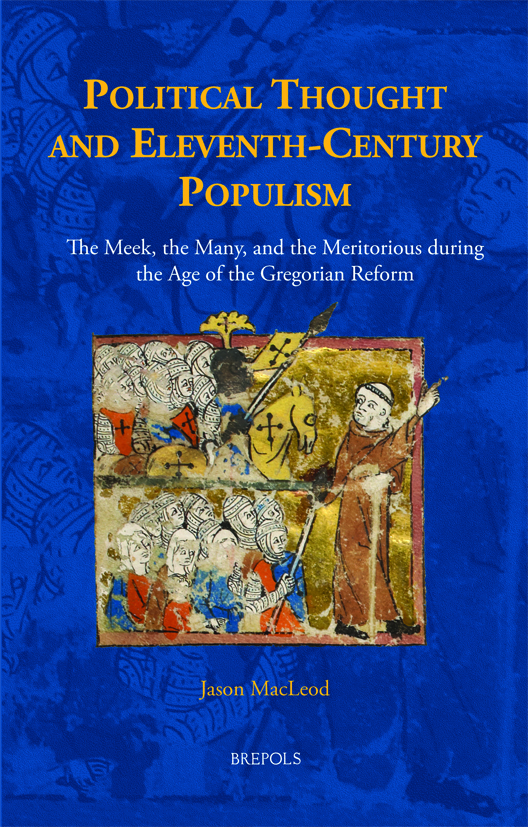 Political Thought and Eleventh-Century Populism
The Meek, the Many, and the Meritorious during the Age of the Gregorian Reform
Volume 38

 Mind Matters
Studies of Medieval and Early Modern Intellectual History in Honour of Marcia Colish
Volume 21

Similar Books
 «Solazoxa festa, stradolze e stracomplia»
Festschrift für Raymund Wilhelm zum 65. Geburtstag mit Beiträgen zu Diskurstraditionen und mittelalterlicher Philologie
Volume 249
 A Collaborative Tapestry in Honour of Shirley Ann Brown / Une fresque brodée en l’honneur de Shirley Ann Brown
The Bayeux Tapestry Seen by her Colleagues and Friends / La Tapisserie de Bayeux vue par ses collègues et amis




 Ars Prophetica
Theology in the Poetry of Twentieth-Century Hebrew Poets Avraham Halfi, Shin Shalom, Amir Gilboa, and T. Carmi
 Behind the Scenes of Medieval Roofs
An Overview of the Roofing Systems of Italian Churches
Volume 90


 Cahiers de l’Association internationale des études françaises
J. M. G. Le Clézio - Enseigner les littératures francophones aujourd’hui - Récit de soi et expérience de l’illusion (XVIIe-XVIIIe siècles)
Volume 78
 Cahiers de littérature française
Les Métamorphoses du texte. Enjeux intertextuels et transpositions visuelles
Volume 25
 Cahiers de recherches médiévales et humanistes – Journal of Medieval and Humanistic Studies
Volume 51
 Cahiers de sémiotique des cultures
Ponctuation et sens. Nouvelles perspectives / Punctuation and meaning. New perspectives
Volume 6


 CompLit
Myth, Folklore and Magic in European Literatures. Critical and Contemporary Reconfigurations



 Dis/United States of Vulnerability
Literary and Cultural Transgressions in U.S. Poetry Since the 1960s
Volume 330





 European Drama and Performance Studies
Dramatisations politiques. Théâtre, politique et idéologie au XIXe siècle (1806-1914)
Volume 27


