
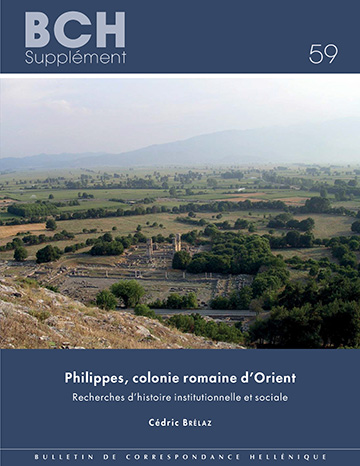
Philippes, colonie romaine d’Orient
Recherches d'histoire institutionnelle et sociale
By (author) C. Brélaz
Paperback (Published)
(December 2018)
ISBN: 9782869582996
Price: $44.00
On back order
Founded on Thracian soil by Macedonian king Philip II, Philippi witnessed the final battle between the Republican army of Brutus and Cassius and the army of Antony and Octavian, the heirs to Caesar. In the aftermath of the battle, which took place in the fall of 42 BCE, Antony decided to take advantage of the large surrounding territory, settling the veterans of the legions who had fought there and founding a Roman colony. Relying on extensive epigraphic evidence, this book explores how the political community that was founded in place of that Greek city was structured and how it functioned, as well as traces the rise of the colony’s ruling elite and the demographic, social, and cultural dynamics of this group over the course of more than three centuries, from the establishment of the colony until the end of the third century CE. Through the systematic comparison of this colony with others that were settled by Rome in the Eastern provinces of the Empire, along with other Greek cities and the Western municipia and colonies, this book places Philippi within the general framework of both the local communities of the Roman Empire and its regional context. Through the example of Philippi, this book argues that, though colonies were provided with set institutions patterned after the Roman model, far from being static copies of Rome as assumed by Gellius, they were living and autonomous offshoots influenced in turn by their provincial environment, and ultimately each colony developed its own specific and unique identity.
Founded on Thracian soil by Macedonian king Philip II, Philippi witnessed the final battle between the Republican army of Brutus and Cassius and the army of Antony and Octavian, the heirs to Caesar. In the aftermath of the battle, which took place in the fall of 42 BCE, Antony decided to take advantage of the large surrounding territory, settling the veterans of the legions who had fought there and founding a Roman colony. Relying on extensive epigraphic evidence, this book explores how the political community that was founded in place of that Greek city was structured and how it functioned, as well as traces the rise of the colony’s ruling elite and the demographic, social, and cultural dynamics of this group over the course of more than three centuries, from the establishment of the colony until the end of the third century CE. Through the systematic comparison of this colony with others that were settled by Rome in the Eastern provinces of the Empire, along with other Greek cities and the Western municipia and colonies, this book places Philippi within the general framework of both the local communities of the Roman Empire and its regional context. Through the example of Philippi, this book argues that, though colonies were provided with set institutions patterned after the Roman model, far from being static copies of Rome as assumed by Gellius, they were living and autonomous offshoots influenced in turn by their provincial environment, and ultimately each colony developed its own specific and unique identity.
- By (author) C. Brélaz
Other Titles in this Series

 Les royaumes de Chypre à l’épreuve de l’histoire
Transitions et ruptures de la fin de l'âge du Bronze au début de l'époque hellénistique
Volume 60

 Obolos 10
Coins in the Peloponnese. La monnaie dans le Peloponnese: Proceedings of the Sixth Scientific Meeting of the Friends of the Numismatic Museum, Argos, May 26-29, 2011. Volume 1: Ancient Times. Volume 2: Byzantine and Modern Times. Actes de la sixieme
Volume 57


Similar Books


 Contesting Labeled Identities
The Sociology of Gentilics in Biblical and Northwest Semitic Literature

 Drunk the Potion, No Whit Charmed
The Doctrine of Pure and Perfect Souls from Iamblichus to Damascius

 Epigraphic “Shades” from Hellenistic Thrace
Contextualizing Inscriptions in Greek from Thracian Tombs

 Epiphanies of the Divine in the Septuagint and the New Testament
Fifth International Symposium of the Corpus Judaeo-Hellenisticum Novi Testamenti (CJHNT), 14-17 May 2015, Nottingham


 Gold, Silver and Glass: Power Networks, Cultural Identities, Technology Transfers and Agency across the Old World (7th Century BC – 1st Century AD)
Proceedings of a Conference Held at the British Museum, 16–18 June 2023
 Language and Power in the Roman Empire and Early India
Hierarchy, Ambiguity, and the Art of Reading the Signs in Cosmopolitan Cultures
 Late Antique villae in the Balkans (3rd–7th c. AD): Current Research Questions and Perspectives
HAEMUS Companion to the Late Antique Balkans 1
Volume 4


 Nurturing the Elite
Representations of Drinking, Eating, and Religious Vessels in Palmyrene Funerary Iconography
Volume 13





 Roman Copies, Collecting, and Culture in the Bay of Naples and Beyond
Papers in Honor of Eugene J. Dwyer



 The Compositional History of the Book of Kings
An Analysis of the Evaluative Frameworks in 1 Kings 14–2 Kings 25




 Zooarchaeology of Ancient Greek Sanctuaries in Southwestern Sicily
Faunal Analysis from Selinus and Akragas as Evidence of Differences in the Treatment of Animals for Ritual Purposes


