
Spartacus, History and Tradition
edited by Kariusz Slapek
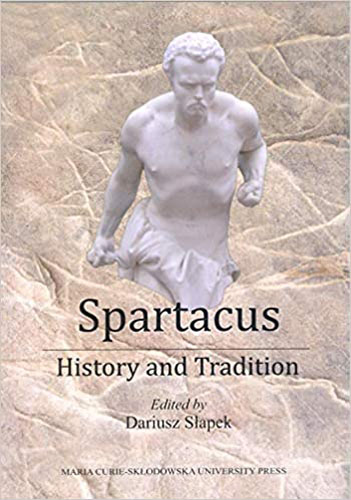
Despite the convergence between the title of the conference and the book discussed here, at first glance it is plain to see that this publication constitutes an autonomous whole, as well as an ambitious attempt to capture the issues connected with Spartacus as a historical character, comprehensively, in all their complexity, and also to tackle the difficult issue of the “posthumous works” of the Thracian slave. We must note that researchers on Spartacus are confronted with two ideologies, or maybe two ways of using the hero for propaganda purposes: on the one hand, Roman historiography, and the other, Marxist thought and communist propaganda. We have to admit that, amongst the main figures of the last century of the Republic, the hero of this book, while admittedly not the most important from the point of view of historical events has without doubt the greatest potential for receptions and appropriations’. This constitutes the significance and contemporary nature of the subject of the work. This collection of articles edited by Dariusz Slapek amply fulfils the definition of a authored monograph. We are presented with a thoughtful choice of texts, clearly connected by a distinct guiding thought. The picture of the ancient slave painted by the authors glitters with a plethora of meanings. This is particularly visible in the second period of Late Antiquity. This incredibly interesting, many-faceted look at the Trachian leader shows, almost as an aside, the importance of the co-operation of specialist from various branches but also the openness of the representatives of studies of antiquity to the inspiration flowing from accomplishments within contemporary humanities”.
Despite the convergence between the title of the conference and the book discussed here, at first glance it is plain to see that this publication constitutes an autonomous whole, as well as an ambitious attempt to capture the issues connected with Spartacus as a historical character, comprehensively, in all their complexity, and also to tackle the difficult issue of the “posthumous works” of the Thracian slave. We must note that researchers on Spartacus are confronted with two ideologies, or maybe two ways of using the hero for propaganda purposes: on the one hand, Roman historiography, and the other, Marxist thought and communist propaganda. We have to admit that, amongst the main figures of the last century of the Republic, the hero of this book, while admittedly not the most important from the point of view of historical events has without doubt the greatest potential for receptions and appropriations’. This constitutes the significance and contemporary nature of the subject of the work. This collection of articles edited by Dariusz Slapek amply fulfils the definition of a authored monograph. We are presented with a thoughtful choice of texts, clearly connected by a distinct guiding thought. The picture of the ancient slave painted by the authors glitters with a plethora of meanings. This is particularly visible in the second period of Late Antiquity. This incredibly interesting, many-faceted look at the Trachian leader shows, almost as an aside, the importance of the co-operation of specialist from various branches but also the openness of the representatives of studies of antiquity to the inspiration flowing from accomplishments within contemporary humanities”.
- By (author) Archeobooks
Similar Books


 Contesting Labeled Identities
The Sociology of Gentilics in Biblical and Northwest Semitic Literature

 Drunk the Potion, No Whit Charmed
The Doctrine of Pure and Perfect Souls from Iamblichus to Damascius

 Epigraphic “Shades” from Hellenistic Thrace
Contextualizing Inscriptions in Greek from Thracian Tombs

 Epiphanies of the Divine in the Septuagint and the New Testament
Fifth International Symposium of the Corpus Judaeo-Hellenisticum Novi Testamenti (CJHNT), 14-17 May 2015, Nottingham


 Gold, Silver and Glass: Power Networks, Cultural Identities, Technology Transfers and Agency across the Old World (7th Century BC – 1st Century AD)
Proceedings of a Conference Held at the British Museum, 16–18 June 2023
 Language and Power in the Roman Empire and Early India
Hierarchy, Ambiguity, and the Art of Reading the Signs in Cosmopolitan Cultures
 Late Antique villae in the Balkans (3rd–7th c. AD): Current Research Questions and Perspectives
HAEMUS Companion to the Late Antique Balkans 1
Volume 4


 Nurturing the Elite
Representations of Drinking, Eating, and Religious Vessels in Palmyrene Funerary Iconography
Volume 13





 Roman Copies, Collecting, and Culture in the Bay of Naples and Beyond
Papers in Honor of Eugene J. Dwyer



 The Compositional History of the Book of Kings
An Analysis of the Evaluative Frameworks in 1 Kings 14–2 Kings 25




 Zooarchaeology of Ancient Greek Sanctuaries in Southwestern Sicily
Faunal Analysis from Selinus and Akragas as Evidence of Differences in the Treatment of Animals for Ritual Purposes


