
Technologie du harponnage sur la côte Pacifique du désert d’Atacama (nord du Chili)
By (author) Benjamín Ballester Riesco

Paperback (Published)
(November 2018)
ISBN: 9781789690279
7.99 x 10.91 inches
Price: $45.00
In stock
These objects do not have a single purpose. This is the central premise that guides the research within this book. Throughout the volume the reader will follow a representation of a marine hunter-gatherer society, a projection deriving from one of its iconic and most important material assets, the harpoon. This very technical object will be studied not only for its most evident function – hunting at sea – and the work delves into the structural, symbolic, technological and world-building aspects of the human societies that used them. To achieve this goal the text begins with a judgment about the role of marine hunting, its prey, and the agents involved in different coastal societies on the American continent, in order to create a comprehensive framework of reference for the subject. It continues by focussing on clarifying, defining and discussing the concept of harponage from technology compared with other historical and ethnographic cases of marine hunters across the globe. A typology of harpoon points from the Atacama Desert is presented, with classification based on their technical attributes, constituent units, composition features and articulation mechanisms, in order to evaluate the chronological scope and geographical distribution of each one of the types of harpoon heads from the last 7000 years of coastal history. The text then explores the multiple values and meanings of the harpoons of the Atacama Desert. The book finally examines the social reasons that influenced the development of an incredibly sophisticated and complex technology of marine hunting. Inferences that take it out of the sea and away from hunting, towards hypotheses that seek answers in the cultural determinism stemming from technical decisions, to utilise technology as another mechanism to establish and strengthen social bonds in the construction of worlds between different agents and collectives, and no longer as a simple tool to satisfy subsistence needs.
Benjamín Ballester is an archaeologist from the University of Chile and holds a Masters in Préhistoire et Protohistoire from the Université Paris 1 Panthéon Sorbonne, France. Currently he is a Contractual Doctoral student at the same French University. He is specialist in the study of American littoral societies, particularly of those who inhabited the Atacama coast in northern Chile, and also researches their history. His investigations focus on anthropology, ethnography, history and archaeology, and are characterized by a multi-disciplinary approach from the social and human sciences. Art, navigation, technology, economy, politic and social practices are some of the principal interest topics. | Archéologue de l’Université de Chili et Master en Préhistoire et Protohistoire de l’Université Paris 1 Panthéon Sorbonne en France. Actuellement il est Doctorante Contractuel de la même Université française. Il s’est spécialisé en l’étude des sociétés littorales américaines, particulièrement sur celles qui habitaient des côtes d’Atacama, au nord du Chili, au long de leur histoire. Ses recherches tournent autour de l’anthropologie, l’ethnographie, l’histoire et l’archéologie, caractérisée par une approche multidisciplinaire depuis les sciences sociales et humaines. L’art, la navigation, la technologie, l’économie, la politique et les pratiques sociales sont leurs principales thématiques d’intérêt. | Arqueólogo de la Universidad de Chile y Master en Préhistoire et Protohistoire de la Université Paris 1 Panthéon Sorbonne de Francia. Actualmente es Doctorante Contractual de la misma universidad francesa. Se ha especializado en el estudio de las sociedades litorales americanas, particularmente en las que habitaron en las costas de Atacama, al norte de Chile, a lo largo de la historia. Sus investigaciones deambulan entre la antropología, etnografía, historia y arqueología, caracterizándose por una aproximación multidisciplinaria desde las ciencias sociales y humanidades. El arte, la navegación, la tecnología, la economía, la política y las prácticas sociales son sus principales temas de interés.
- By (author) Benjamín Ballester Riesco
Other Titles in this Series


 El renacer de los Reyes
Imagen, contexto y significado del friso de Balamku, Campeche, Mexico
Volume 56
 La industria lítica bifacial del sitio en cantera Chipana-1
Conocimiento y técnica de los grupos humanos del Desierto de Atacama, norte de Chile al final del Pleistoceno


 La fábrica del prestigio en Mesoamérica
Interacciones y alteridad en el Altiplano central durante el período epiclásico (600-900 d.C.)
 El Palacio: Historiography and new perspectives on a pre-Tarascan city of northern Michoacán, Mexico


 Aportes del enfoque tecnológico a la arqueología precolombina
Pasado y presente de la alfarería en el valle del río Cuyes y su región (Andes sur-orientales del ecuador)
 Adolescente de Jalpan
Primer estudio iconográfico y esbozo de interpretación iconológica sobre una escultura huasteca en la Sierra Gorda del Noreste de México


Similar Books


 Adolescente de Jalpan
Primer estudio iconográfico y esbozo de interpretación iconológica sobre una escultura huasteca en la Sierra Gorda del Noreste de México


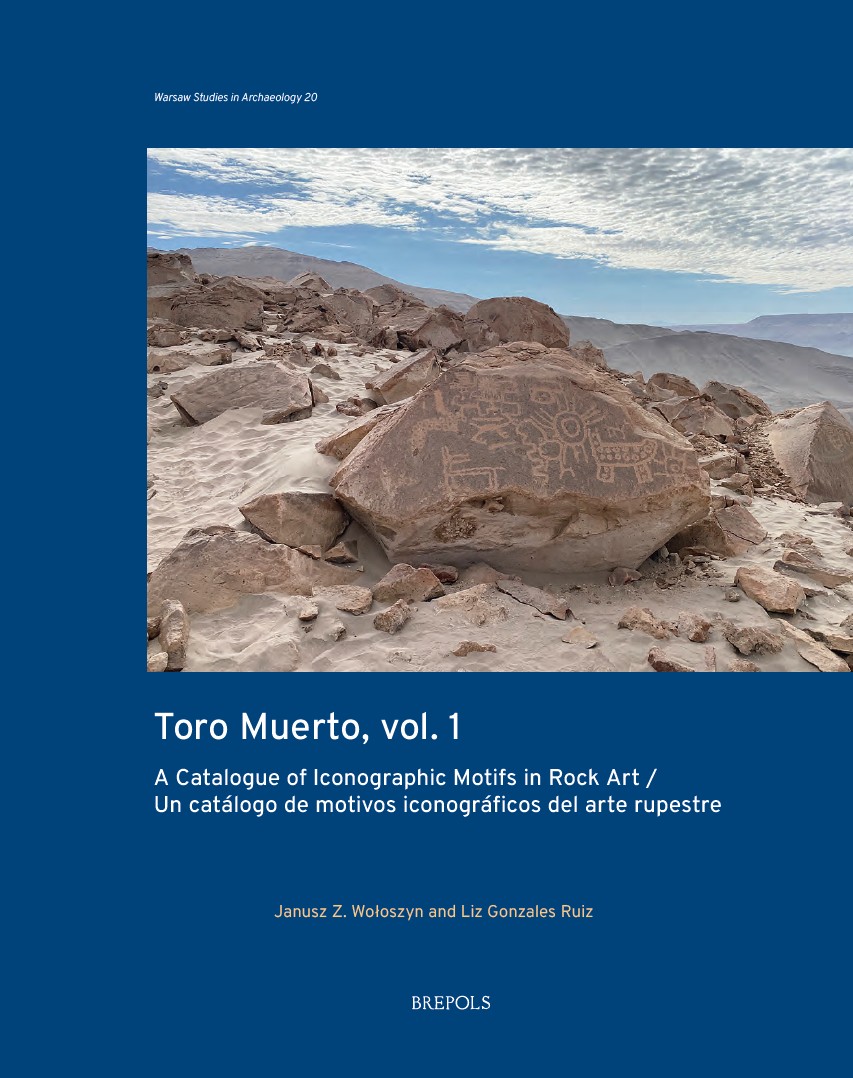 Toro Muerto, vol. I
A Catalogue of Iconographic Motifs in Rock Art / Un catálogo de motivos iconográficos del arte rupestre
Volume 20


 Obsidian Across the Americas
Compositional Studies Conducted in the Elemental Analysis Facility at the Field Museum of Natural History

 La fábrica del prestigio en Mesoamérica
Interacciones y alteridad en el Altiplano central durante el período epiclásico (600-900 d.C.)

 El renacer de los Reyes
Imagen, contexto y significado del friso de Balamku, Campeche, Mexico
Volume 56
 El Palacio: Historiography and new perspectives on a pre-Tarascan city of northern Michoacán, Mexico


 Essai bibliographique sur l’archéologie francophone de la Mésoamérique
Bibliographical essay upon the French-speaking contributions to Mesoamerican archaeology; Ensayo bibliográfico sobre la arqueología francófona de Mesoamérica

 Sea Shells in the Mountains and Llamas on the Coast
The Economy of the Paracas Culture (800 to 200 BC) in Southern Peru
Volume 16
 Wari Women from Huarmey
Bioarchaeological Interpretation of Human Remains from the Wari Elite Mausoleum at Castillo de Huarmey, Peru
 Paisajes en un sector de la Quebrada de Humahuaca durante la Etapa Agroalfarera
Arqueología de Tumbaya (Jujuy, Argentina)
 Peintures et gravures rupestres des Amériques: Empreintes culturelles et territoriales
Proceedings of the XVIII UISPP World Congress (4-9 June 2018, Paris, France) Volume 2, Session XXV-3


