
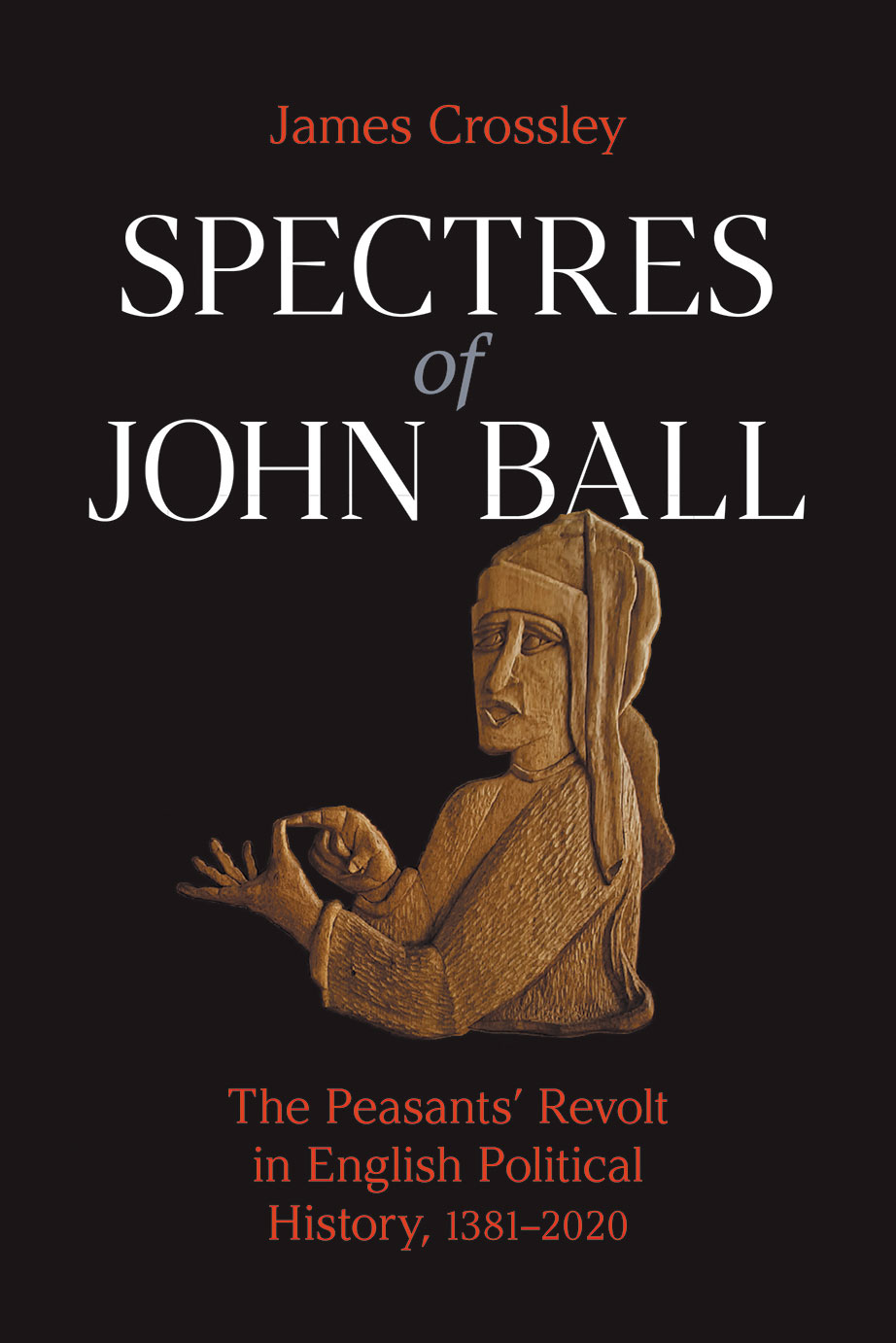
Spectres of John Ball
The Peasants' Revolt in English Political History, 1381-2020
by James Crossley
Paperback (Published)
(March 2022)
ISBN: 9781800501362
Price: $36.95
On back order
Hardback (Published)
(March 2022)
ISBN: 9781800501355
Price: $100.00
On back order
For centuries, the priest John Ball was one of the most infamous or famous figures in the history of English rebels, best known for his saying ‘When Adam delved and Eve Span, Who was then the gentleman’. But over the past hundred years his memory has faded dramatically. Along with Wat Tyler, Ball was one of the leaders of the Peasants’ Revolt of 1381, a historically remarkable event in that leading figures of the realm were beheaded by the rebels. For a few days in June 1381, the rebels dominated London but soon met their demise, with Ball executed. Ball provided the theological justification for the uprising which he saw in apocalyptic terms. After the revolt, he was soon vilified and received an overwhelmingly hostile press for 400 years as an archetypal enemy of the state and a religious zealot. His reputation was rescued from the end of the eighteenth century onward and for over one hundred years he rivalled Robin Hood and Wat Tyler as a great English folk (and even abolitionist) hero. But his 640-year reception involves much more, of course, and is tied up with the story of what England is or could be. Overall, the book explains how we get from an apocalyptic priest who promoted a theocracy favouring the lower orders and the decapitation of the leading church and secular authorities to someone who promoted democracy and vague notions about love and tolerance. The book also explains why he has gone out of fashion and whether he can make another comeback.
For centuries, the priest John Ball was one of the most infamous or famous figures in the history of English rebels, best known for his saying ‘When Adam delved and Eve Span, Who was then the gentleman’. But over the past hundred years his memory has faded dramatically. Along with Wat Tyler, Ball was one of the leaders of the Peasants’ Revolt of 1381, a historically remarkable event in that leading figures of the realm were beheaded by the rebels. For a few days in June 1381, the rebels dominated London but soon met their demise, with Ball executed. Ball provided the theological justification for the uprising which he saw in apocalyptic terms. After the revolt, he was soon vilified and received an overwhelmingly hostile press for 400 years as an archetypal enemy of the state and a religious zealot. His reputation was rescued from the end of the eighteenth century onward and for over one hundred years he rivalled Robin Hood and Wat Tyler as a great English folk (and even abolitionist) hero. But his 640-year reception involves much more, of course, and is tied up with the story of what England is or could be. Overall, the book explains how we get from an apocalyptic priest who promoted a theocracy favouring the lower orders and the decapitation of the leading church and secular authorities to someone who promoted democracy and vague notions about love and tolerance. The book also explains why he has gone out of fashion and whether he can make another comeback.
- By (author) James Crossley
Similar Books
 «Solazoxa festa, stradolze e stracomplia»
Festschrift für Raymund Wilhelm zum 65. Geburtstag mit Beiträgen zu Diskurstraditionen und mittelalterlicher Philologie
Volume 249

 A Collaborative Tapestry in Honour of Shirley Ann Brown / Une fresque brodée en l’honneur de Shirley Ann Brown
The Bayeux Tapestry Seen by her Colleagues and Friends / La Tapisserie de Bayeux vue par ses collègues et amis
 A Companion to Christianity and Sport in Europe and North America (19th-21st centuries)
Volume 1: Western and Eastern Europe
 A Connecting Polemic in the Medieval Mediterranean
The Correspondence of Leo III and ʿUmar II
Volume 6








 Ars Prophetica
Theology in the Poetry of Twentieth-Century Hebrew Poets Avraham Halfi, Shin Shalom, Amir Gilboa, and T. Carmi
 As Messianism Turns to Heresy
The Regenstein Chair Lectures On Lurianic Kabbalah and Shabbatai Tzevi at Hebrew Union College - Cincinnati


 Behind the Scenes of Medieval Roofs
An Overview of the Roofing Systems of Italian Churches
Volume 90


 Beyond Sovereign Courts
Agents and Practices in Early Modern Spanish and Habsburg Diplomacy
Volume 3


 Cahiers de recherches médiévales et humanistes – Journal of Medieval and Humanistic Studies
Volume 51



 Creating the Woman in Antiquity
Proceedings of the 16th Melammu Workshop, Innsbruck, 2–3 June 2022
Volume 13