
Composition in Athenian Black-Figure Vase-Painting
The 'Chariot in Profile' 'Type Scene'
by G. Jurriaans-Helle
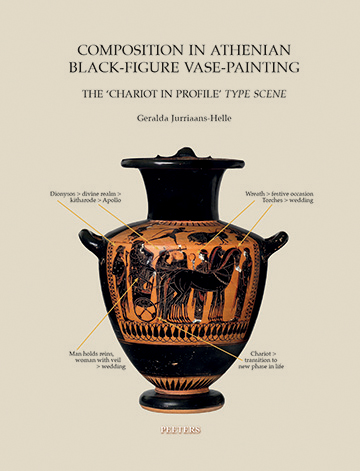
All Athenian black-figure vases – unique masterpieces as well as mass-produced vases – reflect the conventions of Athenian pictorial language. The starting point for this study is that knowledge of this pictorial language provides a better comprehension of the meaning of the representations. Athenians in the 6th century BCE knew its conventions intimately, and one can assume they could easily understand vase-paintings because a few elements or a specific combination of elements were sufficient for them to identify the whole picture. The modern viewer, however, can only approach the intuitive knowledge of the ancient viewer by studying and analysing the surviving images. This study focuses on mass-produced vases, because large numbers provide vital statistical evidence for understanding the meaning of gestures, attributes, and other details, which makes it possible to deduce the rules of Athenian pictorial language and to recognise what is usual and normal, or unusual and exceptional. The methodology is demonstrated in an introductory case study of the type scene ‘Fighting men separated’. Since the visual artists’ use of pictorial language resembles the way in which in oral poetry a singer tells the story by using type scenes, formulaic verses, and epitheta ornantia while adding, omitting, or varying details and names, in this study terms are used that are borrowed from literary studies of Homer’s oral poetry like type scene (the compositional schema or general arrangement of a depiction), subtypes, and typical elements (e.g., figure types, attributes, gestures, and other details). In this study the imagery of more than 1,200 Athenian black-figure vase-paintings of the type scene ‘Chariot in profile’ is examined. Three subtypes are distinguished: ‘Hoplites and other men leaving’ (with a hoplite and charioteer in or near the chariot, and representations with an unarmed man instead of the hoplite in or near the chariot), ‘Wedding Procession’ (with a woman as passenger in the chariot and a man holding the reins), and ‘Apotheosis of Herakles and divine departures’ (with Herakles and Athena in or near the chariot, and related representations of gods driving chariots). The conclusions of this investigation are that Athenian vase-painters composed their paintings according to a commonly understood system of pictorial language; that they were free to make variations, additions, and omissions, but stayed within the boundaries of the system and did not randomly add or omit figures; that innovative compositions were based upon existing compositions with a related meaning, since new images had to be easily and quickly understandable by the public; and that typical elements could have different meanings depending on their context. Since the painters composed the paintings according to a commonly understood system of pictorial language, knowledge of this system will help the modern viewer to understand the deeper meanings of paintings that at first sight are hard to grasp.
- By (author) G. Jurriaans-Helle
Other Titles in this Series
 L’insula V d’Herculanum
Transformations spatiales et diachroniques de l'architecture et du decor des habitations
Volume 45
 De aquaeductu urbis Romae. Sextus Iulius Frontinus and the Water of Rome
Proceedings of the International Frontinus Congress Rome, November 10-18, 2018
Volume 40

Similar Books


 Contesting Labeled Identities
The Sociology of Gentilics in Biblical and Northwest Semitic Literature

 Drunk the Potion, No Whit Charmed
The Doctrine of Pure and Perfect Souls from Iamblichus to Damascius

 Epigraphic “Shades” from Hellenistic Thrace
Contextualizing Inscriptions in Greek from Thracian Tombs

 Epiphanies of the Divine in the Septuagint and the New Testament
Fifth International Symposium of the Corpus Judaeo-Hellenisticum Novi Testamenti (CJHNT), 14-17 May 2015, Nottingham


 Gold, Silver and Glass: Power Networks, Cultural Identities, Technology Transfers and Agency across the Old World (7th Century BC – 1st Century AD)
Proceedings of a Conference Held at the British Museum, 16–18 June 2023
 Language and Power in the Roman Empire and Early India
Hierarchy, Ambiguity, and the Art of Reading the Signs in Cosmopolitan Cultures
 Late Antique villae in the Balkans (3rd–7th c. AD): Current Research Questions and Perspectives
HAEMUS Companion to the Late Antique Balkans 1
Volume 4


 Nurturing the Elite
Representations of Drinking, Eating, and Religious Vessels in Palmyrene Funerary Iconography
Volume 13





 Roman Copies, Collecting, and Culture in the Bay of Naples and Beyond
Papers in Honor of Eugene J. Dwyer



 The Compositional History of the Book of Kings
An Analysis of the Evaluative Frameworks in 1 Kings 14–2 Kings 25




 Zooarchaeology of Ancient Greek Sanctuaries in Southwestern Sicily
Faunal Analysis from Selinus and Akragas as Evidence of Differences in the Treatment of Animals for Ritual Purposes
