
Adoption, Adaption, and Innovation in Pre-Roman Italy
Paradigms for Cultural Change
Edited by Jeremy Armstrong Edited by Aaron Rhodes-Schroder

The ancient Mediterranean basin was once thought to be populated by large, monolithic, cultural-political entities. In this conception, ‘the Greeks’, ‘the Romans’, and other stable and homogenous cultures interacted and vied for supremacy like early modern states or empires. Today, however, thanks largely to an ever-increasing archaeological record, critical and sensitive approaches to the literary evidence, and the impact and application of new theoretical approaches, the ancient Mediterranean region is instead argued to be full of dynamic microcultures organized in a fl uid set of overlapping networks. While this atomization of culture has resulted in more interesting and accurate micro-histories, it has also challenged how we understand cultural interaction and change. This volume draws on this new understanding of cultural identity and contact to address the themes of adoption, adaption, and innovation in Pre-Roman Italy from the 9th-3rd centuries BCE. The contributors to this volume build upon recent paradigm shifts in research that challenge traditional Hellenocentric models and work to establish a new set of frameworks for approaching the tangled question of how ‘indigenous’ and ‘foreign’ features relate to one another in the material record. Using focused case-studies, ranging from the role played by mobile populations in transferring ideas and technologies to the different ways in which ‘foreign’ artistic elements were used by Italian peoples, the volume explores what the – now commonly accepted – connectedness of a wider Mediterranean world meant for the people of Italy in practical terms, and offers new models for how concepts and ideas were transmitted, reinterpreted, repurposed, and re-appropriated in early Italy to fit within their local context.
The ancient Mediterranean basin was once thought to be populated by large, monolithic, cultural-political entities. In this conception, ‘the Greeks’, ‘the Romans’, and other stable and homogenous cultures interacted and vied for supremacy like early modern states or empires. Today, however, thanks largely to an ever-increasing archaeological record, critical and sensitive approaches to the literary evidence, and the impact and application of new theoretical approaches, the ancient Mediterranean region is instead argued to be full of dynamic microcultures organized in a fl uid set of overlapping networks. While this atomization of culture has resulted in more interesting and accurate micro-histories, it has also challenged how we understand cultural interaction and change. This volume draws on this new understanding of cultural identity and contact to address the themes of adoption, adaption, and innovation in Pre-Roman Italy from the 9th-3rd centuries BCE. The contributors to this volume build upon recent paradigm shifts in research that challenge traditional Hellenocentric models and work to establish a new set of frameworks for approaching the tangled question of how ‘indigenous’ and ‘foreign’ features relate to one another in the material record. Using focused case-studies, ranging from the role played by mobile populations in transferring ideas and technologies to the different ways in which ‘foreign’ artistic elements were used by Italian peoples, the volume explores what the – now commonly accepted – connectedness of a wider Mediterranean world meant for the people of Italy in practical terms, and offers new models for how concepts and ideas were transmitted, reinterpreted, repurposed, and re-appropriated in early Italy to fit within their local context.
- Edited by Jeremy Armstrong
- Edited by Aaron Rhodes-Schroder
Other Titles in this Series

 Religious Dynamics in Hispania
Cult Places, Identities, and Cultural Change in a Microcontinent
Volume 1
 Perspectives on Byzantine Archaeology
From Justinian to the Abbasid Age (6th-9th Centuries AD)
Volume 2
 New Approaches to the Materiality of Text in the Ancient Mediterranean
From Monuments and Buildings to Small Portable Objects
Volume 4
Similar Books

 Caesar’s Visions and Impact on the Roman Empire
Revisiting the Archaeological and Historical Record of the 40s BC
Volume 2


 Contesting Labeled Identities
The Sociology of Gentilics in Biblical and Northwest Semitic Literature


 Drunk the Potion, No Whit Charmed
The Doctrine of Pure and Perfect Souls from Iamblichus to Damascius

 Epiphanies of the Divine in the Septuagint and the New Testament
Fifth International Symposium of the Corpus Judaeo-Hellenisticum Novi Testamenti (CJHNT), 14-17 May 2015, Nottingham


 Etruscan and Roman Hellenistic Anatomical ex votos
Reassessing Popular Religious Expressions in Central Italy
Volume 8




 Invisible Labour in Antiquity
Visualizing Obscure Work in the Ancient Mediterannean and West Asia
Volume 1

 Language and Power in the Roman Empire and Early India
Hierarchy, Ambiguity, and the Art of Reading the Signs in Cosmopolitan Cultures
 Late Antique villae in the Balkans (3rd–7th c. AD): Current Research Questions and Perspectives
HAEMUS Companion to the Late Antique Balkans 1
Volume 4

 Nurturing the Elite
Representations of Drinking, Eating, and Religious Vessels in Palmyrene Funerary Iconography
Volume 13


 Portraying the Individual in the Roman East
Local–Imperial Entanglements in Sculpture, Mosaics, and Paintings (First–Fourth Centuries AD)
Volume 18


 Small Worlds and Relational Agencies: Local Societies in Early Medieval Iberia
Pequeños mundos y Agencias relacionales: Sociedades locales altomedievales en la Península Ibérica
 The Compositional History of the Book of Kings
An Analysis of the Evaluative Frameworks in 1 Kings 14–2 Kings 25

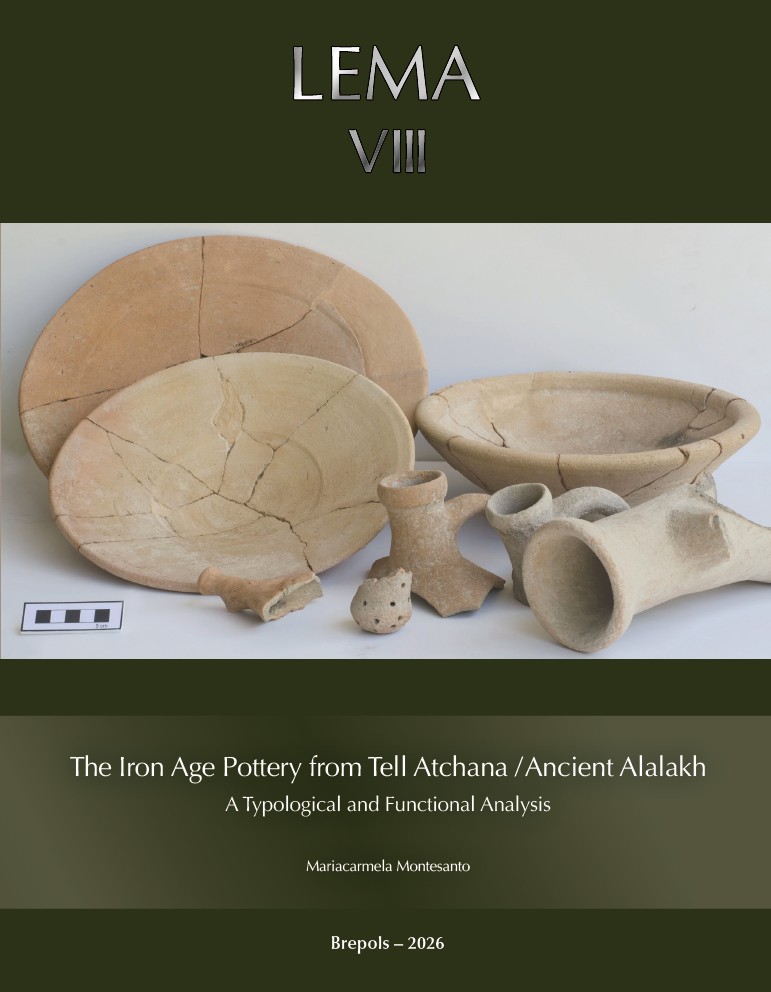 The Iron Age Pottery from Tell Atchana / Ancient Alalakh
A Typological and Functional Analysis
Volume 8


 Writing in the Church of the Nativity in Bethlehem
Inscription and Graffiti in a Multilingual and Multigraphic Perspective
Volume 45

 Roman Copies, Collecting, and Culture in the Bay of Naples and Beyond
Papers in Honor of Eugene J. Dwyer
