The Elements of the Papadike
Byzantine Chant Manuals and Exercises
Original author Anonymous Edited by Christan Troelsgard Edited by Maria Alexandru
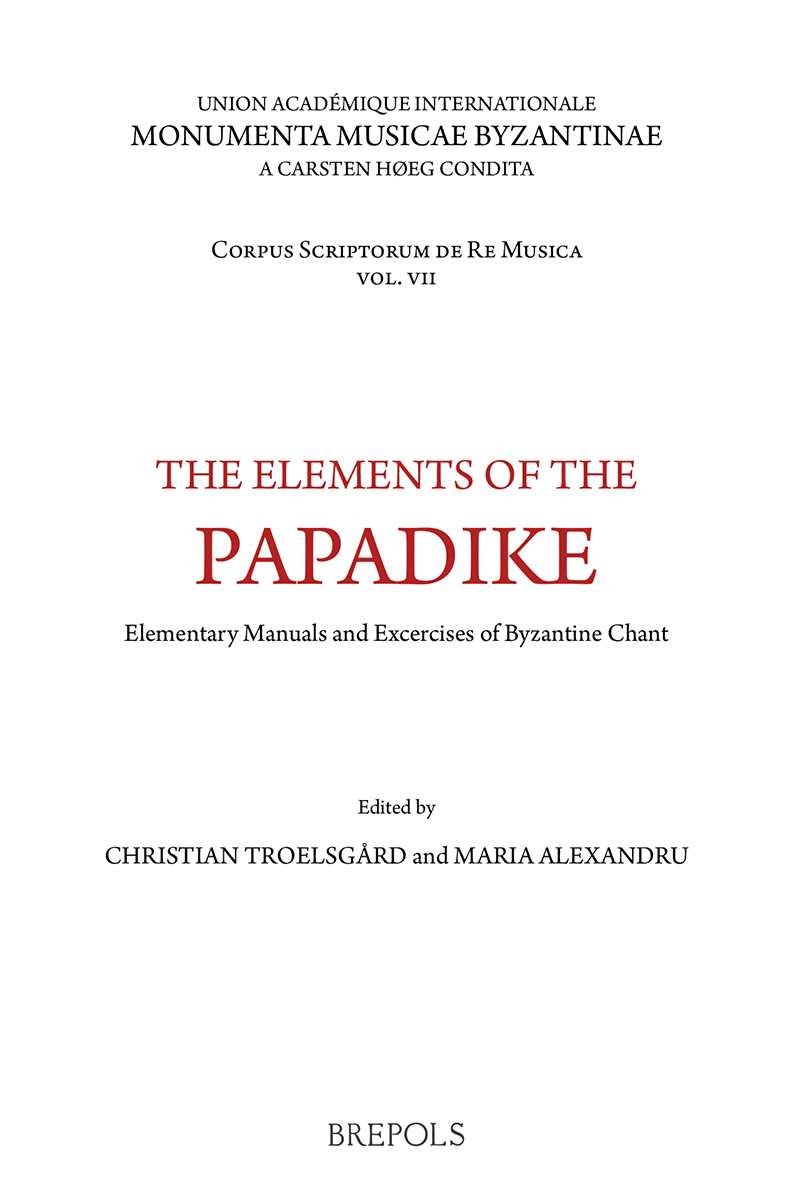
How did the Byzantines learn to sing? This groundbreaking volume offers the first critical edition of instructional texts and notated exercises used for elementary training in medieval Byzantine chant.
How did the Byzantines learn to sing in church? And how can we understand the neumatic signs they used? The Elements of the Papadike presents, for the first time, a critical edition of texts and notated exercises designed for elementary training in medieval Byzantine chant. Careful and long-term studies in the rich manuscript tradition have led the researchers of Monumenta Musicae Byzantinae to establish a secure chronology of the formation and development of these didactic materials. Likewise, the crystallization of four basic types brings clarity to the entire Papadike tradition that began in the thirteenth century, flourished in the fourteenth and fifteenth centuries, and continued well beyond the Fall of Constantinople. The edition of the Greek text and Byzantine neumes is accompanied by English parallel translation and transcriptions into modern notation on facing pages. In addition, each element and exercise is accompanied by a running commentary with explanations and bibliographic references for further reading. The edition forms part of the Monumenta Musicae Byzantinae – Corpus Scriptorum de Re Musica series and fills a significant gap in the documentation of Byzantine chant during the later Middle Ages.
- By (author) Anonymous,
- Edited by Troelsgard, Christian
- Edited by Alexandru, Maria
Similar Books
 Byzantium Beyond Byzantium
Proceedings of the Plenary Sessions at the 25th International Congress of Byzantine Studies (Vienna, 24–29 August 2026)





 John Dunstaple Reading Boethius
John Dunstaple’s Annotations to Boethius’s “De institutione musica” in the Manuscript Oxford, Corpus Christi College Library, MS 118
 Music and Colonialism in Fascist Italy
Identity, Propaganda, and Ethnographic Representation
Volume 13