
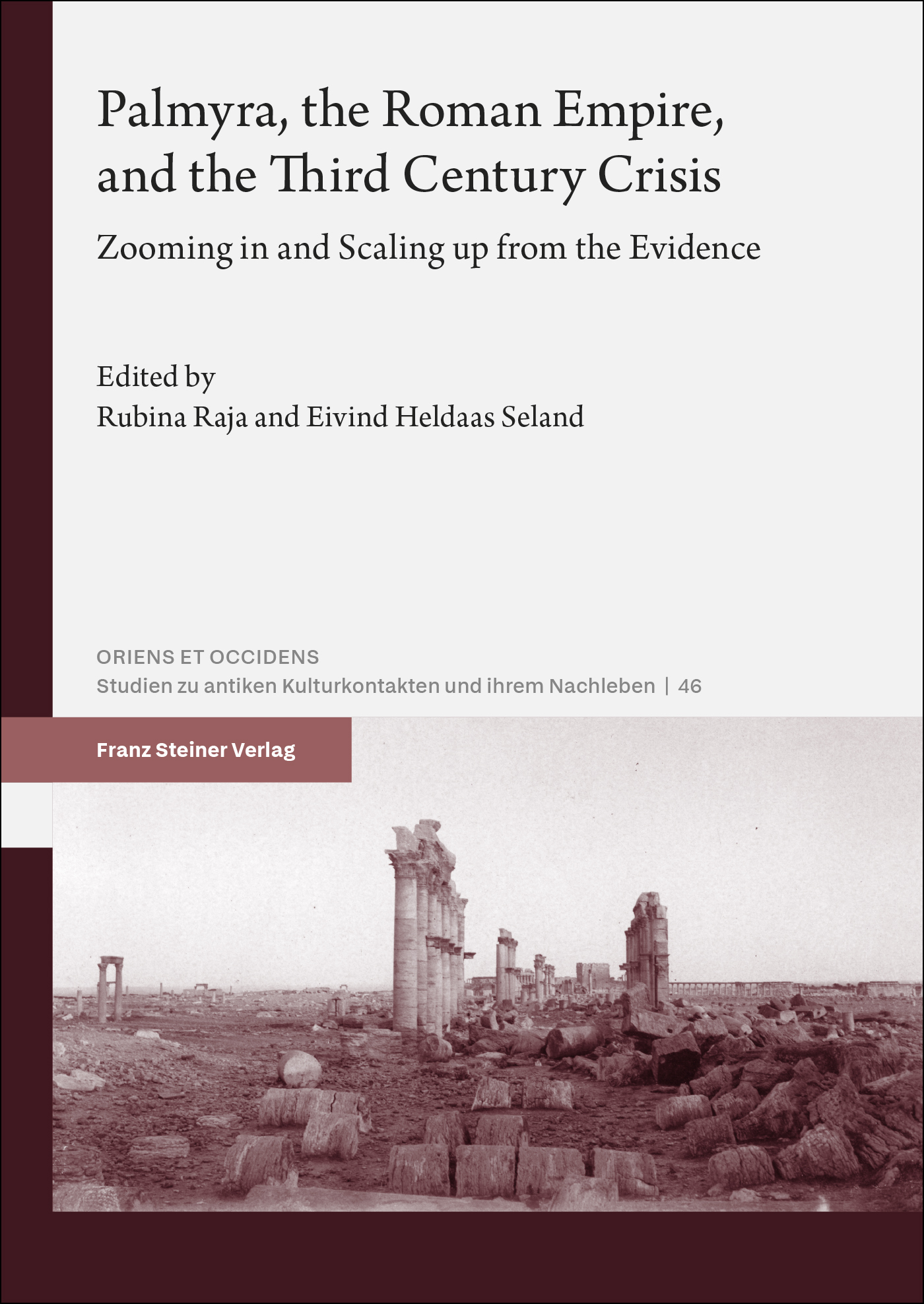
Palmyra, the Roman Empire, and the Third Century Crisis
Zooming in and Scaling up from the Evidence
Edited by Rubina Raja Edited by Eivind Heldaas Seland
Paperback (Published)
(December 2025)
ISBN: 9783515140218
6.69 x 9.49 inches
Price: $114.00
In stock
The third century is often seen as a period of crisis in the Roman world, marked by political upheaval, violence, war, religious strife, hyperinflation, climatic instability, pandemics, and border incursions. These troubled times, however, coincided with the peak of Palmyra’s prosperity. They encompassed the Syrian city’s drift towards centralised rulership and short-lived political hegemony in the Near East, as well as its reach for imperial power and downfall in the years 270–272 CE.
How can this discrepancy between metropolitan crisis and peripheral prosperity be explained? Along with experts on different aspects of Palmyra, this volume gathers contributions from leading scholars working with the Roman Empire, and with neighbouring regions inside and beyond the imperial borders. Highlighting parallels, discrepancies, connections, and disconnections between developments in Palmyra and other parts of the world with which Palmyra interacted, the aim is a more critical, detailed, and nuanced understanding of the situation in the Roman Near East in the third century CE.
- Edited by Rubina Raja
- Edited by Eivind Heldaas Seland
Other Titles in this Series


 Zwischen Steppe und Polis
Die transkulturelle Prägung der palmyrenischen Eliten und ihrer Institutionen

 Die Gartenlandschaft von Pasargadai und ihre Wasseranlagen
Topographischer Befund, Rekonstruktion und achaimenidischer Kontext

 Handelspatrone, Grenzkrieger, Diplomaten und Priester
Die lokalen Eliten des kaiserzeitlichen Tadmors zwischen Nomadentum und Sesshaftigkeit
 Beiträge zur Geschichte und Kultur des alten Iran und benachbarter Gebiete
Festschrift für Rüdiger Schmitt


 Common Dwelling Place of all the Gods
Commagene in its Local, Regional and Global Hellenistic Context
 Lokale Identität im Römischen Nahen Osten
Kontexte und Perspektiven. Erträge der Tagung "Lokale Identität im Römischen Nahen Osten" 19.-21. April 2007


 Rituale der Seuchen- und Schadensabwehr im Vorderen Orient und Griechenland
Formen kollektiver Krisenbewaltigung in der Antike
Volume 10
 Alexander III. zwischen Ost und West
Indigene Traditionen und Herrschaftsinszenierung im makedonischen Weltimperium
 On Alexander’s Tracks
Exploring Geographies, Memories, and Cultural Identities along the North-West Frontier of British India in the Nineteenth Century
 Eran ud Aneran
Studien zu den Beziehungen zwischen dem Sasanidenreich und der Mittelmeerwelt. Beiträge des Internationalen Colloquiums in Eutin, 8.-9. Juni 2000
 Bruderzwist
Strukturen und Methoden der Diplomatie zwischen Rom und Iran von der Teilung Armeniens bis zum Fünfzigjährigen Frieden

 L’image des Parthes dans le monde gréco-romain
Du début du Ier siècle av. J.-C. jusqu'à la fin du Haut-Empire romain
 Eurasian Localisms
Towards a translocal approach to Hellenism and inbetweenness in central Eurasia, third to first centuries BCE

Similar Books


 Contesting Labeled Identities
The Sociology of Gentilics in Biblical and Northwest Semitic Literature

 Drunk the Potion, No Whit Charmed
The Doctrine of Pure and Perfect Souls from Iamblichus to Damascius

 Epigraphic “Shades” from Hellenistic Thrace
Contextualizing Inscriptions in Greek from Thracian Tombs

 Epiphanies of the Divine in the Septuagint and the New Testament
Fifth International Symposium of the Corpus Judaeo-Hellenisticum Novi Testamenti (CJHNT), 14-17 May 2015, Nottingham


 Gold, Silver and Glass: Power Networks, Cultural Identities, Technology Transfers and Agency across the Old World (7th Century BC – 1st Century AD)
Proceedings of a Conference Held at the British Museum, 16–18 June 2023
 Language and Power in the Roman Empire and Early India
Hierarchy, Ambiguity, and the Art of Reading the Signs in Cosmopolitan Cultures
 Late Antique villae in the Balkans (3rd–7th c. AD): Current Research Questions and Perspectives
HAEMUS Companion to the Late Antique Balkans 1
Volume 4


 Nurturing the Elite
Representations of Drinking, Eating, and Religious Vessels in Palmyrene Funerary Iconography
Volume 13





 Roman Copies, Collecting, and Culture in the Bay of Naples and Beyond
Papers in Honor of Eugene J. Dwyer



 The Compositional History of the Book of Kings
An Analysis of the Evaluative Frameworks in 1 Kings 14–2 Kings 25




 Zooarchaeology of Ancient Greek Sanctuaries in Southwestern Sicily
Faunal Analysis from Selinus and Akragas as Evidence of Differences in the Treatment of Animals for Ritual Purposes


