
Jan van Ruusbroec
Mystical Union with God
by P. Mommaers
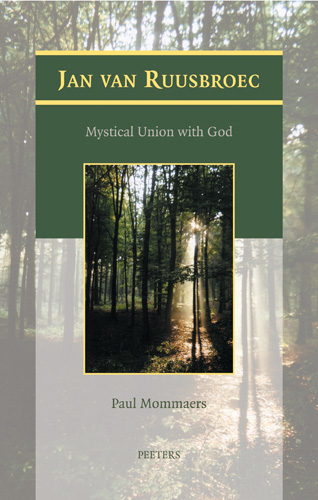
Paperback (Out of print)
(April 2009)
ISBN: 9789042921245
Price: $23.00
On back order
The medieval Flemish mystic Jan van Ruusbroec (1293-1381) is often highly praised. Cuthbert Butler, for one, concluded that there “certainly” has been “no greater mystical writer.” It comes as a surprise, then, that no comprehensive study of Ruusbroec’s mystical doctrine as such is available. Filling up this lacuna seems all the more appropriate as the critical text edition of Ruusbroec’s works is now complete: Jan van Ruusbroec Opera omnia (1981-2006), including the most influential Latin translation as well as a new translation into English besides the Middle Dutch text. The guiding principle for the work offered here is that the mystic himself should be allowed to speak in the very first place, and not the commentator. As the core of Ruusbroec’s writings consists in the description of a person’s awareness – the awareness of an Other -, it is only in a close reading of his work in its entirety, interspersed with textual analyses, that his view of becoming and being mystically one with God may appear. However, as it is a mystical figure and his writings that are central to this study, the first two chapters are dedicated to finding out, always on the base of the mystics’ own reports, what essentially characterizes mystics, what they experience and how they experience it, why they write and in what manner. Ruusbroec’s own description of mystical experience is covered in five chapters. Chapter III – “Profiling the Human” – deals with the way in which this mystic imagines the universally applicable structure of the human psyche. The subject of chapter IV – “Meeting the Divine Other” – is Ruusbroec’s outlining of the contemplative path. It is striking here to see how the phenomenon of “meeting” persists all through the mystic’s growth, from premystical beginnings up to the deepest mystical union. It appears, moreover, that this path is not to be followed necessarily nor does it reflect a linear making-progress but rather a spiralling being-carried along. In chapter V – “Mystically One with God” – the heart of Ruusbroec’s mystical experience comes to the fore, and this is of course where his unique talent for evoking the unseen shines most. The main point here is that for the mystic the most advanced experience of being one with God consists in feeling “unity” as well as “union”, “resting” as well as “working”. In other words, being perfectly one with God should not be seen as a fusion in which the human being is absorbed by the divine. It is by living the interplay of such different aspects as “unity” and “union” that the mystic is fully one with the Other. The complex character of the highest mystical state entails Ruusbroec’s remarkable portrayal of the fully-fledged mystic as a “common man”, that is: as “wholly in God and wholly in himself.” The last two chapters of the book focus on Ruusbroec’s discussion of natural mysticism. On encountering a number of his contemporaries who by their own account were able to “contemplate without (God’s) grace”, he felt he had to take issue with them. In chapter VI it appears that he appreciates not only their method, “turning inwards”, but also its outcome, “feeling the simplicity of their essence (the deep self), hanging in the essence of God.” Chapter VII outlines Ruusbroec’s critique, however, which is mainly aimed at two points. The contemplative who turns inwards in the natural way finally “dwells within himself with rest” and he or she wil necessarily undergo the dehumanizing effects of “not feeling otherness”.
- By (author) P Mommaers
Similar Books
 «Solazoxa festa, stradolze e stracomplia»
Festschrift für Raymund Wilhelm zum 65. Geburtstag mit Beiträgen zu Diskurstraditionen und mittelalterlicher Philologie
Volume 249

 A Collaborative Tapestry in Honour of Shirley Ann Brown / Une fresque brodée en l’honneur de Shirley Ann Brown
The Bayeux Tapestry Seen by her Colleagues and Friends / La Tapisserie de Bayeux vue par ses collègues et amis
 A Companion to Christianity and Sport in Europe and North America (19th-21st centuries)
Volume 1: Western and Eastern Europe
 A Connecting Polemic in the Medieval Mediterranean
The Correspondence of Leo III and ʿUmar II
Volume 6








 Ars Prophetica
Theology in the Poetry of Twentieth-Century Hebrew Poets Avraham Halfi, Shin Shalom, Amir Gilboa, and T. Carmi
 As Messianism Turns to Heresy
The Regenstein Chair Lectures On Lurianic Kabbalah and Shabbatai Tzevi at Hebrew Union College - Cincinnati


 Behind the Scenes of Medieval Roofs
An Overview of the Roofing Systems of Italian Churches
Volume 90


 Cahiers de recherches médiévales et humanistes – Journal of Medieval and Humanistic Studies
Volume 51



 Creating the Woman in Antiquity
Proceedings of the 16th Melammu Workshop, Innsbruck, 2–3 June 2022
Volume 13
 Cultic Kisses
Fruitful Encounters Between Deities and Humans. Festschrift for Angelika Berlejung on the Occasion of Her 65th Birthday
 De/colonizing Theologies
Glocal Histories, Contemporary Challenges, Theoretical Reflections
Volume 4

 Drunk the Potion, No Whit Charmed
The Doctrine of Pure and Perfect Souls from Iamblichus to Damascius
