‘Temple Beauties’: The Entrance-Portico in the Architecture of Great Britain 1630-1850
By (author) Richard Riddell
Paperback (Published)
(December 2011)
ISBN: 9781905739448
8.27 x 11.69 inches
Price: $70.00
In stock
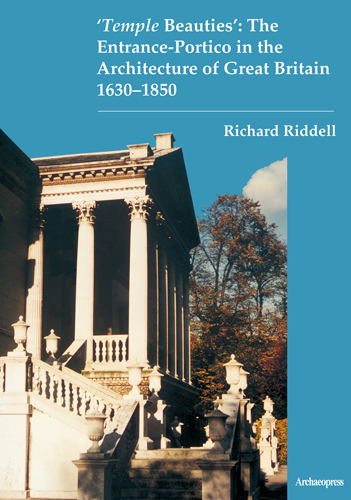
The portico was a defining feature of the Classical architectural revival of the eighteenth and early nineteenth century in Britain, but has been rarely studied in its own right. In this well illustrated volume Richard Riddell first provides a definition for the portico, then explores its symbolism and significance.
The portico is one of the most characteristic and significant features of western architecture and, yet, perhaps, also one of the least closely observed. Redolent of Antiquity and comprising the essential vocabulary of classical architecture in the form of the orders – columns, entablatures and, usually, pediments – it evokes past glories and epitomizes the modular system of design that is central to that architecture. It has often played a key role in, or acted as a barometer of, stylistic innovations. Used widely in Antiquity, especially in temples, the portico suffered a decline following the dissolution of Roman imperial authority in the West. However, sufficient literary and physical remains survived which, when viewed in particular ways, enabled it to regain a central position in architecture, following the Renaissance. Revived in Italy, it was subsequently adopted elsewhere in Europe and eventually in this country, and it is to the tentative introduction of the portico to Britain in the early seventeenth century, its widespread use throughout the eighteenth and much of the nineteenth centuries, and the beginning of its decline towards the end of our period, that this study is devoted.
Preface
I The Portico
1 Introduction
2 Definitions
3 Summary and Note on Portico Types
II From Frontispiece to Portico in Great Britain
1 Introduction
2 Frontispieces
3 Porches and Loggia Porticoes
4 Summary
III Inigo Jones and the Palladian Portico
1 Introduction
2 Temple and Church
3 Summary
IV The Baroque Portico
1 Jones, Webb, and the Baroque
2 Webb, Wren and the Baroque Church
3 Hawksmoor, Vanbrugh and Archer
4 Fifty New Churches
5 Temple Front and Portico in the English Baroque
6 Summary
V The Portico in English Neo-Palladianism
1 Introduction
2 The Reinstatement of Inigo Jones and Palladio
3 Palladio and Porticoes
4 The English Country House and its Functions
5 The Disadvantages of Porticoes
6 Summary
VI Neo-Classicism and the Greek Revival Portico
1 Introduction
2 Neo-Classicism: Imitation and Originality
3 Visual Effect: The Rule and the Eye
4 Architectural Association
5 The Associations of Grecian and Greek Architecture
6 The Greek Revival: A Tentative Beginning
7 The Greek and Roman Debate
8 Greece Revived
VII The Decline of the Portico
VIII Conclusion
Appendix: Summary and Chronologies of the First Introductions and Principal Uses of the Architectural Orders in the Entrance-Porticoes of Great Britain, 1630-1850
Bibliography
Plates
Index, Preface ;
I The Portico ;
1 Introduction2 Definitions3 Summary and Note on Portico Types II From Frontispiece to Portico in Great Britain ;
1 Introduction2 Frontispieces3 Porches and Loggia Porticoes4 Summary III Inigo Jones and the Palladian Portico ;
1 Introduction2 Temple and Church3 Summary IV The Baroque Portico ;
1 Jones, Webb, and the Baroque2 Webb, Wren and the Baroque Church3 Hawksmoor, Vanbrugh and Archer4 Fifty New Churches5 Temple Front and Portico in the English Baroque6 Summary V The Portico in English Neo-Palladianism ;
1 Introduction2 The Reinstatement of Inigo Jones and Palladio3 Palladio and Porticoes4 The English Country House and its Functions5 The Disadvantages of Porticoes6 Summary VI Neo-Classicism and the Greek Revival Portico ;
1 Introduction2 Neo-Classicism: Imitation and Originality3 Visual Effect: The Rule and the Eye4 Architectural Association5 The Associations of Grecian and Greek Architecture6 The Greek Revival: A Tentative Beginning7 The Greek and Roman Debate8 Greece Revived VII The Decline of the Portico ;
VIII Conclusion ;
Appendix: Summary and Chronologies of the First Introductions and Principal Uses of the Architectural Orders in the Entrance-Porticoes of Great Britain, 1630-1850 ;
Bibliography ;
Plates ;
Index
- By (author) Richard Riddell
Similar Books


 Balthasar Caymox of Nuremberg
Early Modern German Print Publishers: Popular Prints of the Seventeenth Century
 Behind the Scenes of Medieval Roofs
An Overview of the Roofing Systems of Italian Churches
Volume 90
 Beyond Sovereign Courts
Agents and Practices in Early Modern Spanish and Habsburg Diplomacy
Volume 3

 Circulation, Use, Impact
The Consumption of Architectural Books in the Early Modern Eastern Adriatic
Volume 1

 Councils, Conflicts, Correspondence
Urban Diplomacy in Reval (Tallinn) and Lübeck (c. 1470–1570)
Volume 67


 Innovationes Lovanienses: Arts, Law and Theology at the University of Louvain (1425–1797)
Studium Lovaniense: Learning across Borders, 2
Volume 18
 Late Antique villae in the Balkans (3rd–7th c. AD): Current Research Questions and Perspectives
HAEMUS Companion to the Late Antique Balkans 1
Volume 4
 Legal Visuality
Exegesis, Ambiguity, and Dissimulation of the Donation of Constantine in the Early Modern Period


 Naples as Laboratory / Laboratorium Neapel
Style Options, Artistic Rivalry and Self Fashioning in Neapolitan Baroque Painting / Plurale Stilbildung, Kunstlerkonkurrenz und Self Fashioning in der neapolitanischen Barockmalerei

 Power and Women in Southeast and Central Europe in Late Medieval and Early Modern Period (1300-1600)
Volume 10




 Staging the Spectacle of Majesty
Ceremonial, Courtly Space, and Collecting under the Spanish Habsburgs
Volume 9
 Students, Scholars and Their Books at the University of Louvain (1425-1797)
Studium Lovaniense: Learning across Borders, 1
Volume 17


 The Embodied Court in the Premodern World
Understanding the Physicality, Performativity and Lifecycle of Bodies at Court in Europe and Beyond, 1400-1800
Volume 4


 The Sacred and the Secular in Renaissance Florence
Vallombrosan Exorcisms and the Rise of Observant Mendicancy
Volume 31
 Tradition, Interpretation, and Change
Developments in the Liturgy of Medieval and Early Modern Ashkenaz