
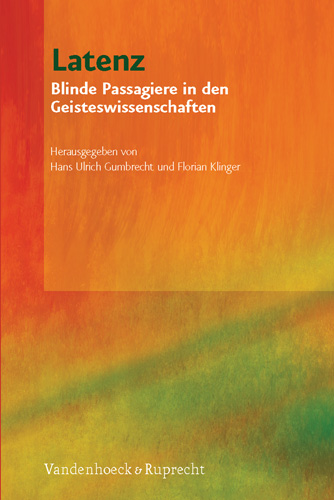
Latenz
Blinde Passagiere in den Geisteswissenschaften
Contributions by Vincent Barletta Contributions by Roger Chartier Contributions by Winfried Menninghaus Contributions by Arbogast Schmitt Contributions by Carolyn Abbate Contributions by Bernhard Siegert Contributions by Marilia Librandi Rocha Contributions by Anselm Haverkamp Contributions by Joseph Vogl Contributions by Dan Diner Contributions by Joan Ramon Resina Contributions by Michael Zink Contributions by Henning Ritter Contributions by Eelco Runia Contributions by Peter Sloterdijk Contributions by David Wellbery Contributions by Horst Bredekamp Contributions by Robert Pogue Harrison Edited by Hans Ulrich Gumbrecht Edited by Florian Klinger Adapted by
Paperback (Published)
(May 2011)
ISBN: 9783525300237
6.1 x 9.13 inches
Price: $69.00
On back order
International renommierte Autoren widmen sich einer zentralen Kategorie der Reflexion und historischen Forschung in den Geisteswissenschaften.
English summary: Surprisingly, somehow, and in different contexts and places, the dimension of Latency has emerged as an important and still unresolved dimension of historical research and reflection in the Humanities and Arts. Latent phenomena are those whose existence and presence we are certain of – without knowing, however, where they are and what their identity is. We could well be confronted with what is latent without knowing that it has come to show itself. Our volume brings together twenty different reactions to this notion, among them some of the most internationally visible and intellectually outstanding representatives of the Humanities today, such as Carolyn Abbate, Horst Bredekamp, Roger Chartier, Dan Diner, Robert Harrison, Anselm Haverkamp, Winfried Menninghaus, Peter Sloterdijk, Joseph Vogl, David Wellbery, and Michel Zink. It tries to develop and differentiate the concept in as many ways, as many contexts, and as many directions as possible – with the intention of building a new pragmatics for using the dimension of Latency. The result is powerfully centrifugal – for it largely transcends the mere application of the concept to different disciplinary contexts. What the volume, in the complex convergence of its multiple contributions and their multiple approaches makes visible, in the end, is the emergence of a new epistemological situation, to which the need for the concept of Latency already reacts although it has not yet fully articulated itself. German text. German description: Die Dimension der Latenz ist zu einer neuen Kategorie der Reflexion in den Geisteswissenschaften geworden. Latente Phanomene sind solche, deren Existenz und Prasenz wir uns sicher sind, ohne dabei genau zu wissen, wo sie sich befinden und worin sie bestehen. Was latent ist, kann uns gegenuberstehen, ohne dass wir seiner Erscheinung gewahr sind. In diesem Band widmen sich zwanzig renommierte Autorinnen und Autoren dieser bislang erst ansatzweise theoretisch entfalteten Denkfigur. Dazu zahlen u. a. Carolyn Abbate, Horst Bredekamp, Roger Chartier, Dan Diner, Robert Harrison, Anselm Haverkamp, Winfried Menninghaus, Peter Sloterdijk und Joseph Vogl. Sie alle versuchen anhand vielseitiger Beispiele eine neue Pragmatik der Verwendung des Begriffs zu formulieren.
- Contributions by Vincent Barletta
- Contributions by Roger Chartier
- Contributions by Winfried Menninghaus
- Contributions by Arbogast Schmitt
- Contributions by Carolyn Abbate
- Contributions by Bernhard Siegert
- Contributions by Marilia Librandi Rocha
- Contributions by Anselm Haverkamp
- Contributions by Joseph Vogl
- Contributions by Dan Diner
- Contributions by Joan Ramon Resina
- Contributions by Michael Zink
- Contributions by Henning Ritter
- Contributions by Eelco Runia
- Contributions by Peter Sloterdijk
- Contributions by David Wellbery
- Contributions by Horst Bredekamp
- Contributions by Robert Pogue Harrison
- Edited by Hans Ulrich Gumbrecht
- Edited by Florian Klinger
- Adapted by
Similar Books


 Dis/United States of Vulnerability
Literary and Cultural Transgressions in U.S. Poetry Since the 1960s
Volume 330


 European Drama and Performance Studies
Dramatisations politiques. Théâtre, politique et idéologie au XIXe siècle (1806-1914)
Volume 27


 Modernization, Crises, Cultural Revolutions
Yugoslavia’s 1960s and 1970s through the amateur film lens



 Visual Memory and Oblivion
Monuments and Conflicts in Urban Spaces in Central and Eastern Europe from the Nineteenth Century to the Present Day







 “Tod durch Erschießen”
Generaloberst Nikolaus von Falkenhorst. Wehrmachtsbefehlshaber in Norwegen 1940–1945. Erinnerungen – Verhörprotokolle – Urteilssprüche
Volume 63
 “Zum Siege unserer menschenfreundlichen Prinzipien”
Ungarische Freimaurernetzwerke im „Orient“ 1886-1920




 Coburgs südöstliche Netzwerke – Coburg’s Networks in Southeastern Europe
Bulgarien, Rumänien und Ostmitteleuropa im 19. und 20. Jahrhundert. Hrsg. von Franziska Bartl und Frank-Lothar Kroll mit einem Grußwort Seiner Majestät des Königs der Bulgaren Simeon II.
Volume 39


 Dark Like You
Zur medienreflexiven Modernität der Kinder- und Jugendzeitschrift ‚The Brownies’ Book‘ (1920–1921)
Volume 191