
The Flemish Primitives VI
The Bernard van Orley Group
By (author) Alexandre Galand
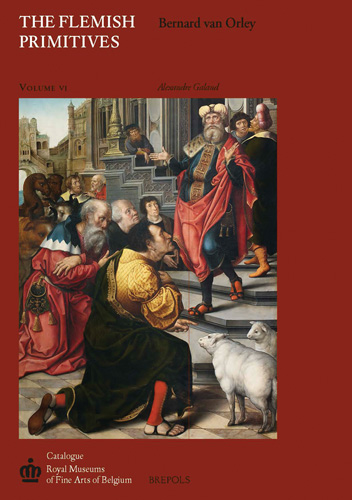
The years 1510 and 1520 appear to be a crucial moment for the introduction of the Renaissance in the former Netherlands. That period coincides with the first activity period of Bernard van Orley, a major witness of the transition. Until now, research has been concentrating on the artist through his superb tapestries. Yet, from the en
The years 1510 and 1520 appear to be a crucial moment for the introduction of the Renaissance in the former Netherlands. That period coincides with the first activity period of Bernard van Orley, a major witness of the transition. Until now, research has been concentrating on the artist through his superb tapestries. Yet, from the end of the first decade of the 16th century to 1521, when he signed the monumental Job and Lazarus Polyptych (Brussels, MRBAB/KMSKB, Inv. 1822), the artist produced paintings which integrated more and more shapes from the Italian peninsula. Did this change in perspective lead to significant differences in terms of workshop practices? How can works be best characterized when they make up the hard core of a catalogue with changing frontiers? In what way can archives shed new light on the artist’s activity? Those questions are at the centre of a catalogue and essays, which aim to renew the vision of Bernard van Orley’s painting, on the basis of the works kept in the Royal Museum of Fine Arts of Belgium.
- By (author) Alexandre Galand
Other Titles in this Series
 The Flemish Primitives III
Hieronymus Bosch, Albrecht Bouts, Gerard David, Colijn de Coter, Goossen van der Weyden
Volume 3
Similar Books
 A Collaborative Tapestry in Honour of Shirley Ann Brown / Une fresque brodée en l’honneur de Shirley Ann Brown
The Bayeux Tapestry Seen by her Colleagues and Friends / La Tapisserie de Bayeux vue par ses collègues et amis





 Balthasar Caymox of Nuremberg
Early Modern German Print Publishers: Popular Prints of the Seventeenth Century


 Beyond Sovereign Courts
Agents and Practices in Early Modern Spanish and Habsburg Diplomacy
Volume 3


 Circulation, Use, Impact
The Consumption of Architectural Books in the Early Modern Eastern Adriatic
Volume 1


 Councils, Conflicts, Correspondence
Urban Diplomacy in Reval (Tallinn) and Lübeck (c. 1470–1570)
Volume 67


 ENTANGLED AFRICA
Intra-African Relations Between Rain Forest and Mediterranean from Around 4,000 BCE to 1,500 CE


 Gold, Silver and Glass: Power Networks, Cultural Identities, Technology Transfers and Agency across the Old World (7th Century BC – 1st Century AD)
Proceedings of a Conference Held at the British Museum, 16–18 June 2023


 Homo-Politicus in the Balkans
Early Modern Southeast European History in Imperial and Regional Context

 Innovationes Lovanienses: Arts, Law and Theology at the University of Louvain (1425–1797)
Studium Lovaniense: Learning across Borders, 2
Volume 18
 Legal Visuality
Exegesis, Ambiguity, and Dissimulation of the Donation of Constantine in the Early Modern Period
 Listening to the Swan Song
More-than-Human Beings and Sounds in Literature and Culture Through the Ages


 Monastic Manuscripts from the Eastern Mediterranean (Sinai, Jerusalem, Antioch)
Production, Use, and Contexts


 Naples as Laboratory / Laboratorium Neapel
Style Options, Artistic Rivalry and Self Fashioning in Neapolitan Baroque Painting / Plurale Stilbildung, Kunstlerkonkurrenz und Self Fashioning in der neapolitanischen Barockmalerei

 Nurturing the Elite
Representations of Drinking, Eating, and Religious Vessels in Palmyrene Funerary Iconography
Volume 13

