
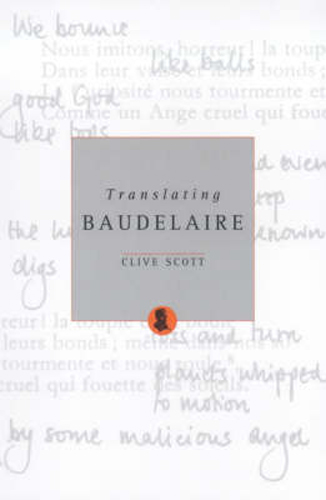
Translating Baudelaire
By (author) Clive Scott
Paperback (Published)
(September 2000)
ISBN: 9780859896580
6.14 x 9.21 inches
Price: $37.00
In stock
Hardback (Published)
(September 2000)
ISBN: 9780859896573
6.14 x 9.21 inches
Price: $112.00
In stock
This book is the record of an apprenticeship in translating Baudelaire, and in translating poetry more generally. Re-assessing the translator’s task and art, Clive Scott explores various theoretical approaches as he goes in search of his own style of translation. In the course of the book, versions of seventeen of Baudelaire’s poems are offered, with detailed evaluations of the poems and the translations. Translating Baudelaire considers two neglected questions: What form should the criticism of translation take, if the critic is to do justice to the translator’s ‘project’? How can a translator persuade readers to respond to a translation as a text with its own creative dynamic and expressive ambitions?
A defence of foreignizing translation
translating rhythm
the dead language of translation
translating and co-authoring
translation and transformation
"
shot"
and "
reverse shot"
translation
the route through prose
the criticisms of translation
translation and intercutting. Appendices: "
translations"
of translations of "
La Cloche felee"
texts of of Verlaine's "
Nevermore"
, Elliot's "
Nevermore"
and Baudelaire's "
Le Balcon"
text of Baudelaire's "
Assommons les pauvres!"
text of Baudelaire's "
Le Voyage"
,
Contents: A defence of foreignizing translation; translating rhythm; the dead language of translation; translating and co-authoring; translation and transformation; "shot" and "reverse shot" translation; the route through prose; the criticisms of translation; translation and intercutting. Appendices: "translations" of translations of "La Cloche felee"; texts of of Verlaine's "Nevermore", Elliot's "Nevermore" and Baudelaire's "Le Balcon"; text of Baudelaire's "Assommons les pauvres!"; text of Baudelaire's "Le Voyage".
Clive Scott is Professor of European Literature, University of East Anglia and Fellow of the British Academy. His most recent books include The Poetics of French Verse: Studies in Reading (Clarendon Press, 1998) and The Spoken Image: Photography and Language (Reaktion Books, 1999).
- By (author) Clive Scott
"Clive Scott's Translating Baudelaire offers exhilarating perspectives on the practice of (verse) translation. Imbued with a postmodernist sense of the mobility and provisionality of text, he seeks to liberate the translator from what he calls 'pre-postmodernist' anxieties...His unrivalled ability to analyse French verse and his remarkable talents as a wordsmith, indeed as a poet, combine to produce compelling renderings of some of Baudelaire's finest verse. His book is an intoxicating invitation to jouissance, promising redemption from 'a state of punishment, in which we are compelled to reiterate our sense of loss'. But after he has explicated his own, fine translation of 'Le Voyage'-his choices of form and lexis, his 'intercutting' (intertextually inspired additions) and allusions-one may be left with the residual sense of having been lured into an artificial paradise, a pre-postlapsarian realm as it were, in which the translator has conscious intentions which explain his text. One had thought such an author dead." (Times Literary Supplement, April 27, 2001)
—
“Clive Scott’s Translating Baudelaire offers exhilarating perspectives on the practice of (verse) translation. Imbued with a postmodernist sense of the mobility and provisionality of text, he seeks to liberate the translator from what he calls “pre-postmodernist” anxieties . . . His unrivalled ability to analyse French verse and his remarkable talents as a wordsmith, indeed as a poet, combine to produce compelling renderings of some of Baudelaire’s finest verse. His book is an intoxicating invitation to jouissance, promising redemption from “a state of punishment, in which we are compelled to reiterate our sense of loss”. But after he has explicated his own, fine translation of “Le Voyage”—his choices of form and lexis, his “intercutting” (intertextually inspired additions) and allusions—one may be left with the residual sense of having been lured into an artificial paradise, a pre-postlapsarian realm as it were, in which the translator has conscious intentions which explain his text. One had thought such an author dead.” (Times Literary Supplement, April 27, 2001)
—
Similar Books


 Ars Prophetica
Theology in the Poetry of Twentieth-Century Hebrew Poets Avraham Halfi, Shin Shalom, Amir Gilboa, and T. Carmi


 Cahiers de l’Association internationale des études françaises
J. M. G. Le Clézio - Enseigner les littératures francophones aujourd’hui - Récit de soi et expérience de l’illusion (XVIIe-XVIIIe siècles)
Volume 78
 Cahiers de lexicologie
Particules floues — Nouvelles études sur le français et l'espagnol
Volume 128
 Cahiers de littérature française
Les Métamorphoses du texte. Enjeux intertextuels et transpositions visuelles
Volume 25
 Cahiers de recherches médiévales et humanistes – Journal of Medieval and Humanistic Studies
Volume 51
 Cahiers de sémiotique des cultures
Ponctuation et sens. Nouvelles perspectives / Punctuation and meaning. New perspectives
Volume 6


 CompLit
Myth, Folklore and Magic in European Literatures. Critical and Contemporary Reconfigurations

 Des mots aux actes
Traduction épistémique et littéraire. Nouvelles tendances en histoire et didactique
Volume 15


 Deutsch als Fremdsprache nach Englisch an chinesischen Hochschulen
Eine empirische Forschung über Lernstrategien zum Wortschatzlernen
 Dis/United States of Vulnerability
Literary and Cultural Transgressions in U.S. Poetry Since the 1960s
Volume 330


 European Drama and Performance Studies
Dramatisations politiques. Théâtre, politique et idéologie au XIXe siècle (1806-1914)
Volume 27


