
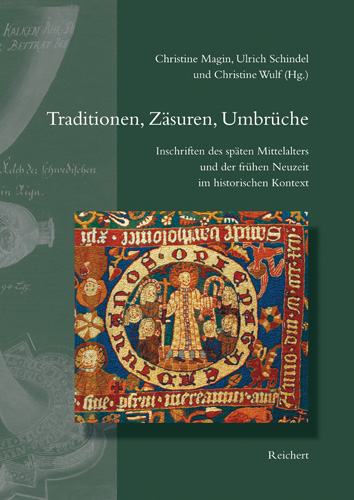
Traditionen, Zäsuren, Umbrüche
Inschriften des späten Mittelalters und der frühen Neuzeit im historischen Kontext. Beiträge zur 11. Internationalen Fachtagung für Epigraphik vom 9. bis 12. Mai 2007 in Greifswald
Edited by Christine Magin Edited by Ulrich Schindel Edited by Christine Wulf
Hardback (Published)
(March 2009)
ISBN: 9783895005978
6.69 x 9.45 inches
Price: $92.00
In stock
The main themes of the volume are: Visual Representations of Religious Concepts; Early Modern Epigraphic Collections; Genealogy and Princely Self-Presentation; Language and Prestige in Inscriptions, from 1517 until 1648; Death and Burial Culture; The Culture of Funerary Monuments in the Rhine-Main-Moselle-Region. Each of these themes is explored in an interdisciplinary pair of essays (epigraphic plus either historical, art historical or philological), in which the transition, around 1500, from the Late Medieval to the Early Modern periods is the main focus. In addition, the volume includes individual studies on the following: Inscriptions on Weapons and Armoury; Languages used in Inscriptions in England, 1300 to 1700; The Monuments of the Old Jewish Cemetery in Worms; The Adaptation of Antique rhetorical conventions of prince-pleasing. Finally, several brief reports describe ongoing epigraphic research projects in Denmark, Sweden, Finland, Latvia and Russia. English summaries of all contributions are included.
English description: The main themes of the volume are: Visual Representations of Religious Concepts; Early Modern Epigraphic Collections; Genealogy and Princely Self-Presentation; Language and Prestige in Inscriptions, from 1517 until 1648; Death and Burial Culture; The Culture of Funerary Monuments in the Rhine-Main-Moselle-Region. Each of these themes is explored in an interdisciplinary pair of essays (epigraphic plus either historical, art historical or philological), in which the transition, around 1500, from the Late Medieval to the Early Modern periods is the main focus. In addition, the volume includes individual studies on the following: Inscriptions on Weapons and Armoury; Languages used in Inscriptions in England, 1300 to 1700; The Monuments of the Old Jewish Cemetery in Worms; The Adaptation of Antique rhetorical conventions of prince-pleasing. Finally, several brief reports describe ongoing epigraphic research projects in Denmark, Sweden, Finland, Latvia and Russia. English summaries of all contributions are included. German description: Aus dem Inhalt: Visualisierung von Glaubensinhalten, fruhneuzeitliche Inschriftensammlungen, Genealogie und landesherrliche Selbstdarstellung, Sprache und Prestige in Inschriften von 1517 bis 1648, Tod und Begrabnis, Sepulkralkultur des Rhein-Main-Mosel-Gebiets. Diese Themen werden jeweils in zwei epigraphischen und historischen bzw. philologischen Beitragen behandelt, in denen besonders der Ubergang zwischen Mittelalter und Neuzeit um 1500 im Zentrum der Aufmerksamkeit steht. In Einzelstudien werden Inschriften auf Waffen, die Inschriftensprache in England von 1300 bis 1700, die Denkmaler des alten judischen Friedhofs in Worms und die Rezeption antiker Konventionen des Herrscherlobs untersucht. Inschriftenprojekte in Danemark, Schweden, Finnland, Lettland und Russland werden in Kurzberichten charakterisiert.
- Edited by Christine Magin
- Edited by Ulrich Schindel
- Edited by Christine Wulf
"Dass der Band einen umfangreichen Tafelteil enthalt, versteht sich angesichts der Beitrage von selbst. Ein Register fehlt, was aber angesichts der geografisch und thematisch breit gestreuten Aufsatze zu verschmerzen ist. Entscheidend ist, dass die Bedeutung des Inschriftenvorhabens fur die Geschichtswissenschaft und fur andere historisch arbeitende Nachbardisziplinen deutlich geworden ist." Enno Bunz, In: Neues Archiv fur sachsische Geschichte. 81 (2010). S. 297.
—
„Dass der Band einen umfangreichen Tafelteil enthält, versteht sich angesichts der Beiträge von selbst. Ein Register fehlt, was aber angesichts der geografisch und thematisch breit gestreuten Aufsätze zu verschmerzen ist. Entscheidend ist, dass die Bedeutung des Inschriftenvorhabens für die Geschichtswissenschaft und für andere historisch arbeitende Nachbardisziplinen deutlich geworden ist.“<br/><br/>Enno Bünz.<br/><br/>In: Neues Archiv für sächsische Geschichte. 81 (2010). S. 297.
—
Similar Books
 A Collaborative Tapestry in Honour of Shirley Ann Brown / Une fresque brodée en l’honneur de Shirley Ann Brown
The Bayeux Tapestry Seen by her Colleagues and Friends / La Tapisserie de Bayeux vue par ses collègues et amis

 Behind the Scenes of Medieval Roofs
An Overview of the Roofing Systems of Italian Churches
Volume 90








 Innovation and Medieval Communities
The Circulation of Ideas and Practices in and out of the Town (1200-1500)
Volume 63
 John Dunstaple Reading Boethius
John Dunstaple’s Annotations to Boethius’s “De institutione musica” in the Manuscript Oxford, Corpus Christi College Library, MS 118
 Linguistic and Cultural Dynamics in a Frontier Society
New Perspectives on Northeastern Bavaria and Western Bohemia in the Early Middle Ages
Volume 9

 Medieval Debates on Foreknowledge: Future Contingents, Prophecy, and Divination
Acts of the XXVII Annual Colloquium of the SIEPM, Trento 12-15 September 2023
Volume 31
 Medieval Yeghegis, Armenia
History, Archaeology, Society. Local Multiplicities and Global Connections of a Rural Centre on the Silk Road(s)




 Power and Women in Southeast and Central Europe in Late Medieval and Early Modern Period (1300-1600)
Volume 10



 The Anglo-Norman Bible’s Books of Kings, a Critical Edition
(BL Royal 1 C III, fols 234r-274v)
Volume 37


 The Embodied Court in the Premodern World
Understanding the Physicality, Performativity and Lifecycle of Bodies at Court in Europe and Beyond, 1400-1800
Volume 4


 The Middle English ‘Medicines for Horses’
Edited from the Manuscript formerly at Kensington Palace, HRH Duke of Gloucester MS s.n. (olim York House MS 45)
Volume 69
