
Thorvald’s Cross
The Viking-Age Cross-Slab ‘Kirk Andreas MM 128’ and Its Iconography
By (author) Dirk H. Steinforth
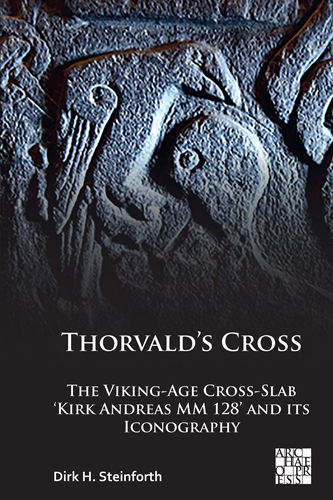
Paperback (Published)
(January 2022)
ISBN: 9781789698558
6.1 x 9.25 inches
Price: $28.00
In stock
The ‘Manx Crosses’, Scandinavian-style gravestones from the Isle of Man, are a unique collection of stone monuments unequalled in the medieval Viking World. Focussing on one particular example, ‘Thorvald’s cross’, this book collates all the available information and presents a new interpretation as to how to understand this remarkable monument.
Thorvald’s Cross. The Viking Age Cross-Slab ‘Kirk Andreas MM 128’ and its Iconography provides an in-depth analysis of one of the Isle of Man’s most important and intriguing monuments. The Manx Crosses are a unique collection of Scandinavian-style grave stones unequalled in the medieval Viking World. Their carvings and inscriptions offer a window into Viking Age society and spirituality at a time when the Celtic Manx and Scandinavian settlers in the Island came to terms with each other. Among these stones, the iconic ‘Thorvald’s Cross’ (MM 128) in St Andrew’s church in the village of Andreas demands particular attention, as it features figural scenes with humans and animals deriving from both pagan Norse mythology and Christian religious imagery. According to the prevailing view, the triumph of Christianity over paganism is shown in the two preserved reliefs, but differing opinions have been put forward. This book brings together all available information about Thorvald’s Cross and discusses and analyses former and current hypotheses regarding the stone’s iconography, weighing their respective merits and shortcomings. Based on in-depth research and an ‘autopsy’ of the stone on-site, it considers the images in their spiritual, cultural, and chronological context and presents a new interpretation of this remarkable monument, arguing that the depiction of religious confrontation was not its original purpose, but that both scenes convey a common, much more subtle and comforting Christian message.
Introduction Background The Manx Crosses 'Thorvald's Cross': the fragment Kirk Andreas MM 128 The stone's date Description The figural elements of Face 1 The figural elements of Face 2 The iconography of the two faces of Thorvald's Cross Interpretation of Face 2 Interpretation of Face 1 The juxtaposition and the message Combination 1: Ooinn's fall and Christ's triumph Combination 2: Vioarr's victory and Christ's triumph Combination 3: Ooinn's fall and Vioarr's victory and Christ's triumph Summary and conclusion Acknowledgements Bibliography Places to visit, Introduction ;
Background ;
The Manx Crosses ;
‘Thorvald’s Cross’: the fragment Kirk Andreas MM 128 ;
The stone’s dateDescriptionThe figural elements of Face 1The figural elements of Face 2 The iconography of the two faces of Thorvald’s Cross ;
Interpretation of Face 2Interpretation of Face 1 The juxtaposition and the message ;
Combination 1: Óðinn’s fall and Christ’s triumphCombination 2: Víðarr’s victory and Christ’s triumphCombination 3: Óðinn’s fall and Víðarr’s victory and Christ’s triumph Summary and conclusion ;
Acknowledgements ;
Bibliography ;
Places to visit
Dirk H. Steinforth is a medieval archaeologist. He gained his MA and PhD from the Georg-August-University of Gottingen, Germany, and specialises in the early Viking Age in the Isle of Man and Irish Sea area. He has published two books as well as a number of articles on the subject. His interests include history and chronology, religion and burial-customs, art-history and iconography, ethnogenesis, and settlement archaeology. His current research as an independent scholar focuses especially on the early Vikings in north-west England, and medieval stone monuments and their imagery. He also works as a translator, proofreader, and editor.
- By (author) Dirk H. Steinforth
"Although the book is rather thin, the wealth of its content would be enough for an encyclopaedia. Moreover, its interestingly worded and lucid language proves that scholarly works do not need to be boring; such a well-written book will certainly interest not only scholars but laypeople who follow the archaeology of the Isle of Man, or those interested in the iconography of Early Christian sculpture." Joanna Pyrgies (2022): The Journal of Irish Archaeology Volume XXXI "Ultimately, the book is a useful summary of current and past ideas, and it argues an interesting and largely plausible case for one particular theory." Thomas Williams (2023): Medieval Archaeology vol 67.1
—
‘Although the book is rather thin, the wealth of its content would be enough for an encyclopaedia. Moreover, its interestingly worded and lucid language proves that scholarly works do not need to be boring; such a well-written book will certainly interest not only scholars but laypeople who follow the archaeology of the Isle of Man, or those interested in the iconography of Early Christian sculpture.’ – Joanna Pyrgies (2022): The Journal of Irish Archaeology Volume XXXI
—
'Ultimately, the book is a useful summary of current and past ideas, and it argues an interesting and largely plausible case for one particular theory.' – Thomas Williams (2023): Medieval Archaeology vol 67.1
—
Similar Books
 «Solazoxa festa, stradolze e stracomplia»
Festschrift für Raymund Wilhelm zum 65. Geburtstag mit Beiträgen zu Diskurstraditionen und mittelalterlicher Philologie
Volume 249
 A Collaborative Tapestry in Honour of Shirley Ann Brown / Une fresque brodée en l’honneur de Shirley Ann Brown
The Bayeux Tapestry Seen by her Colleagues and Friends / La Tapisserie de Bayeux vue par ses collègues et amis

 Behind the Scenes of Medieval Roofs
An Overview of the Roofing Systems of Italian Churches
Volume 90

 Cahiers de recherches médiévales et humanistes – Journal of Medieval and Humanistic Studies
Volume 51







 Innovation and Medieval Communities
The Circulation of Ideas and Practices in and out of the Town (1200-1500)
Volume 63
 John Dunstaple Reading Boethius
John Dunstaple’s Annotations to Boethius’s “De institutione musica” in the Manuscript Oxford, Corpus Christi College Library, MS 118

 Medieval Debates on Foreknowledge: Future Contingents, Prophecy, and Divination
Acts of the XXVII Annual Colloquium of the SIEPM, Trento 12-15 September 2023
Volume 31

 Medieval Yeghegis, Armenia
History, Archaeology, Society. Local Multiplicities and Global Connections of a Rural Centre on the Silk Road(s)

 Nicholas of Lyra’s Commentaries on the Gospels of Matthew and Luke
Franciscan Exegesis in a Time of Crisis



 Power and Women in Southeast and Central Europe in Late Medieval and Early Modern Period (1300-1600)
Volume 10





 The Anglo-Norman Bible’s Books of Kings, a Critical Edition
(BL Royal 1 C III, fols 234r-274v)
Volume 37