
South Arabian Funerary Stelae from the British Museum Collection
by Lombardi, Alessandra

The funerary field is particularly interesting and rich in stimuli allowing us knowledge of religious thought and art of ancient civilisations. Pre-Islamic South Arabia (8th century BC – 6th century AD) produced a large amount of objects related to this field and, among them, the funerary stelae are the most important for their large number, the variety of subjects and decorations represented on them. Starting from the rich British Museum collection, this study organizes and classifies material for the most part from the international antique trade. Often information regarding provenance and archaeological context is lacking here. However, the analysis of these stelae allows us to reconstruct a picture rich in regional styles, with reciprocal influences. From the archaic and more traditional stylized expressions – typical of the Minaean region – to the more recent complex and figurative representations of the Sabaean area, this book shows the originality and specificity of South Arabian art, paying particular attention to the contacts with foreign cultures, especially with the Hellenistic and Roman world. Such foreign influences are analysed in depth in the rich Appendix, edited by Fabio E. Betti, where specific topics in relation to the changes in ancient South Arabian art during the first centuries AD are studied. They were changes of ‘fashion’, evident especially in decorative motifs within the architecture and the daily life of the South Arabian elites, as shown by the clothes, hairstyles and jewellery of the women of that time.
The funerary field is particularly interesting and rich in stimuli allowing us knowledge of religious thought and art of ancient civilisations. Pre-Islamic South Arabia (8th century BC – 6th century AD) produced a large amount of objects related to this field and, among them, the funerary stelae are the most important for their large number, the variety of subjects and decorations represented on them. Starting from the rich British Museum collection, this study organizes and classifies material for the most part from the international antique trade. Often information regarding provenance and archaeological context is lacking here. However, the analysis of these stelae allows us to reconstruct a picture rich in regional styles, with reciprocal influences. From the archaic and more traditional stylized expressions – typical of the Minaean region – to the more recent complex and figurative representations of the Sabaean area, this book shows the originality and specificity of South Arabian art, paying particular attention to the contacts with foreign cultures, especially with the Hellenistic and Roman world. Such foreign influences are analysed in depth in the rich Appendix, edited by Fabio E. Betti, where specific topics in relation to the changes in ancient South Arabian art during the first centuries AD are studied. They were changes of ‘fashion’, evident especially in decorative motifs within the architecture and the daily life of the South Arabian elites, as shown by the clothes, hairstyles and jewellery of the women of that time.
- By (author) Alessandra Lombardi
Other Titles in this Series

 A Cosmopolitan City on the Arabian Coast
The Imported and Local Pottery from Khor Rori. Khor Rori Report 3
Volume 12
 Inscriptions from the Southern Highlands of Yemen
The epigraphic collections of the museums of Baynun and Dhamar
Volume 8


 Husn Salut and the Iron Age of South East Arabia
Excavations of the Italian Mission to Oman 2004-2014
Volume 15


 The City-States of the Jawf at the Dawn of Ancient South Arabian History (8th-6th centuries BCE). I
From cities to kingdoms
Volume 17.1
 The City-States of the Jawf at the Dawn of Ancient South Arabian History (8th-6th centuries BCE). II
Corpus of the inscriptions
Volume 17.2
 The City-States of the Jawf at the dawn of ancient South Arabian history (8th-6th centuries BCE). III
A lexical and onomastic index of the Inscriptions
Volume 18

Similar Books


 Caesar’s Visions and Impact on the Roman Empire
Revisiting the Archaeological and Historical Record of the 40s BC
Volume 2

 Connecting the Dots: Counting, Writing, and the Beginnings of Civilization
The Secret Lives of Clay Tokens: A Memoir


 Etruscan and Roman Hellenistic Anatomical ex votos
Reassessing Popular Religious Expressions in Central Italy
Volume 8


 Ḫattušaš utnē išḫameški
Hittite and Other Ancient Near Eastern Studies Presented to Piotr Taracha on the Occasion of His 65th Birthday



 Invisible Labour in Antiquity
Visualizing Obscure Work in the Ancient Mediterannean and West Asia
Volume 1
 Late Antique villae in the Balkans (3rd–7th c. AD): Current Research Questions and Perspectives
HAEMUS Companion to the Late Antique Balkans 1
Volume 4

 New Research on Old Collections in Southwest Asian Archaeology
Proceedings of the Workshop Held at the British Museum, London, 31 July – 2 August, 2023
 Old Aramaic Inscriptions and their Contexts
An Epigraphic, Archaeological, and Historical Synthesis
Volume 63


 Portraying the Individual in the Roman East
Local–Imperial Entanglements in Sculpture, Mosaics, and Paintings (First–Fourth Centuries AD)
Volume 18
 Punning in Odd or Elegant Constructions in Jeremiah
The Convergence of Linguistics, Rhetoric, and Textuality in the Hebrew Text of Jeremiah

 Shame in the Worlds of the Hebrew Bible and Akkadian Texts
A Linguistic Study and Its Implications
Volume 33
 Small Worlds and Relational Agencies: Local Societies in Early Medieval Iberia
Pequeños mundos y Agencias relacionales: Sociedades locales altomedievales en la Península Ibérica
 Telling Contexts
Archaeological and Textual Studies in Honor of Elizabeth Bloch-Smith and Mark S. Smith
 The Body
Lived, Cultured, Adorned: Essays on Dress and the Body in the Bible and Ancient Near East in Honor of Nili S. Fox
 The Discourse of Rites
Shaping and Reshaping the (Counter-)Priestly Rituals Conducted Outside the Tabernacle

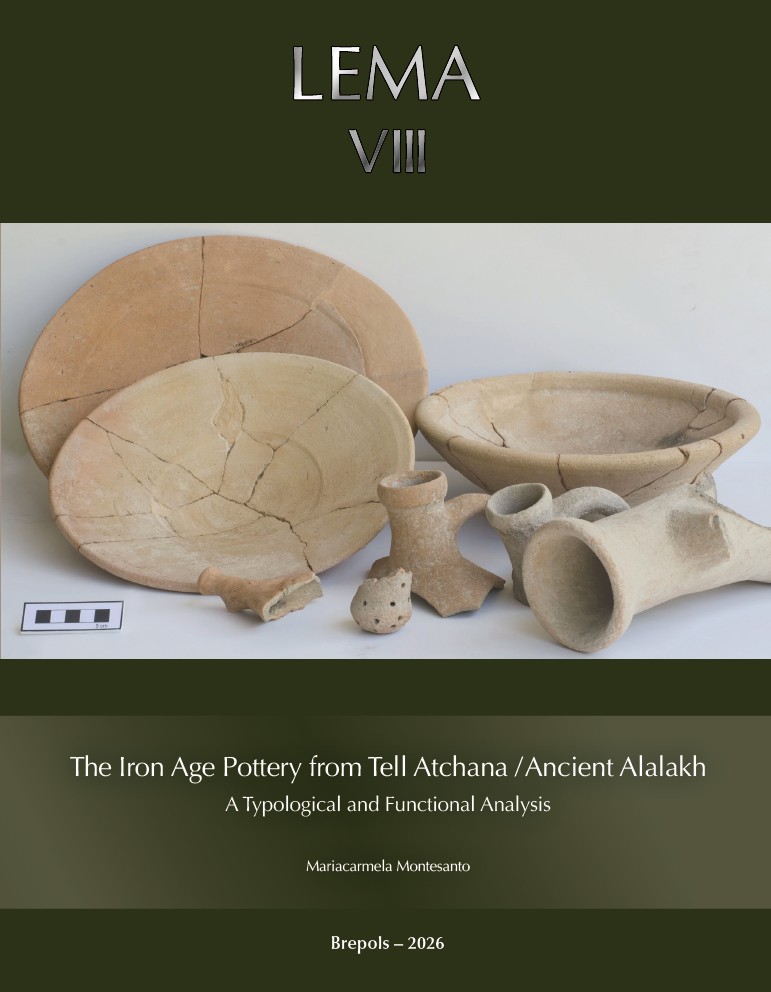 The Iron Age Pottery from Tell Atchana / Ancient Alalakh
A Typological and Functional Analysis
Volume 8



 Writing in the Church of the Nativity in Bethlehem
Inscription and Graffiti in a Multilingual and Multigraphic Perspective
Volume 45