
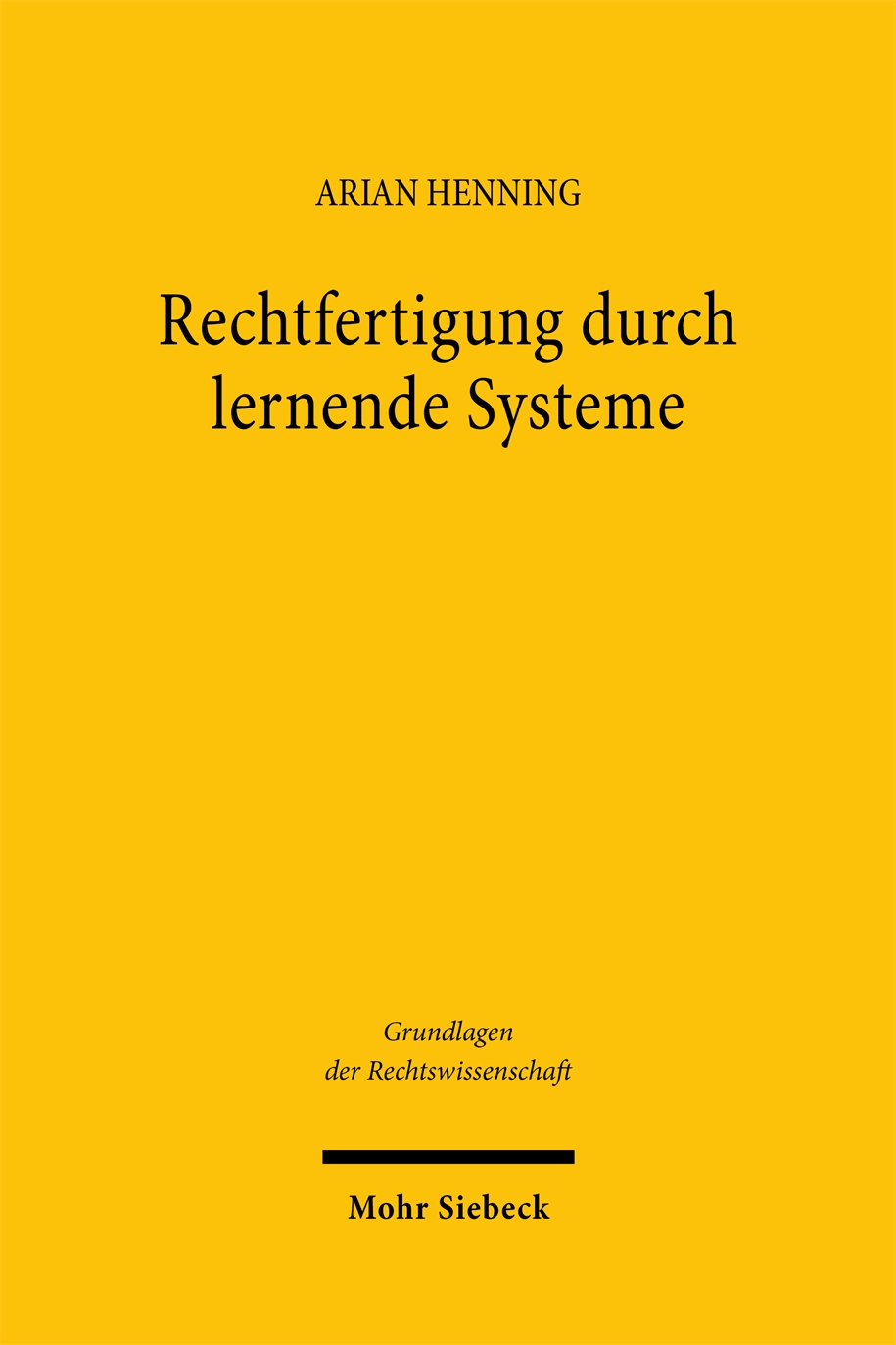
Rechtfertigung durch lernende Systeme
Erklärbarkeit als Element einer neuen Begründungsarchitektur im Recht
Paperback (Forthcoming)
(February 2027)
ISBN: 9783162010056
6.1 x 9.13 inches
Price: $128.00
When machines are involved in decision-making, the state must be able to explain why. Arian Henning shows how AI-assisted decisions can be justified in accordance with the rule of law and demonstrates which explanations actually work in practice.
Artificial intelligence is increasingly being used in the exercise of public authority. However, the complex decision-making logic of learning systems can hardly be reconstructed in individual cases. This poses a direct challenge to a state governed by the rule of law, which is founded on the principle of justification, since the traditional instruments of legal reasoning risk reaching their functional limits. The European legislature has responded to this challenge: the AI Act, adopted in 2024, requires deployers of such systems for the first time to provide meaningful explanations, but leaves open what these explanations must contain and how they relate to the rule-of-law obligation to provide reasons.
This is where Arian Henning’s study begins. Legal theory has traditionally bridged the gap between the making and presentation of legal decisions by focusing not on the actual determinants of a decision, but on the normative reconstruction of the reasons relevant to it. Could this approach also be applied to algorithmic decisions? Answering this question brings law to the interface with computer science. Its explainability methods are not readily compatible with the requirements of justification under the rule of law. The author therefore translates the central procedural functions of legal reasoning into the logic of algorithmic explanation models and develops a normative framework for a new architecture of legal reasoning.
A behavioral science experiment involving 4,250 participants tests this concept in the context of administrative proceedings. It reveals a finding that has so far received little attention: in algorithmic decision-making, counterfactual explanations lead to disproportionately large gains in perceived fairness and significantly reduce the fairness gap compared with human decisions.
The study thus combines a normative theory of explainability with empirical evidence showing which explanations enhance the fairness and acceptance of algorithmic decisions by public authorities. It was awarded the Science Prize of the German Foundation for Law and Computer Science and the Doctoral Thesis Award of Bucerius Law School.
Other Titles in this Series
 Evidenzbasierte Jurisprudenz
Methoden empirischer Forschung und ihr Erkenntniswert für das Recht am Beispiel des Gesellschaftsrechts
Volume 23
 Das Personal der Republik
Entstehung und Entwicklung eines demokratischen Personalverfassungsrechts der Exekutive am Beispiel der Vereinigten Staaten von Amerika
Volume 38
 Gesetzgebungskunst
Gute Gesetzgebung als Gegenstand einer legislativen Methodenbewegung in der Rechtswissenschaft um 1900 - Zur Geschichte der Gesetzgebungslehre
Volume 5


 Der Schutz der Privatsphare im Zivilrecht
Eine historisch-vergleichende Untersuchung zum deutschen, franzosischen und englischen Recht vom ius commune bis heute
Volume 7


 Recht und demokratische Reversibilitat
Verfassungstheoretische Legitimation und verfassungsdogmatische Grenzen der Bindung demokratischer Mehrheiten an erschwert anderbares Recht
Volume 36


 Grundrechtsbindung des Gesetzgebers
Eine rechtsvergleichende Studie zu Deutschland, Frankreich und den USA
Volume 16


 Welt der Kommentare
Struktur, Funktion und Stellenwert juristischer Kommentare in Geschichte und Gegenwart
Volume 30
 Verfassungsvergleichung als Postulat
Eine deutsch-franzosische Wissenschaftsgeschichte seit 1870
Volume 44

 Gesetzesmaterialien und Wille des Gesetzgebers
Fallgruppen verbindlicher Willensausserungen
Volume 34
 Diskursive Vernunft und formelle Gleichheit
Zu Demokratie, Gewaltenteilung und Rechtsanwendung in der Rechtstheorie von Jurgen Habermas
Volume 10
 Informationelle Selbstgefährdung
Zur rechtsfunktionalen, spieltheoretischen und empirischen Rationalität der datenschutzrechtlichen Einwilligung und des Rechts auf informationelle Selbstbestimmung
Volume 31
 Entzauberung des Rechts auf informationelle Selbstbestimmung
Eine Untersuchung zu den Grundlagen der Grundrechte
Volume 45

 Der Erbvertrag als Problem von Rechtswissenschaft
Eine rechtswissenschaftsgeschichtliche Untersuchung vor dem Hintergrund der Geschichte eines allgemeinen Vertragsbegriffs
Volume 33
 Rechtsdogmatik und Wissenschaftstheorie
Möglichkeiten und Grenzen eines interdisziplinären Diskurses
 Nebeneinander und Einheit im Burgerlichen Recht
Zur Gliederung des Rechtsstoffs im Burgerlichen Gesetzbuch
Volume 18
