Notwehr und überindividuelle Schutzgüter
Zur dogmatischen Reichweite des § 32 StGB bei Straftatbeständen, die neben individuellen Rechtsgütern auch solche der Allgemeinheit schützen
By (author) Philipp Alexander Burek
Hardback (Published)
(June 2026)
ISBN: 9783162004901
6.1 x 9.13 inches
Price: $150.00
In stock
Self-defence is directed against the attacker – but what applies when defensive action simultaneously affects legal interests of the public at large? Philipp Alexander Burek explores a largely neglected borderline area of criminal law scholarship and recalibrates the law of self-defence where criminal offences protect multiple legal interests.
Philipp Alexander Burek examines the doctrinal scope of self-defence where defensive conduct affects not only the individual legal interests of the attacker but also collective interests protected by law. Such collateral damage resulting from self-defence marks a borderline area between self-defence and necessity that has so far remained insufficiently explored. The prevailing dichotomy, according to which self-defence either applies without limitation or must give way entirely, is criticised as inadequate. The central thesis is that self-defence derives its justificatory force solely in relation to the attacker. Interferences with supra-individual legal interests therefore constitute persisting wrongdoing. On this basis, the author develops the concept of a partial justification in self-defence. Methodologically, the study combines doctrinal analysis with historical and teleological interpretation, rejects both the doctrine of the third-party effect of self-defence and recourse to section 34 of the German Criminal Code, and advances a differentiated solution for composite offences under current German criminal law.
Hinführung zum Gegenstand der Untersuchung
I. Einführende Gedanken zum Notwehrkonflikt
II. Notwehr und Begleitschäden an Individualrechtsgütern
III. Überindividuelle Begleitschäden und „ein gravierendes, bislang völlig übergangenes Problem"
IV. BGH NJW 2013, 2133 als instruktives Fallbeispiel
V. Untersuchungsgegenstand und grobe Bestandsaufnahme
VI. Zielsetzung und Gang der Untersuchung
Erstes Kapitel: Grundlegendes
I. Grundzüge der Rechtfertigungsdogmatik
II. Zur Rechtfertigungswirkung der Notwehr
Zweites Kapitel: Notwehr und Straftatbestände, die sowohl individuelle als auch Rechtsgüter der Allgemeinheit schützen
I. Ausgangspunkt und Referenzfall
II. Die „Lehre von der Drittwirkung der Notwehr"
III. Der rechtfertigende Notstand nach § 34 StGB
IV. Der Gedanke einer notwehrrechtlichen „Teilrechtfertigung"
Drittes Kapitel: Vertiefungen zur notwehrrechtlichen Teilrechtfertigung
I. Delikte, die einer Teilrechtfertigung prinzipiell zugänglich erscheinen
II. Einige Folgefragen
Ergebnisse der Untersuchung
Born 1992; studied law at the University of Bochum; First State Examination in Law (2023); Research Associate at the Chair of Criminal Law and Criminal Procedure, Business Criminal Law, and International Criminal Law at Ruhr University Bochum; PhD awarded in 2025.
- By (author) Philipp Alexander Burek
Other Titles in this Series
 Grundzuge eines EU-Strafverfassungsrechts
Ein konzeptioneller Ansatz fur die europaische Integration des Straf- und Strafverfahrensrechts
Volume 40
 Rechtsauskunft und strafrechtlicher Verantwortungsausschluss
Zugleich ein intrasystematischer und jurisdiktionsubergreifender Rechtsvergleich
Volume 29
 Die Neuregelung der Strafbarkeit des Jahresabschlussprufers
Ein Vorschlag de lege ferenda zur Erfassung der strafwurdigen und strafbedurftigen Konstellationen von beruflichem Fehlverhalten des Jahresabschlussprufers
Volume 14
 Personelle Strafgewalt
Ein Pladoyer fur das Domizilprinzip im Lichte grenzuberschreitender Migration
Volume 31
 Die Methode der richterlichen Straftatenpravention
Zu den Regeln der Rezeption von Empirie und Qualitat im Recht
Volume 6
 Das sozialethische Unwerturteil als staatliches Fremdbild
Zum verfassungsrechtlichen Schuldprinzip und seinen Anforderungen an die Strafgesetzgebung
Volume 43
 Gebundene Freiheit und strafrechtliche Schuld
Zur Reformbedurftigkeit des Schuldbegriffs vor dem Hintergrund neurowissenschaftlicher Erkenntnisse
Volume 17
 Notwehrprovokation
Zugleich ein Beitrag zu den moralphilosophischen Grundlagen des Notwehrrechts
Volume 45
 Normtheoretische Grundlagen der Lehre von der objektiven Zurechnung
Sicheres Fundament oder Achillesferse?
Volume 33
 Rechtfertigender Notstand und staatliche Verfahren
Zur Reichweite des Vorrangs staatlicher Verfahren unter besonderer Berucksichtigung von Notstandshandlungen zugunsten des Umwelt-, Klima- und Tierschutzes
Volume 44
 Grenzen der Delegation von Strafbarkeitsrisiken durch Compliance
Zugleich ein Beitrag zur strafrechtlichen Geschaftsherrenhaftung
Volume 19
 Die Erwartung kunftiger Straffreiheit
Eine Untersuchung zur Strafaussetzung zur Bewahrung und deren Widerruf wegen einer neuen Straftat
Volume 35
 Strafe und Strafgesetzgebung im demokratischen Verfassungsstaat
Der Einfluss des grundgesetzlichen Demokratieprinzips auf Straftheorie und Strafgesetzgebung am Beispiel ausgewahlter Staatsschutzdelikte
Volume 9
 Beteiligung an organisatorischen Machtapparaten
Eine Untersuchung zur Begrundung und Verteilung strafrechtlicher Verantwortung
Volume 20
 Die Lebensleistung des Taters als Strafzumessungserwagung
Zugleich ein Beitrag zu den Grundlagen des Strafzumessungsrechts
Volume 24
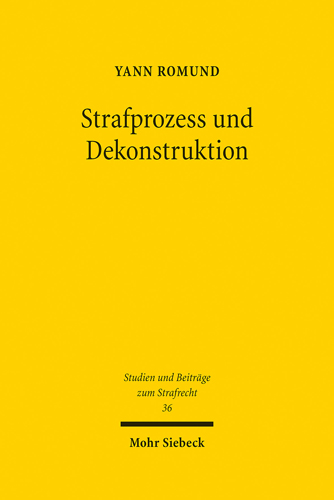 Strafprozess und Dekonstruktion
Eine Studie zur Anwesenheit des Angeklagten in der Hauptverhandlung
Volume 36
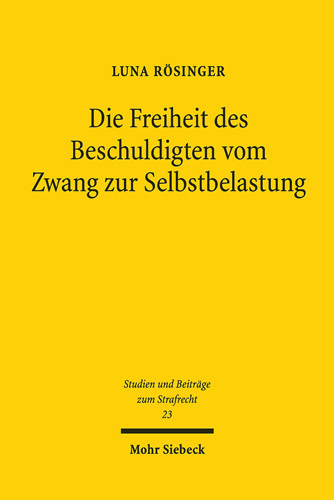 Die Freiheit des Beschuldigten vom Zwang zur Selbstbelastung
Uber den Begrundungszusammenhang von Mitwirkungsfreiheit und Strafverfahrenseingriff
Volume 23
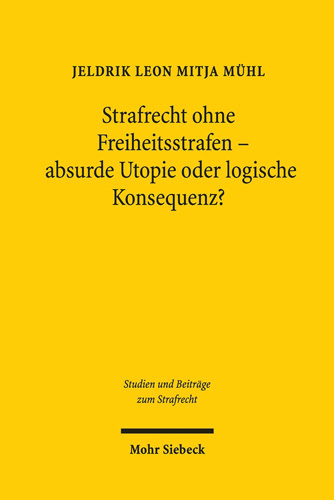 Strafrecht ohne Freiheitsstrafen – absurde Utopie oder logische Konsequenz?
Die Laufzeitleistungsstrafe als alternative Sanktion
Volume 1
 Erfolgszurechnung in der Strafzumessung
Die verschuldeten Auswirkungen der Tat gemass 46 Abs. 2 StGB in einer regelgeleiteten Strafmasslehre
Volume 10
 Faires Verstandigungsverfahren durch Transparenz
Mitteilungs- und Dokumentationspflichten im Rahmen der strafprozessualen Verstandigung
Volume 22