
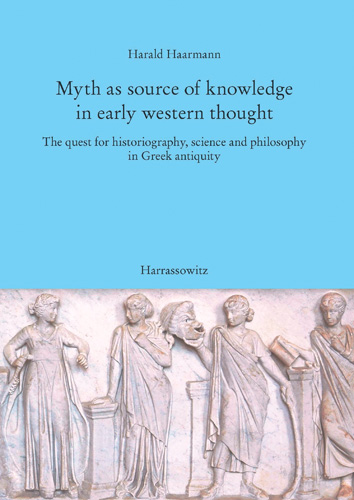
Myth as source of knowledge in early western thought
The quest for historiography, science and philosophy in Greek antiquity
by Harald Haarmann
Paperback (Published)
(April 2015)
ISBN: 9783447103626
6.65 x 9.49 inches
Price: $68.00
On back order
The perception of intellectual life in Greek antiquity by the representatives of the European Enlightenment of the 18th century favoured the establishment of the cult of reason. Myth as a potential source of knowledge was disregarded: instead, the monopoly of truth-finding through pure rationalisation was asserted. This tendency, positing, as it did, reason in opposition to myth, did a signal disservice to the realities of intellectual life among the ancient Greeks. Nevertheless, these distortions of the Enlightenment have conditioned our approach to education and have led to our privileging of reason as a mode of enquiry right up to the present day. The ancient Greek intellectuals (i.e. the pre-Socratic philosophers, the early historiographers, philosophers of the classical age) did not set myth (mythos) and reason (logos) in opposition to each other. In fact, they benefited from both as differing modes of enquiry, each in its own right and possessing its own value. Plato, in his reasoning, was much concerned with the proper use of mythical narrative. In one of his dialogues, he even coined a new term for explaining how mythical topics and motifs should be exploited as a source of knowledge. This term is mythologia, and it first occurs in Plato’s Republic (394b). The present study aims to offer a corrective to traditional cliches and received wisdom about intellectual life in ancient Greece. The work proposes, and aims to reconstruct, a mental landscape in which myth and reason connect and vividly interact, and in which the concepts of mythos and logos are intertwined in the terminological network of the ancient Greek language.
- By (author) Harald Haarmann
Similar Books



 Contesting Labeled Identities
The Sociology of Gentilics in Biblical and Northwest Semitic Literature


 Drunk the Potion, No Whit Charmed
The Doctrine of Pure and Perfect Souls from Iamblichus to Damascius

 Epigraphic “Shades” from Hellenistic Thrace
Contextualizing Inscriptions in Greek from Thracian Tombs

 Epiphanies of the Divine in the Septuagint and the New Testament
Fifth International Symposium of the Corpus Judaeo-Hellenisticum Novi Testamenti (CJHNT), 14-17 May 2015, Nottingham


 Éthique, politique, religions
Superstition (XVIIe - XXIe siècles). Sémantique, histoires et cultures


 Gold, Silver and Glass: Power Networks, Cultural Identities, Technology Transfers and Agency across the Old World (7th Century BC – 1st Century AD)
Proceedings of a Conference Held at the British Museum, 16–18 June 2023

 La Lettre clandestine
La littérature philosophique clandestine, ses éditeurs et ses éditions
Volume 34
 Language and Power in the Roman Empire and Early India
Hierarchy, Ambiguity, and the Art of Reading the Signs in Cosmopolitan Cultures
 Late Antique villae in the Balkans (3rd–7th c. AD): Current Research Questions and Perspectives
HAEMUS Companion to the Late Antique Balkans 1
Volume 4
 Libertinage et philosophie à l’époque classique (XVIe-XVIIIe siècle)
Athéisme, Modernité et Sécularisation / Atheism, Modernity and Secularization
Volume 23


 Nurturing the Elite
Representations of Drinking, Eating, and Religious Vessels in Palmyrene Funerary Iconography
Volume 13


 Political Thought and Eleventh-Century Populism
The Meek, the Many, and the Meritorious during the Age of the Gregorian Reform
Volume 38


