
Kostbare Einbandbeschläge an armenischen Handschriften
Dokumentation jüngster Maßnahmen zur Bestandserhaltung
By (author) Margret Jaschke By (author) Robert Stähle
Hardback (Published)
(September 2015)
ISBN: 9783954900534
8.27 x 11.69 inches
Price: $147.00
In stock
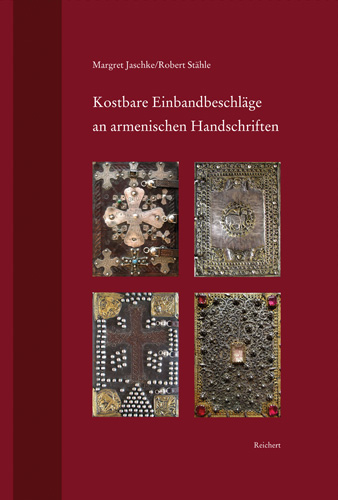
This book illuminates the largely unknown Armenian book and binding design which has been essential for the Armenian people since their adoption of Christianity. The MATENADARAN in Yerevan/Armenia, included in the UNESCO Memory of the World Register since 1997, holds the world’s largest collection of Armenian manuscripts.<br/>Based on a selection from more than 200 restored gospel books, the authors describe their approach to restoring damaged applications respectively lost closures.<br/>The included glossary illustrates the metalwork terminology and contributes to the linguistic standardisation of the associated processes.<br/>
English summary: The Mesrop Mashtots Institute of Ancient Manuscripts in Yerevan, Armenia, has been included in the UNESCO Memory of the World Register since 1997 and holds the world’s largest collection of Armenian manuscripts, among them a considerable number of gospel books with precious silver metalwork bindings. These codices may often be only small, yet feature “treasure bindings”. The multitude of metalwork bindings, from closures to decorative and iconographic-sculptural elements, and their careful workmanship are amazing. Surprisingly, this Armenian cultural heritage has, with few exceptions, remained practically unknown among European experts, even though the Armenians were the first people to adopt Christianity in 301 as their state religion and began spreading their belief in written form in the 5th century. Based on a selection of almost 80 objects, the authors document the restoration of damaged or lost metalwork performed on more than 200 bindings since 2001. By that they provide a comprehensive insight of historic Armenian bindings, particularly their own varied and abundant metalwork. According to the technical appearance and workmanship of the metalwork on the covers they developed a principle of arrangement for the variety to be classified. An elaboration on the various closure systems and their development emphasizes this variety and recognizes the Armenian gold- and silversmiths’ expert workmanship. The authors also provide a richly illustrated glossary of the terminology used in restoration to facilitate understanding and to support general discussions about the restoration of metalwork bindings. This publication is an expert presentation based on the authors’ extensive practical experience with book restoration. It unlocks a largely unknown aspect of Armenia’s cultural heritage. In addition, it may be a source of inspiration and a treasure trove for preservation experts (museums, libraries, archives, restorers, etc.) and lovers of historical books. German description: Das Matenadaran – “Mesrop-Mashtotz-Institut fur Alte Handschriften” in Yerevan /Armenien – ist seit 1997 UNESCO-Weltkulturerbe Es beherbergt die weltweit grosste Sammlung armenischer Handschriften, darunter eine grosse Anzahl von Codices mit silberbeschlagenen Einbanden, die trotz ihrer haufig auffallend kleinen Formate “Prachteinbande” sind. Die Vielfalt der Beschlage und deren sorgfaltige handwerkliche Ausfuhrung – sowohl der Klausuren als auch der dekorativen und ikonographisch bildnerischen Ausstattung – sind bemerkenswert. Die Armenier haben als erstes Volk schon im Jahr 301 n. Chr. den christlichen Glauben als Staatsreligion angenommen und seit dem 5. Jahrhundert im Schrifttum verbreitet. Trotzdem ist dieses Kulturgut in europaischen Fachkreisen mit wenigen Ausnahmen nahezu unbekannt geblieben. Margret Jaschke und Robert Stahle geben einen umfassenden Uberblick uber die historische armenische Einbandkunst, speziell uber die verschiedenen Beschlagsarten und ihre Reichhaltigkeit. Das Buch ist systematisch gegliedert nach der handwerklich-technischen Beschaffenheit der Beschlage an den jeweiligen vorderen Einbanddeckeln der Handschriften. Ein Exkurs zu den unterschiedlichen Verschlusssystemen und deren Entwicklung unterstreicht die Vielfalt und wurdigt die handwerkliche Meisterschaft der armenischen Gold- und Silberschmiede. Mit einer Auswahl von 70 Objekten dokumentieren die Autoren die Instandsetzung schadhafter oder verloren gegangener Beschlage, die sie seit 2001 an uber 200 Einbanden vorgenommen haben. Sie halten sich dabei prinzipiell an die weltweit akzeptierten Grundsatze der Restaurierethik. Ihre Auftraggeber wunschen jedoch auch, dass die ursprungliche Pracht der Bucher weitgehend wieder hergestellt wird. Sie sehen das wertvolle Kulturgut nicht in erster Linie als Forschungsobjekt der Entwicklung des armenischen Schrifttums und der Buchkunst. Bucher werden in Armenien allgemein sehr wertgeschatzt und mit viel Ehrerbietung behandelt. Ihre Ausstattung soll dem Evangelium als Wort Gottes angemessen sein. Ein ausfuhrliches bebildertes Glossar zu den Fachausdrucken, die bei der Beschreibung der Instandsetzungen verwendet werden, erleichtert nicht nur das Verstandnis, sondern leistet auch einen wichtigen Beitrag zur sprachlichen Vereinheitlichung und Verstandigung uber die Restaurierung von Metallbeschlagen. Die Veroffentlichung ist eine Fundgrube fur Fachleute der Bestandserhaltung in Museen, Bibliotheken, Archiven – fur Restauratoren und Archivare ebenso wie fur Liebhaber historischer Bucher. Sie stellt die tatsachlich durchgefuhrten praktischen Arbeiten authentisch dar, erschliesst einen bislang weitgehend unbekannten Aspekt armenischen Kulturgutes und bietet daruber hinaus viele wertvolle Anregungen.
- By (author) Margret Jaschke
- By (author) Robert Stähle
Similar Books


 Between Bones and Beliefs
Human-Bird Relations in Central and Northern Europe in the First Millennium AD
Volume 4
 Circulation, Use, Impact
The Consumption of Architectural Books in the Early Modern Eastern Adriatic
Volume 1


 Engaged Languages and Literatures / Langues et Littératures engagées
Critical Views / Regards Critiques


 Monastic Manuscripts from the Eastern Mediterranean (Sinai, Jerusalem, Antioch)
Production, Use, and Contexts


 Students, Scholars and Their Books at the University of Louvain (1425-1797)
Studium Lovaniense: Learning across Borders, 1
Volume 17

 The Antiquarian Book-trade in Switzerland
Sir Thomas Phillipps's Acquisitions in the 1820s and their Later Dispersal
Volume 69


 Visual Memory and Oblivion
Monuments and Conflicts in Urban Spaces in Central and Eastern Europe from the Nineteenth Century to the Present Day
 “Italien übertrifft alles, was man mir darüber gesagt hat”
Wilhelmine von Bayreuth und Friedrich II. im Briefdialog über die Italienreise der Markgräfin


 Die Handschriften aus St. Emmeram in Regensburg. Pars 2,6: Clm 14691–14850
Neu beschrieben von Anja Freckmann, Friedrich Helmer, Hardo Hilg, Julia Knödler, Carolin Schreiber, Juliane Trede und Elisabeth Wunderle


 Österreichische Zeitschrift für Kunst und Denkmalpflege LXXX, Heft 2
Postmoderne & Pluralismus. Architektur der 1980er Jahre in Österreich

 Uses and Reuses of Medieval Manuscript Books / Usi e riusi del libro manoscritto nel Medio
Southern Italy. Latin Manuscripts / Italia meridionale. Manoscritti latini
Volume 71


 Boğazköy Tablets in the Museum of Anatolian Civilisations (Bo 95–Bo 3993)
Anadolu Medeniyetleri Müzesinde Bulunan Boğazköy Tabletleri (Bo 95–Bo 3993)
Volume 3