
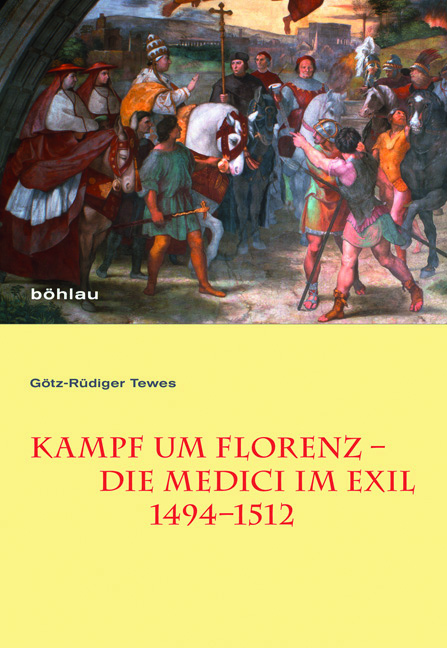
Kampf um Florenz – Die Medici im Exil (1494–1512)
By (author) Götz-Rüdiger Tewes
Hardback (Published)
(January 2011)
ISBN: 9783412206437
7.2 x 9.69 inches
Price: $225.00
On back order
Mit den Medici verbinden sich glanzvolle Namen und Geschichten, doch zwischen Lorenzo dem Prachtigen und dem Pontifikat seines Sohnes Giovanni als Leo X. lebte die Familie 18 Jahre (1494-1512) im Exil ausserhalb von Florenz. Der Autor schildert, wie die Medici ins Exil gerieten, wie sie es bewaltigten, wie sie um ihre Reputation und um die Restitution ihrer Macht in Florenz kampften und wie sie sich dabei auf ein dichtes Netzwerk aus engen Freunden stutzen konnten. Zu den politischen und sozialen Dimensionen dieser Exilsgeschichte gehort untrennbar die wirtschaftliche. Das Buch zeigt, dass die Medici-Bank nicht wie bislang angenommen in den 1490er Jahren Bankrott ging, sondern in Gestalt bereits zuvor gegrundeter Tarnbanken weiterlebte. Die bewahrten Bankiers der Medici schufen die Basis fur den Kampf um Florenz, nicht nur dort und in Rom, sondern in ganz Europa. Werben mussten sie allerdings um die Unterstutzung der italienischen Machte, vor allem um die der Papste. So stellt sich das Exil der Medici als ein komplexes Stuck europaischer Geschichte dar. The Medici: Magnificent Names and Stories – but between the era of Lorenzo the Magnificent and the pontificate of his son Giovanni as Leo X, the family suffered 18 years of hardship in exile, a time whose investigation remained a desideratum. Especially on the base of mainly new sources, the author has now systematically analyzed the circumstances under which the Medici came into exile, how they coped with the situation, how they fought for their reputation and for the restitution of their power in Florence, and how they were able to rely on a dense network of close friends. In addition to the political and social dimensions of this exile story, comes inseparably an economic one, because it can be shown that the famous Medici Bank did not – as hitherto assumed – collapse in 1492/94, but instead persisted successfully through camouflage banks that were already established around 1480. The experienced Medici bankers created a foundation from which to fight for Florence, not only there and in Rome, but in the whole of Europe, not least in France, whose King was the Medici’s most important ally. Much more effort had to be put into soliciting the support of the italian powers, especially that of pope Alexander VI and Julius II. Latter finally caused through his conflict with the french a dramatic constellation for the Medici and their network, which led to extraordinary solutions. In this way the Medici exile presents itself as a complex part of european history.
Götz-Rüdiger Tewes ist habilitierter Historiker und lehrt mittelalterliche Geschichte an der Universität zu Köln.
- By (author) Götz-Rüdiger Tewes
Similar Books
 «Solazoxa festa, stradolze e stracomplia»
Festschrift für Raymund Wilhelm zum 65. Geburtstag mit Beiträgen zu Diskurstraditionen und mittelalterlicher Philologie
Volume 249
 A Collaborative Tapestry in Honour of Shirley Ann Brown / Une fresque brodée en l’honneur de Shirley Ann Brown
The Bayeux Tapestry Seen by her Colleagues and Friends / La Tapisserie de Bayeux vue par ses collègues et amis




 As Messianism Turns to Heresy
The Regenstein Chair Lectures On Lurianic Kabbalah and Shabbatai Tzevi at Hebrew Union College - Cincinnati
 Balthasar Caymox of Nuremberg
Early Modern German Print Publishers: Popular Prints of the Seventeenth Century

 Behind the Scenes of Medieval Roofs
An Overview of the Roofing Systems of Italian Churches
Volume 90


 Beyond Sovereign Courts
Agents and Practices in Early Modern Spanish and Habsburg Diplomacy
Volume 3

 Cahiers de recherches médiévales et humanistes – Journal of Medieval and Humanistic Studies
Volume 51


 Circulation, Use, Impact
The Consumption of Architectural Books in the Early Modern Eastern Adriatic
Volume 1




 Councils, Conflicts, Correspondence
Urban Diplomacy in Reval (Tallinn) and Lübeck (c. 1470–1570)
Volume 67






 Food Security under Armed Conflict
Global Knowledge Landscape and Public Attention to Social, Economic, and Humanitarian Dimensions


