
I Methoni Kai I Istoria
I Venetia Kai I Eksousia (Modon and History: Venice and Power)
by Panayotis Foutakis

Modon and History: Venice and Power. Modon is the name given by the Venetians to the town of Methoni, Messenia, in Greece. Will appeal to the general reader with an interest in Venice’s empire as well as to the academic historian. 438 illus., most in colour. Greek language text.
This monograph on the castle of Modon leads us on a journey from Homer to the 20th century, and concentrates particularly on the Venetian presence. It aims to remain accessible to the general reader, and explores certain themes that until now have been shrouded in darkness: the correct name of Modon, its ancient walls and coins, the written and pictorial evidence for the castle, the structure of its Venetian administration, the deciphering and identification of the 27 coats of arms of Modon, the history of the lion of Venice, the study of the 18 lions, embedded in the walls, the discovery of the real attribution of the wrongly named Morosini, column, the restoration of the name of the so-called Villehardouin tower, the examination and reading of the mason’s mark of the central gate, the finding of the correct original name of the eight-sided tower of the mole, which is still called by its Turkish name Bourtzi, and the identification of the Mediaeval form of the old harbour. When the restoration of the castle is secured, excavations will be able to bring to light those treasures still hidden in once-rich. Modon. Some of these treasures will demonstrate a privileged development, others will bring out a particular sensitivity. Some are buried, under the ground, some others have fallen into the sea, but all of them are locked up in a talkative silence. Time and Man have shifted and accumulated the soil, burying valuable evidence of the past. Nature’s fury threw down buildings and sent to the depths the ships that ignored her caprices. Everything that escaped the earthquakes, conquerors, and the antiquities looters remains under earth and stones. The most valuable treasures are those that do not, gleam, as long as there are those that value the knowledge they reveal. The debt to cultural heritage is incalculable; the damage it has suffered, great; concern for its preservation, however, is small, for the time being. It is good for people to dream; but it is safer to know what they must do when they wake up.
- By (author) Panayotis Foutakis
Similar Books


 Behind the Scenes of Medieval Roofs
An Overview of the Roofing Systems of Italian Churches
Volume 90
 Caesar’s Visions and Impact on the Roman Empire
Revisiting the Archaeological and Historical Record of the 40s BC
Volume 2

 Circulation, Use, Impact
The Consumption of Architectural Books in the Early Modern Eastern Adriatic
Volume 1


 Etruscan and Roman Hellenistic Anatomical ex votos
Reassessing Popular Religious Expressions in Central Italy
Volume 8




 Invisible Labour in Antiquity
Visualizing Obscure Work in the Ancient Mediterannean and West Asia
Volume 1
 Late Antique villae in the Balkans (3rd–7th c. AD): Current Research Questions and Perspectives
HAEMUS Companion to the Late Antique Balkans 1
Volume 4


 Portraying the Individual in the Roman East
Local–Imperial Entanglements in Sculpture, Mosaics, and Paintings (First–Fourth Centuries AD)
Volume 18

 Small Worlds and Relational Agencies: Local Societies in Early Medieval Iberia
Pequeños mundos y Agencias relacionales: Sociedades locales altomedievales en la Península Ibérica


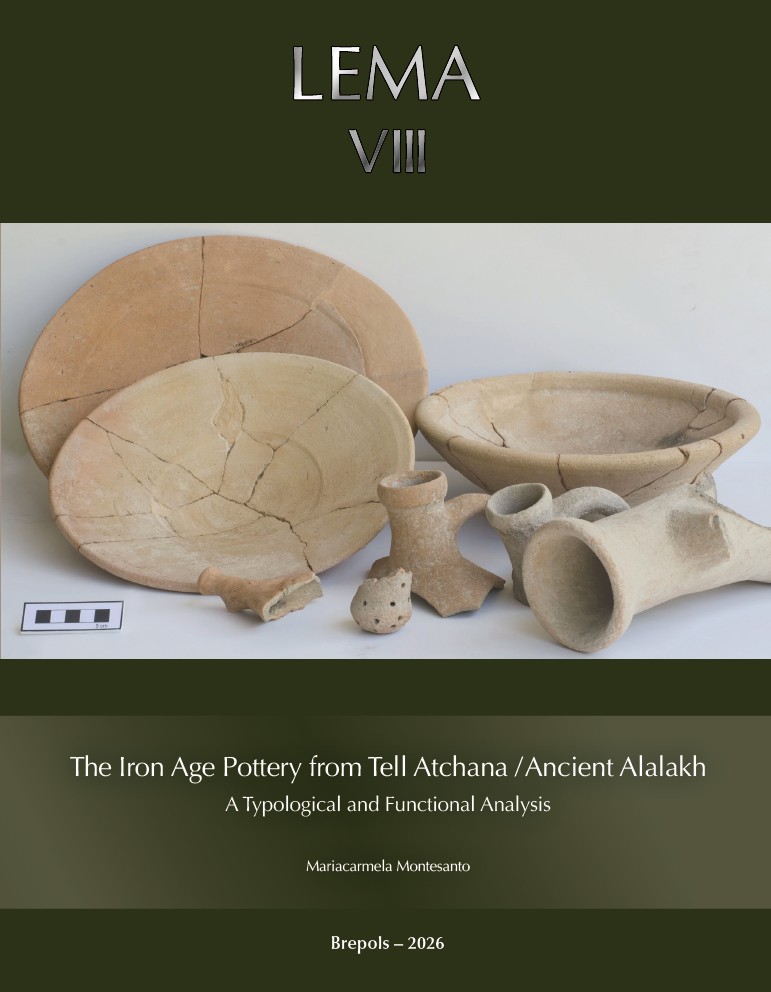 The Iron Age Pottery from Tell Atchana / Ancient Alalakh
A Typological and Functional Analysis
Volume 8


 Visual Memory and Oblivion
Monuments and Conflicts in Urban Spaces in Central and Eastern Europe from the Nineteenth Century to the Present Day

 Writing in the Church of the Nativity in Bethlehem
Inscription and Graffiti in a Multilingual and Multigraphic Perspective
Volume 45


 Atlante tematico di topografia antica 36-2026
Urbanistica e monumenti, porti, Roma. Ricerche sui monti Aurunci
Volume 36
 Cerámica común romana y ciclo haliéutico
Análisis de los contextos de las cetariae de Iulia Traducta
 Die Entwicklung erdbebensicherer Bautechniken in der Frühen und Mittleren Eisenzeit in Ostanatolien
Volume 11

 La chiesa di San Francesco grande e l’ospedale antico di Padova
Archeologia Storia Arte Architettura e Restauri
Volume 8