
Hieronymus Ammon, Imitatio Crameriana (Nuremberg 1649)
Edited by S Modersheim

In 1649 Hieronymus Ammon, a town lawyer in Nuremberg, published a sophisticated bilingual emblem book in Latin and German under the title Imitatio Crameriana. The book is a compilation of forty heart emblems, imitations of Daniel Cramer’s Emblemata Sacra. At this time Nuremberg was a centre of economic and political power, and boasted a thriving culture. The town’s poets had a serious interest in rhetoric and poetics, and they showed an appreciation for the vernacular culture that was being promoted by the Sprachgesellschafften. In this context the notion of imitatio is important as a theory of learning and translation. Imitating classical patterns was considered a means to develop style through independent variation. Cramer’s heart emblems were considered by Ammon and his friends as an ideal model. Even more so because they adhered to orthodox protestant dogma. Thus these emblems fulfilled the expectations of erudition and wit, while satisfying protestant principles of scripture. Most of the biblical mottoes were texts used for daily sermons in the Lutheran church. The substantial introduction is followed by a list of Ammon’s Latin mottoes which are juxtaposed with their source mottoes in Cramer’s emblems and accompanied by English translations; there is also a second list of the key motifs in the emblem pictures.
In 1649 Hieronymus Ammon, a town lawyer in Nuremberg, published a sophisticated bilingual emblem book in Latin and German under the title Imitatio Crameriana. The book is a compilation of forty heart emblems, imitations of Daniel Cramer’s Emblemata Sacra. At this time Nuremberg was a centre of economic and political power, and boasted a thriving culture. The town’s poets had a serious interest in rhetoric and poetics, and they showed an appreciation for the vernacular culture that was being promoted by the Sprachgesellschafften. In this context the notion of imitatio is important as a theory of learning and translation. Imitating classical patterns was considered a means to develop style through independent variation. Cramer’s heart emblems were considered by Ammon and his friends as an ideal model. Even more so because they adhered to orthodox protestant dogma. Thus these emblems fulfilled the expectations of erudition and wit, while satisfying protestant principles of scripture. Most of the biblical mottoes were texts used for daily sermons in the Lutheran church. The substantial introduction is followed by a list of Ammon’s Latin mottoes which are juxtaposed with their source mottoes in Cramer’s emblems and accompanied by English translations; there is also a second list of the key motifs in the emblem pictures.
- Edited by S Modersheim
Other Titles in this Series
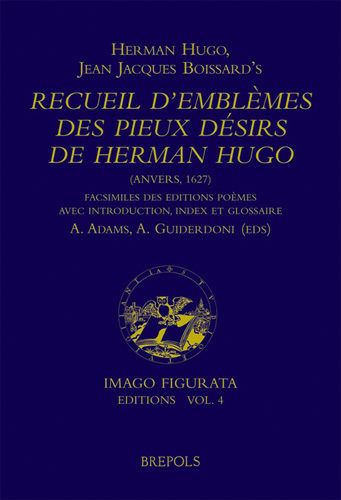 Recueil d’emblemes des Pieux Desirs de Herman Hugo (Anvers, 1627)
Facsimile des poemes avec introduction, index et glossaire
Volume 6
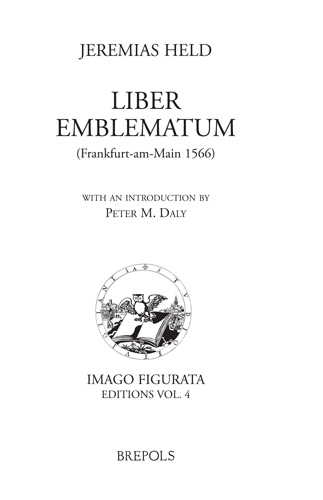 Jeremias Held. ‘Liber Emblematum’ (Frankfurt-am-Main 1566)
'Liber Emblematum' (Frankfurt-am-Main 1566)
Volume 4
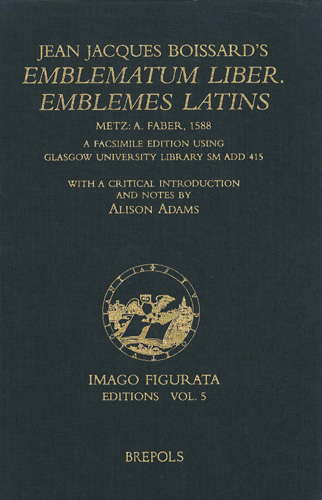 Jean Jacques Boissard’s Emblematum liber / Emblemes latins (Metz,1588). Metz, A. Faber, 1588
Facsimile Edition Using Glasgow University Library SM Add 415, with a Critical Introduction and Notes
Volume 5
Similar Books
 A Collaborative Tapestry in Honour of Shirley Ann Brown / Une fresque brodée en l’honneur de Shirley Ann Brown
The Bayeux Tapestry Seen by her Colleagues and Friends / La Tapisserie de Bayeux vue par ses collègues et amis




 Ars Prophetica
Theology in the Poetry of Twentieth-Century Hebrew Poets Avraham Halfi, Shin Shalom, Amir Gilboa, and T. Carmi


 Balthasar Caymox of Nuremberg
Early Modern German Print Publishers: Popular Prints of the Seventeenth Century


 Cahiers de l’Association internationale des études françaises
J. M. G. Le Clézio - Enseigner les littératures francophones aujourd’hui - Récit de soi et expérience de l’illusion (XVIIe-XVIIIe siècles)
Volume 78
 Cahiers de littérature française
Les Métamorphoses du texte. Enjeux intertextuels et transpositions visuelles
Volume 25
 Cahiers de recherches médiévales et humanistes – Journal of Medieval and Humanistic Studies
Volume 51
 Cahiers de sémiotique des cultures
Ponctuation et sens. Nouvelles perspectives / Punctuation and meaning. New perspectives
Volume 6


 CompLit
Myth, Folklore and Magic in European Literatures. Critical and Contemporary Reconfigurations


 Dis/United States of Vulnerability
Literary and Cultural Transgressions in U.S. Poetry Since the 1960s
Volume 330


 ENTANGLED AFRICA
Intra-African Relations Between Rain Forest and Mediterranean from Around 4,000 BCE to 1,500 CE

 European Drama and Performance Studies
Dramatisations politiques. Théâtre, politique et idéologie au XIXe siècle (1806-1914)
Volume 27


