
Das Poseidonheiligtum bei Akovitika in Messenien
Struktur und Entwicklungszusammenhang eines regionalen Zentrums. Ergebnisse einer Notgrabung 1969 und einer Nachuntersuchung mit Prospektion 2005
Edited by Moritz Kiderlen Edited by Petros G. Themelis
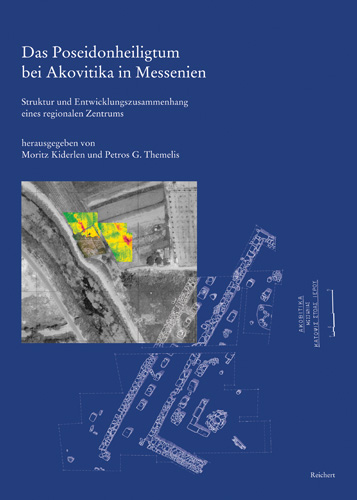
Hardback (Published)
(February 2011)
ISBN: 9783895007286
8.86 x 12.4 inches
Price: $192.00
In stock
Named after a suburb of the present city of Kalamata, the Poseidon sanctuary of Akovitika achieved considerable importance in the early Iron Age, even though it was surrounded by coastal swamps, which made staying there difficult. In light of this paradoxical finding, the interdisciplinary research campaign from 2005, which followed a rescue excavation of 1969, worked on the following questions: How can the development of the landscape and the geographical settlement context be reconstructed? What factors could have been decisive for the choice of the settlement location? Can the relevant parties that were active in the sanctuary, the catchment area, and the economic situation of the sanctuary be determined? What was the political function of the sanctuary before and after the laconic territorial state through to the current Messinia?
English summary: Named after a suburb of the present city of Kalamata, the Poseidon sanctuary of Akovitika achieved considerable importance in the early Iron Age, even though it was surrounded by coastal swamps, which made staying there difficult. In light of this paradoxical finding, the interdisciplinary research campaign from 2005, which followed a rescue excavation of 1969, worked on the following questions: How can the development of the landscape and the geographical settlement context be reconstructed? What factors could have been decisive for the choice of the settlement location? Can the relevant parties that were active in the sanctuary, the catchment area, and the economic situation of the sanctuary be determined? What was the political function of the sanctuary before and after the laconic territorial state through to the current Messinia? German description: Das nach einem Vorort der heutigen Stadt Kalamata benannte Poseidonheiligtum von Akovitika gewann in der fruhen Eisenzeit betrachtliche Bedeutung, obwohl es von Kustensumpfen umgeben war, die den Aufenthalt schwierig machten. Vor dem Hintergrund dieses paradoxen Befundes bearbeitete die interdisziplinare Forschungskampagne von 2005, die an eine Notgrabung des Jahres 1969 anschloss, folgenden Fragen: Wie ist die Entwicklung des landschaftlichen und siedlungsgeographischen Kontextes zu rekonstruieren? Welche Faktoren konnten fur die Platzwahl bei der Grundung ausschlaggebend gewesen sein? Konnen die im Heiligtum prasenten Akteure, der Einzugsbereich und die Konjunkturen des Heiligtums ermittelt werden? Worin bestand die politische Funktion des Heiligtums vor und nach dem Ausgreifen des lakonischen Territorialstaates auf das heutige Messenien?
- Edited by Moritz Kiderlen
- Edited by Petros G. Themelis
"Review - German ""Le chercheur [M. Kiderlen] dispose donc avec cette publication d'une etude complete du site, de son materiel et de l'interaction entre l'homme et son environnement dans un contexte historique et geographique large ; on souhauterait bien sur disposer d'autres etudes de ce type pour que les comparaisons soient possibles.""Helene ,AurignyIn: L'antiquite classique. 81 (2012). S. 332-334.------------------------------------"
—
“Le chercheur [M. Kiderlen] dispose donc avec cette publication d’une étude complète du site, de son matériel et de l’interaction entre l’homme et son environnement dans un contexte historique et géographique large ; on souhauterait bien sûr disposer d’autres études de ce type pour que les comparaisons soient possibles.”<br/><br/>Hélène ,Aurigny<br/><br/>In: L’antiquité classique. 81 (2012). S. 332-334.<br/><br/>------------------------------------<br/><br/>„Auch wenn die Ergebnisse der Grabung von 1969 und der Neuaufnahme der Funde und Befunde von 2005 keine gesicherten Rekonstruktionen und Interpretationen zulassen, ist doch festzustellen, daß die Hypothesen von Themelis und Kiderlen gut begründet sind. Auf jeden Fall handelt es sich bei der Publikation um einen Gewinn für die Archäologie: Die Befunde besitzen architekturgeschichtliche Relevanz, und die Kenntnis des Ortes ist angesichts der vielen weißen Stellen in der Topographie Messeniens von großer Bedeutung. Nicht zuletzt aber wurde hier auch die Chance zur Vorlage einer Altgrabung durch die Zusammenarbiet von griechischen Behörden mit Dritten genutzt, die in Form und Inhalt Respekt abnötigt. Den Herausgebern ist nicht nur zu den Ergebnissen, sondern auch zum Mut der Publikation einer Altgrabung zu gratulieren!“<br/><br/>Thomas Mattern<br/><br/>In: Gnomon. 84 (2012) Heft 7. S. 624-627.<br/><br/>------------------------------------<br/><br/>„Die in Englisch und Deutsch (teilweise mit paralleler Übersetzung) verfassten Beiträge präsentieren die Ergebnisse der Untersuchungen, die u.a. auch die siedlungsgeographische Einbindung berücksichtigen (S. 13-36). Daran schliesst eine Reihe von Spezialuntersuchungen zu Geoarchäologie, Geophysik und archäologischen Profilen an, zusammen mit den detaillierten Katalogen der Dachziegel, der Keramik und der Metallfunde (S. 37-135). Abgeschlossen wird der Band mit drei Exkursen, unter anderem zum oben erwähnten Dipinto (S. 137-145), und umfangreichen bibliographischen Angaben (S. 147-159). Die restlichen Seiten nehmen die oftmals grossformatigen Fotografien, Grafiken und Zeichnungen ein, die um die ebenfalls grosszügigen Beilagen ergänzt werden. Die umfangreiche Dokumentation selbst kleinster Fragmente wäre auch für viele andere Kultplätze, auch für solche von geringerer Bedeutung, zu wünschen. Deutlich ist aber auch, dass viele Fragen offen und zu ihrer Beantwortung weitere Grabungen notwendig sind.“<br/><br/>Lorenz E. Baumer<br/><br/>In: Museum Helveticum. 69 (2012) 1. S. 114-115.<br/>----------------------------------------------------<br/><br/>„Das wichtigste Verdienst des hier vorgestellten Buches ist die vollständige Dokumentation der Funde und Befunde, die im ausgegrabenen Teil des Poseidonheiligtums von Akovitika zutage gekommen sind. Gleichzeitig macht es deutlich, wie viele offene Fragen nach wie vor mit diesem Heiligtum verbunden sind. Neue Grabungen in Akovitika werden hoffentlich eines Tages zu einer Erweiterung unseres gegenwärtigen Wissenstandes führen.“<br/><br/>Von Florian Ruppenstein<br/><br/>In: Göttinger Forum für Altertumswissenschaft 16 (2013) 1159-1172, <a target="_blank" href="http://gfa.gbv.de/dr,gfa,016,2013,r,23.pdf">http://gfa.gbv.de/dr,gfa,016,2013,r,23.pdf</a>, 13.08.2013, 15:04.
—
Similar Books

 Caesar’s Visions and Impact on the Roman Empire
Revisiting the Archaeological and Historical Record of the 40s BC
Volume 2


 Drunk the Potion, No Whit Charmed
The Doctrine of Pure and Perfect Souls from Iamblichus to Damascius

 Epiphanies of the Divine in the Septuagint and the New Testament
Fifth International Symposium of the Corpus Judaeo-Hellenisticum Novi Testamenti (CJHNT), 14-17 May 2015, Nottingham


 Etruscan and Roman Hellenistic Anatomical ex votos
Reassessing Popular Religious Expressions in Central Italy
Volume 8




 Invisible Labour in Antiquity
Visualizing Obscure Work in the Ancient Mediterannean and West Asia
Volume 1
 Language and Power in the Roman Empire and Early India
Hierarchy, Ambiguity, and the Art of Reading the Signs in Cosmopolitan Cultures
 Late Antique villae in the Balkans (3rd–7th c. AD): Current Research Questions and Perspectives
HAEMUS Companion to the Late Antique Balkans 1
Volume 4

 Nurturing the Elite
Representations of Drinking, Eating, and Religious Vessels in Palmyrene Funerary Iconography
Volume 13


 Portraying the Individual in the Roman East
Local–Imperial Entanglements in Sculpture, Mosaics, and Paintings (First–Fourth Centuries AD)
Volume 18

 Small Worlds and Relational Agencies: Local Societies in Early Medieval Iberia
Pequeños mundos y Agencias relacionales: Sociedades locales altomedievales en la Península Ibérica
 The Compositional History of the Book of Kings
An Analysis of the Evaluative Frameworks in 1 Kings 14–2 Kings 25

 The Iron Age Pottery from Tell Atchana / Ancient Alalakh
A Typological and Functional Analysis
Volume 8



 Writing in the Church of the Nativity in Bethlehem
Inscription and Graffiti in a Multilingual and Multigraphic Perspective
Volume 45
 Contesting Labeled Identities
The Sociology of Gentilics in Biblical and Northwest Semitic Literature


 After Life in Roman Paganism. L’Égypte des astrologues. Les Mages hellénisés
Introductions historiographiques
Volume 7

 Atlante tematico di topografia antica 36-2026
Urbanistica e monumenti, porti, Roma. Ricerche sui monti Aurunci
Volume 36
 Cerámica común romana y ciclo haliéutico
Análisis de los contextos de las cetariae de Iulia Traducta


 Diodor über den ersten Sklavenaufstand auf Sizilien
Ein philologischer und historischer Kommentar
Volume 67