PREFACE by Jeanne Magagna
INTRODUCTION
1. One month: the baby’s state of unintegration and primary functions of the mother
2. Two months: identity changes in the parents
3. Three months: the holding function in relation to the processes of introjection and projection (the ‘presence’ of the object)
4. Four months: regression-projection (how the baby develops real strength)
5. Five months: towards integration
6. Six months: reactions to situations involving change, loss and search for the object
7. Seven months: the personality of the baby – constitutional and environmental factors
8. Eight months: dependence on the external object
9. Nine months: the recreation of the original object – the development of the ego and its connection with reality
10. Ten months: baby parts of the adult personality; further progress made by the baby
11. Eleven months: the acquisition of mobility (crawling) and object relationships
12. Twelve months: the holding function at the end of the first year
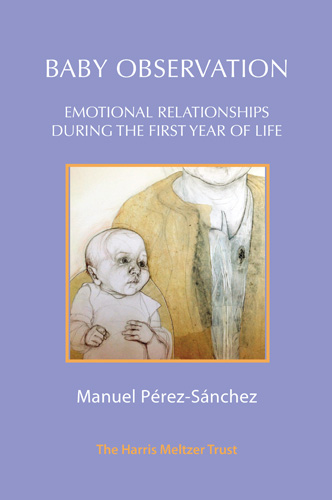
Baby Observation
Emotional Relationships during the First Year of Life
By (author) Manuel Pérez-Sánchez
Paperback (Published)
(October 2020)
ISBN: 9781912567812
5.94 x 9.09 inches
Price: $40.00
On back order
A vivid description of a baby’s first year of life.Original edition 1990 (Clunie Press). New edition 2021 with foreword by Jeanne Magagna.
Manuel Perez-Sanchez has presented a very vivid description of a baby’s first year of life. Direct observational material is lent understanding through the combination of his and Esther Bick’s thoughts regarding the weekly infant observations. We read how the baby progresses from a state of unintegration in which the anxious baby requires the containing presence of the parents and uses primitive bodily methods of providing protection against anxiety in their absence. We then move to a more comfortable stage in which the baby has introjected the parents as providing a sense of internal security. We see how each step in the baby’s development involves a reciprocal change in the parents’ relationship to the baby.
- By (author) Manuel Pérez-Sánchez
Similar Books
 Attics and Basements
The Evocative, Expressive and Embracing Functions of Homes and Other Human Dwellings















 Die Erhebung und Bewertung von Zeugenaussagen im Strafprozess
Juristische, aussagepsychologische und psychiatrische Aspekte. Bd. 9





 Kann man Filterblasen platzen lassen?
101 Fragen und Antworten rund um Verschwörungstheorien, Fake News und ideologische Überzeugungen