
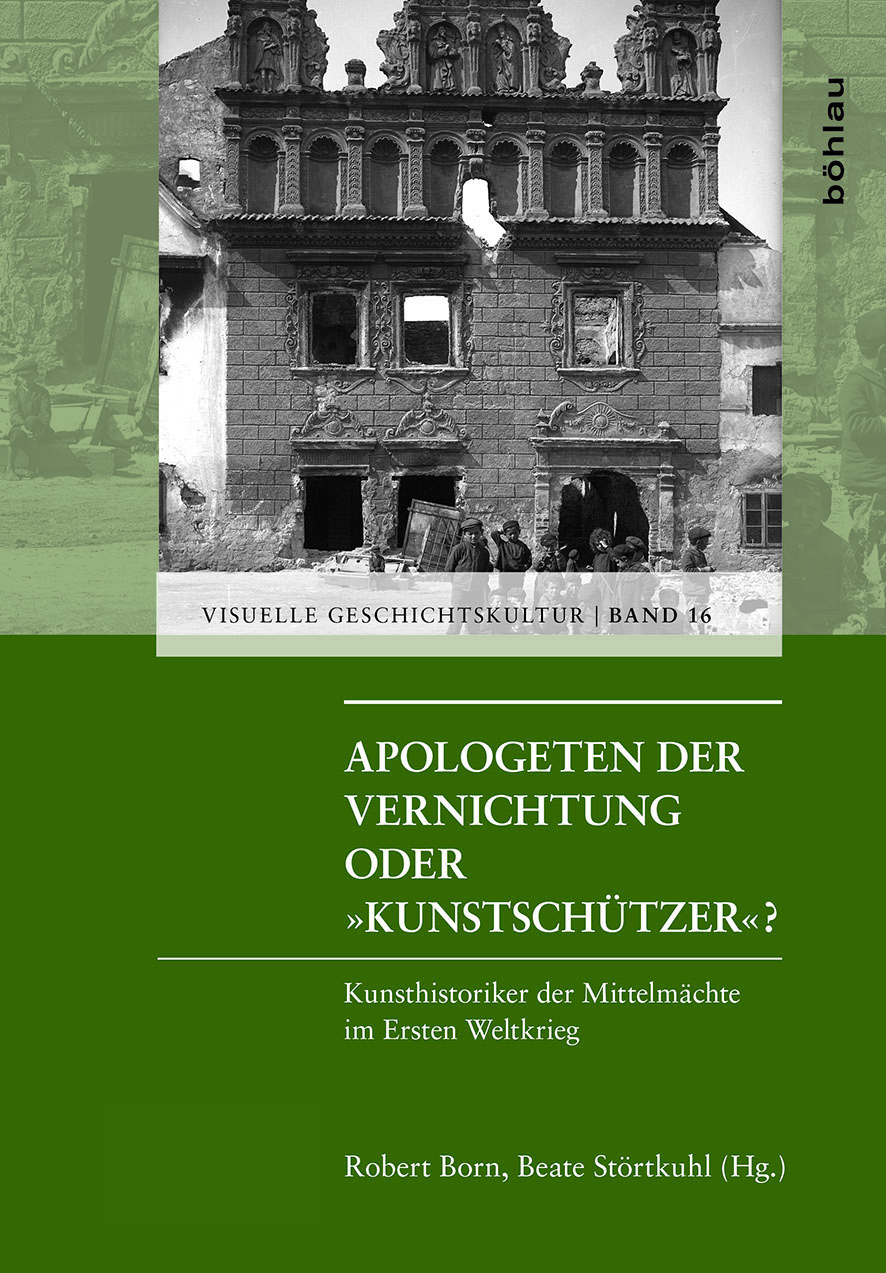
Apologeten der Vernichtung oder »Kunstschützer«?
Kunsthistoriker der Mittelmächte im Ersten Weltkrieg
Contributions by Christoph Roolf Contributions by Karin Reichenbach Contributions by Giuseppina Perusini Contributions by Heino Neumayer Contributions by Laima Lauckaite Contributions by Christina Kott Contributions by Franko Coric Contributions by Christian Marchetti Contributions by Hildegard Frübis Contributions by Ewa Manikowska Contributions by Evonne Levy Contributions by Almut Goldhahn Edited by Robert Born Edited by Beate Störtkuhl
Hardback (Published)
(February 2017)
ISBN: 9783412507169
6.69 x 9.49 inches
Price: $82.00
On back order
Der Erste Weltkrieg war der erste militarische Konflikt, in dem die Geisteswissenschaften Aufgaben der Propaganda ubernahmen. Im Herbst 1914, nach den Zerstorungen in Reims und Leuven, starteten die Mittelmachte mit dem “Kunstschutz” eine Kampagne, die den Vorwurf “deutscher Barbarei” in der Kriegsfuhrung widerlegen sollte. Die Aktivitaten des “Kunstschutzes” umfassten alle Kriegsschauplatze, die bisherige Forschung blieb jedoch auf Belgien und Frankreich konzentriert. Dieser Band behandelt den Themenkomplex erstmals in vergleichender Perspektive und legt dabei den Schwerpunkt auf die Regionen des ostlichen und sudostlichen Europa. Die Beitrage untersuchen, welche Interessen die deutschen und osterreichischen Wissenschaftler – u. a. Kunsthistoriker, Archaologen, Ethnologen – in den jeweiligen Besatzungsgebieten leiteten, welche Schutz- und Wiederaufbaumassnahmen sie tatsachlich initiierten, ob und in welcher Form es zu Interferenzen mit Fachkollegen vor Ort kam.
- Contributions by Christoph Roolf
- Contributions by Karin Reichenbach
- Contributions by Giuseppina Perusini
- Contributions by Heino Neumayer
- Contributions by Laima Lauckaite
- Contributions by Christina Kott
- Contributions by Franko Coric
- Contributions by Christian Marchetti
- Contributions by Hildegard Frübis
- Contributions by Ewa Manikowska
- Contributions by Evonne Levy
- Contributions by Almut Goldhahn
- Edited by Robert Born
- Edited by Beate Störtkuhl
Other Titles in this Series
 Denkmalschutz – Architekturforschung – Baukultur
Entwicklungen und Erscheinungsformen in den baltischen Ländern vom späten 19. Jahrhundert bis heute
Similar Books
 A Collaborative Tapestry in Honour of Shirley Ann Brown / Une fresque brodée en l’honneur de Shirley Ann Brown
The Bayeux Tapestry Seen by her Colleagues and Friends / La Tapisserie de Bayeux vue par ses collègues et amis



 Balthasar Caymox of Nuremberg
Early Modern German Print Publishers: Popular Prints of the Seventeenth Century


 ENTANGLED AFRICA
Intra-African Relations Between Rain Forest and Mediterranean from Around 4,000 BCE to 1,500 CE


 Gold, Silver and Glass: Power Networks, Cultural Identities, Technology Transfers and Agency across the Old World (7th Century BC – 1st Century AD)
Proceedings of a Conference Held at the British Museum, 16–18 June 2023


 Legal Visuality
Exegesis, Ambiguity, and Dissimulation of the Donation of Constantine in the Early Modern Period
 Listening to the Swan Song
More-than-Human Beings and Sounds in Literature and Culture Through the Ages


 Monastic Manuscripts from the Eastern Mediterranean (Sinai, Jerusalem, Antioch)
Production, Use, and Contexts

 Naples as Laboratory / Laboratorium Neapel
Style Options, Artistic Rivalry and Self Fashioning in Neapolitan Baroque Painting / Plurale Stilbildung, Kunstlerkonkurrenz und Self Fashioning in der neapolitanischen Barockmalerei

 Nurturing the Elite
Representations of Drinking, Eating, and Religious Vessels in Palmyrene Funerary Iconography
Volume 13


 Portraying the Individual in the Roman East
Local–Imperial Entanglements in Sculpture, Mosaics, and Paintings (First–Fourth Centuries AD)
Volume 18


 Technical Studies of Asian Art
Proceedings of the Seventh Forbes Symposium at the Freer Gallery of Art


