A Better World Is Possible
An Exploration of Utopian Visions
by Ambrose Ih-ren Mong

Paperback (No longer our product)
(October 2018)
ISBN: 9780227176924
6.1 x 9.17 inches
Price: $45.00
In stock
A study of utopian thought in Western and Chinese traditions, bringing out the differences and similarities in their visions of a better, more just world.
Paradise has been widely perceived as somewhere on ocean islands or in distant mountains where people come together to set up tightly-knit societies so they can live, work and worship in harmony and peace. For the first-time ever, in this widely-researched work that bridges the utopian ideas and visions of East and West, Ambrose Mong explores the writings of influential thinkers from ancient China to Renaissance Europe and today, including Thomas More, Teilhard de Chardin, Confucius and Mo Tzu,and even twentieth century political reformist Kang Youwei.
- By (author) Ambrose Ih-ren Mong
"Ambrose Mong's latest book compares and contrasts eastern and western philosophical conceptions of a better world. ... Himself a Catholic priest who grew up between east and west in Singapore, Ambrose draws inspiration from the writings of Teilhard de Chardin (a Jesuit forbidden by his superiors from teaching religion) on a united humanity. A Better World Is Possible asks more questions than it answers, but they are questions which define our times."George Yeo, Singapore Foreign Minister (2004-2011)"In this book, Ambrose Mong takes up the age-old question of whether it is possible and even necessary for humans to imagine a better world, and more importantly, how to bring it about. Practicing what is called 'intercultural imaginary', Mong skillfully brings together the Western ideals of utopia as 'no place' and the Eastern conceptions of it as 'a better place' and produces one of the most enriching and challenging vision of a future that may be called the Reign of God as it has been inaugurated in the death and resurrection of Jesus. Written in his trade-mark lucid style and undergirded by a vast erudition, [this book] joins the rank of classics in political philosophy and Christian ethics such as Thomas More' Utopia, with a much-needed intercultural and interreligious approach unknown to its illustrious predecessor."Dr Peter C. Phan, The Ignacio Ellacuria, SJ Chair of Catholic Social Thought, Department of Theology, Georgetown University"In this volume ... Mong explores the fascinating possibilities of Utopia, asking whether 'a better world' is possible. His scholarship is meticulous. His writing is crystal clear. His vision is hope- and faith-filled."Stephen Bevans, SVD, Louis J. Luzbetak, SVD Professor of Mission and Culture, EmeritusCatholic Theological Union, ChicagoUtopia is by no means a purely western invention, people all over the world long for a better world. The book offers inspiring reading and motivation for it.Christian Tauchner, SVD, Bibliographia, pp.161-2
—
Similar Books


 Drunk the Potion, No Whit Charmed
The Doctrine of Pure and Perfect Souls from Iamblichus to Damascius
 Éthique, politique, religions
Superstition (XVIIe - XXIe siècles). Sémantique, histoires et cultures


 La Lettre clandestine
La littérature philosophique clandestine, ses éditeurs et ses éditions
Volume 34
 Libertinage et philosophie à l’époque classique (XVIe-XVIIIe siècle)
Athéisme, Modernité et Sécularisation / Atheism, Modernity and Secularization
Volume 23


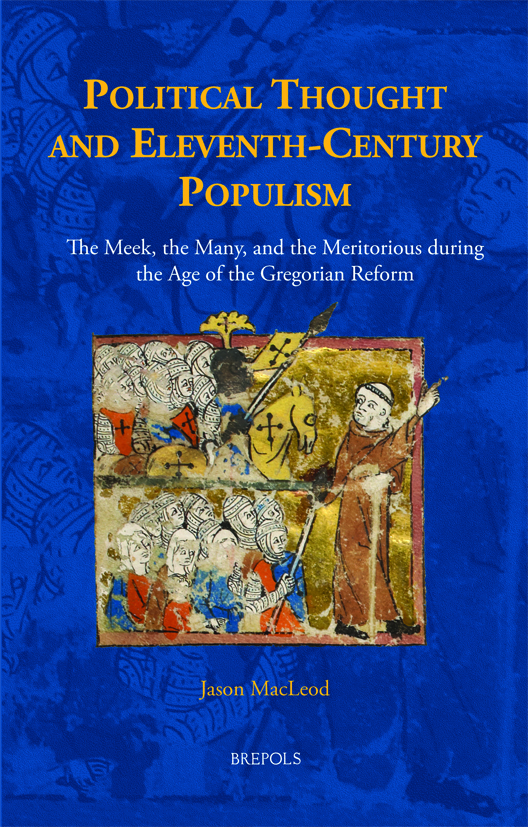 Political Thought and Eleventh-Century Populism
The Meek, the Many, and the Meritorious during the Age of the Gregorian Reform
Volume 38


 The Latin Hermes in Translation
Asclepius, Glosses on Trismegistus, Book of Six Principles of Things, Book of 24 Philosophers
Volume 50



 ‘Emergente Evolution’?
Fallstudien zur philosophischen Rekonstruktion und schopfungstheologischen Rezeption eines naturalistischen Paradigmas
Volume 40
 Al-Ğābirīs Genese und Kritik der Arabischen Vernunft
On Genesis and Critique of Arab Reason by Muḥammed ʿĀbid al-Ğābirī


 Das Dasein und das isolierte Subjekt
Die Frage der philosophischen Selbstinterpretation des Menschen bei Heidegger


 Der Geist des Menschen und die originäre Erfahrung der Zerbrechlichkeit
Eine philosophisch-theologische Grundlegung nach Edith Stein im Dialog mit der medizinischen Anthropologie und der existentiellen Psychologie