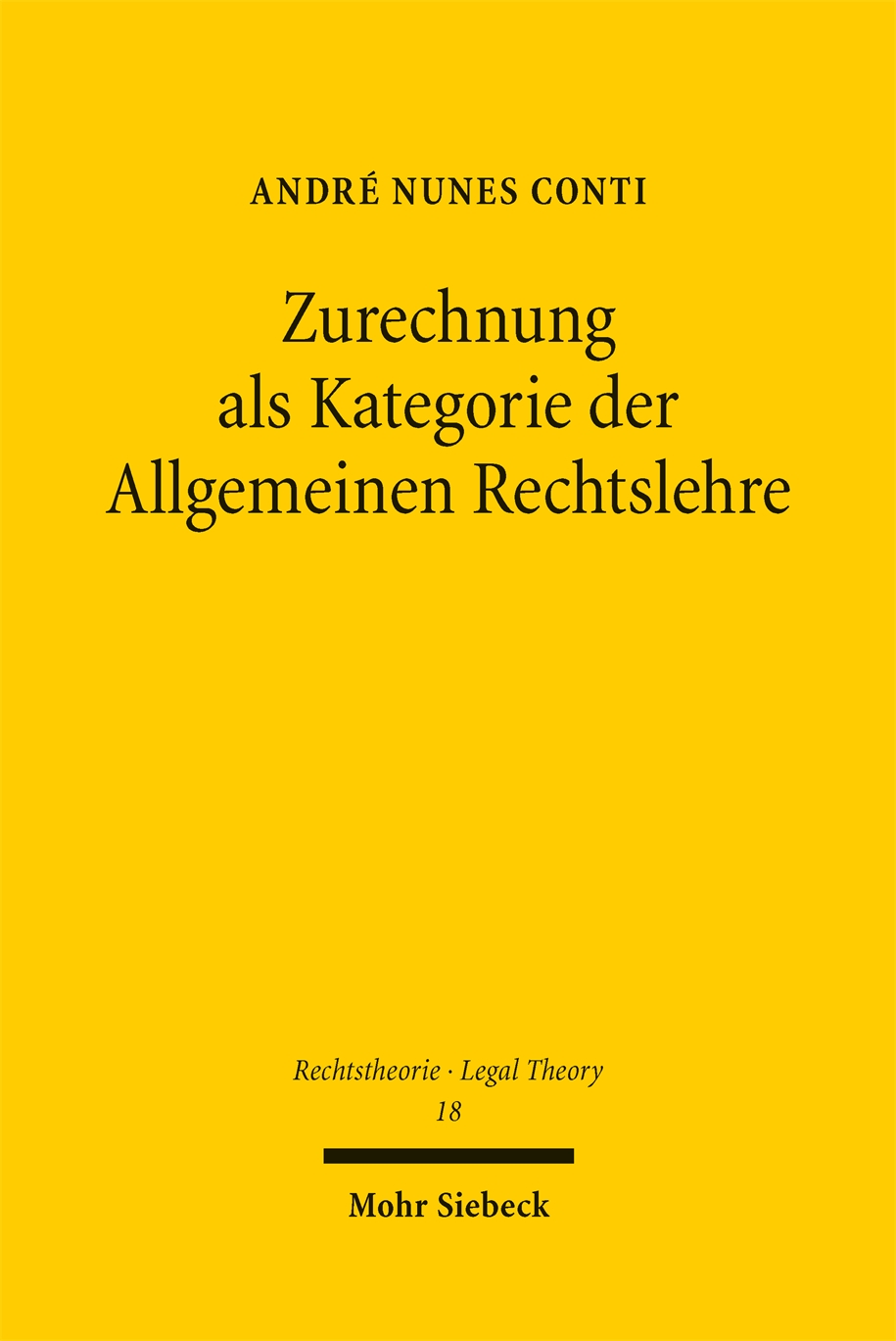
Zurechnung als Kategorie der Allgemeinen Rechtslehre
Eine rechtstheoretische Untersuchung zur Definition, Entwicklung und Aufgabe des Zurechnungsbegriffs
Hardback (Published)
(October 2026)
ISBN: 9783162011114
6.1 x 9.13 inches
Price: $171.00
The concept of attribution is ubiquitous in law, yet its overall contours often appear fragmented. Drawing inspiration from Wittgenstein, André Nunes Conti examines legal language and its historical foundations in order to systematically elucidate and more precisely define this fundamental legal category.
The concept of attribution plays a pivotal role across all fields of law in the application of legal rules, yet legal scholarship often perceives it as inconsistent and fragmented. Addressing this common observation, the present study adopts a complementary perspective at the level of analytical legal theory, seeking to supplement existing research focused on substantive law. Drawing on the tradition of General Jurisprudence and inspired by the philosophy of Ludwig Wittgenstein, André Nunes Conti concentrates on the formal dimension of legal language in order to contribute to greater conceptual clarity.
Methodologically, the study proceeds in three steps. First, it undertakes a philosophical analysis of the concept, locating attribution both formally and logically within legal norms and pragmatically within legal reasoning and justification. Building on this foundation, the work offers a historical contextualization of the concept through key turning points in legal thought, from Baldus de Ubaldis and Samuel Pufendorf to Hans Kelsen. It demonstrates that the technical concept of attribution rests historically on two equally significant theological paradigms: on the one hand, the freedom-oriented attribution of actions developed in moral theology, and on the other, the chance-oriented attribution to third parties found in Christian doctrines of justification.
Finally, the study applies the resulting concept to contemporary law in order to examine whether it reveals comparable structural patterns across different areas of the legal system. Its scholarly aim is to provide a concept that is formally robust and analytically productive, facilitating the comparative examination of a wide range of legal problems through a balanced combination of conceptual precision and systematic clarity.
Other Titles in this Series
 Urbane Ungleichheit im Verfassungsrecht
Zum Einfluss des Verfassungsrechts auf Raum, Macht und Teilhabe in der Stadt

 Rechtswerdung
Der Produktionsprozess von Normen und Institutionen des Rechts unter Einbeziehung geistesphilosophischer, handlungstheoretischer und sozialontologischer Erkenntnisse
Volume 8
 Maßstabsinterpretation
Die Auslegung verfassungsgerichtlicher Maßstäbe aus pragmatistischer Perspektive
 Pfadabhangigkeit und Recht
Rechtswissenschaftliche Rezeption eines sozialwissenschaftlichen Konzepts. Zugleich ein Theorieangebot zur Erklarung informeller Strukturbildung im Recht
Volume 9
 Rechtswidriges Recht
Die Merkl-Sander-Kontroverse innerhalb der Wiener Schule der Rechtstheorie
Volume 10
 Delegierte Verfassungsentwicklung
Eine Studie uber das Verhaltnis von Entstehungs- und Geltungszeit in der Verfassungsanwendung unter besonderer Berucksichtigung der jungeren US-amerikanischen Methodendebatte
Volume 12


 Rechtssprachliche Kommunikation
Im Kontext von Zivilrecht, EU-Recht, Rechtsvergleichung und schiedsrichterlichem Verfahren
Volume 6
 Zurechnung im Recht
Ein Beitrag zur Entwicklung einer allgemeinen Zurechnungslehre am Beispiel des Rechts der politischen Parteien
Volume 7
 Metamethodik des juristischen Entscheidens
Notwendigkeit, Grenzen und Prämissen methodischer Entscheidungsbegründung
 Die Systematisierung des islamischen Rechts
Ein Beitrag zur Geschichte teleologischen Naturrechtsdenkens
Volume 3


Similar Books


 Drunk the Potion, No Whit Charmed
The Doctrine of Pure and Perfect Souls from Iamblichus to Damascius
 East Meets West: Justice, Law, and Politics
The 13th Kobe Lecture and the 2nd IVR Japan International Conference, Chiba, September 2023
 Éthique, politique, religions
Superstition (XVIIe - XXIe siècles). Sémantique, histoires et cultures
 False Friends in Comparative Law
Advantages and Risks of Legal Transplants in Civil Law – the Polish-German Perspective


 La Lettre clandestine
La littérature philosophique clandestine, ses éditeurs et ses éditions
Volume 34
 Law, Economics, and Inequalities in the Welfare State
Proceedings of the Special Workshops held at the 31st World Congress of the International Association for Philosophy of Law and Social Philosophy in Seoul, Republic of Korea, 2024
 Legal Pluralism and the Tajik Experience of Xinjiang
Between Custom and the Chinese State: An Ethnographic Perspective
 Libertinage et philosophie à l’époque classique (XVIe-XVIIIe siècle)
Athéisme, Modernité et Sécularisation / Atheism, Modernity and Secularization
Volume 23
 Liturgia semper reformanda
Adaptations and accommodations in the liturgy in light of canon 838 of the Code of Canon Law


 Political Thought and Eleventh-Century Populism
The Meek, the Many, and the Meritorious during the Age of the Gregorian Reform
Volume 38


 The EPPO/OLAF Compendium of National Procedures: Estonia
Desktop codes on the procedural law of the Member States with annotations by national experts
 The EPPO/OLAF Compendium of National Procedures: Greece
Desktop codes on the procedural law of the Member States with annotations by national experts
 The EPPO/OLAF Compendium of National Procedures: Italy
Desktop codes on the procedural law of the Member States with annotations by national experts

 The Latin Hermes in Translation
Asclepius, Glosses on Trismegistus, Book of Six Principles of Things, Book of 24 Philosophers
Volume 50

 The Right to Regulate of Developing Countries in International Investment Law
A Contextual Approach to International Investment Agreements
Volume 11