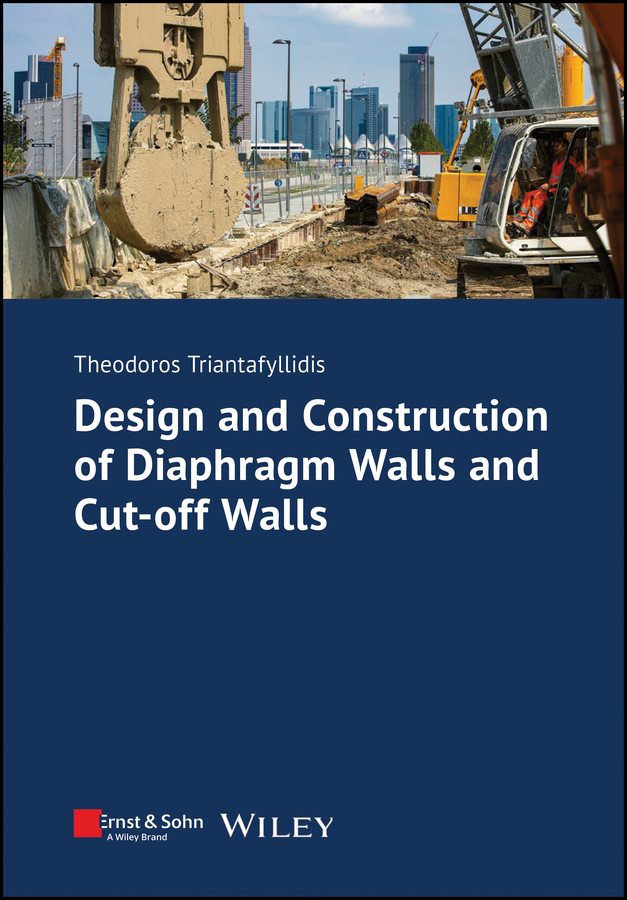
Design and Construction of Diaphragm Walls and Cut-off Walls
By (author) Theodoros Triantafyllidis Translated by Rachel Waddington
Paperback (Forthcoming)
(December 2026)
ISBN: 9783433034811
6.69 x 9.65 inches
Price: $174.00
This book provides a clear and concise overview of diaphragm wall and cut-off wall construction methods as well as their limitations. From the design stage until the execution the specialized civil engineering works are complex and very challenging requiring specific knowledge and skills. This book aims to broaden the understanding of consultants, clients and contractors regarding the challenges, limitations, and alternatives of the practical implementation by highlighting various perspectives, thereby enabling the exploration and adoption of new approaches to quality assurance.
The book provides practical guidance from design through to all execution stages, along with detailed descriptions – including graphics and photos – of the procedures, the working equipment, and the measurement or monitoring devices.
Methods of calculation and design approaches are presented clearly with examples throughout the entire construction procedure. Numerous explanations with practical examples also give important hints for the placement of reinforcement and the concreting operations as well as the installation of precast elements in the diaphragm wall. Analyses of possible wall deformations and settlements of adjacent structures due to installation processes are presented. Compositions of supporting slurry mixtures, their preparation, their rheological properties as well as testing are presented in detail. Furthermore, it reveals solutions for difficult situations that may arise due to unknown or unforeseen artificial or natural obstacles or specific site or ground conditions, which may affect the entire construction procedure.
For engineers involved in design and construction, this work represents an indispensable, up-to-date practical handbook. Drawing on his extensive experience with large-scale projects, the author provides valuable insights into the methods described that go beyond the current state of the art.
Preface
1 Introduction
1.1 Definition of quality assurance
1.2 Definition of specialised deep foundation engineering
1.3 Quality assurance in specialised deep foundation engineering
2 Diaphragm wall technique
2.1 History of the diaphragm wall technique
2.2 Areas of application
2.3 Notable example of a specialised deep foundation engineering project with diaphragm walls
2.4 Diaphragm wall construction methods
2.4.1 Two-phase construction method
2.4.2 Single-phase construction method
2.4.3 Combined construction method
2.4.4 Deep foundations with diaphragm wall elements
2.5 Description of the construction phases
2.5.1 Preliminary work
2.5.2 Construction of the guide wall
2.5.3 Dividing the wall into panels
2.5.4 Example of the dimensioning of a guide wall
2.6 Excavation
2.6.1 Grab method
2.6.2 Cutter method
2.6.3 Selection of excavation equipment
2.6.4 Special considerations during excavation
2.7 Quality assurance measures for diaphragm wall excavation
2.7.1 Monitoring the slurry level
2.7.2 Verifying the excavation depth
2.7.3 Verifying the verticality of a trench excavation
3 Supporting slurries and their properties
3.1 Density and unit weight of the slurry
3.2 Viscosity, yield strength, and thixotropy of the slurry
3.3 Model for describing slurry properties
3.4 Determining the yield strength
3.5 Additional slurry tests
3.6 Requirements for supporting slurries and clays
3.7 Designation of slurries
3.8 Testing the clay after delivery
3.9 Slurry testing (frequency and timing)
3.10 Permissible values for slurry properties
3.11 Corrective measures for improving slurry properties
3.12 Negative influences on slurry properties
4 Preparing the supporting slurry
4.1 Small mixing units
4.2 Larger mixing units
4.3 Supraton system
4.4 Regeneration units
4.5 Problems when mixing and storing supporting slurry
5 Joints and stop-end elements
5.1 Stop-end tubes
5.2 Flat joint elements
5.3 Pre-cast stop-end elements
5.4 Some special measures to improve the watertightness of joints
6 Analyses for the open trench
6.1 Stability in relation to groundwater ingress
6.2 Safety in relation to the slurry level falling below the minimum level required for structural stability
6.3 Internal trench stability analysis (sloughing and peel-off)
6.4 Gross (external) stability analysis
7 Reinforcement in diaphragm walls
7.1 Formation of reinforcement cages and recesses
7.2 Slab connections
8 Concrete pouring for a diaphragm wall element
8.1 Possible concreting defects
8.2 Remedial work on joint defects
8.3 Remedial work on diaphragm wall surfaces during pit excavation
8.4 Smooth surfaces and prevention of overbreak concrete
9 Precast diaphragm walls
10 Deformation of diaphragm walls
10.1 Measurements on diaphragm walls
10.2 Notes on the installation of measuring equipment
10.3 Deformation forecasting in deep excavations
10.4 Influences on settlement of nearby buildings
10.5 Consideration of installation effects
11 Slurry trench cut-off walls
11.1 Slurry trench cut-off wall method
11.2 Quality assurance in cut-off walls
11.3 Narrow cut-off walls
11.4 Qualification testing of cut-off wall materials
11.5 Determining the cutting resistance of
11.6 Experience with the effects of contaminants on cut-off wall materials
References
Theodoros Triantafyllidis studied civil engineering at the Technical University (TH) of Karlsruhe, where he earned his doctorate in 1984 and completed his habilitation in 1989 at the Institute of Soil Mechanics and Rock Mechanics. After moving into the construction industry, Theodoros Triantafyllidis held executive positions at specialized foundation engineering companies in Germany and abroad before being appointed to the Chair of Foundation Engineering and Soil Mechanics at Ruhr University Bochum in 1998. In 2007, he assumed the directorship of the Institute of Soil Mechanics and Rock Mechanics at the University of Karlsruhe (today: KIT Karlsruhe Institute of Technology). In 2019, he received an honorary doctorate from the University of Patras. Until 2024, Theodoros Triantafyllidis served as an inspection expert and checking engineer for the German Federal Railway Authority (EBA), conducting structural engineering inspections in geotechnical engineering and tunnel construction, and as an expert on the stability of slopes at open-pit lignite mines in North Rhine-Westphalia. Since his retirement, he has been working as a consultant for companies in Germany and abroad.
- By (author) Theodoros Triantafyllidis
- Translated by Rachel Waddington