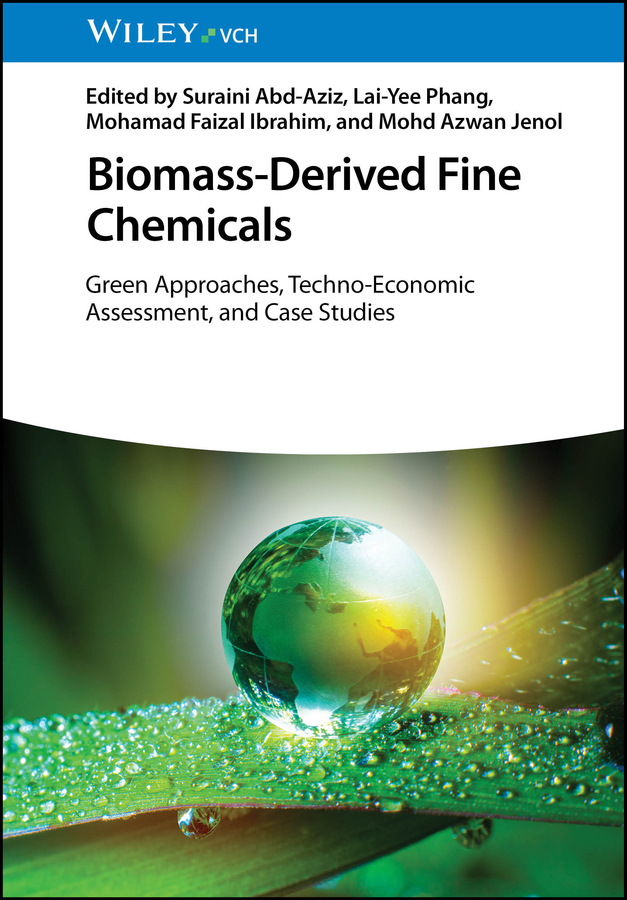
Biomass-Derived Fine Chemicals
Green Approaches, Techno-Economic Assessment, and Case Studies
Edited by Suraini Abd-Aziz Edited by Lai-Yee Phang Edited by Mohamad Faizal Ibrahim Edited by Mohd Azwan Jenol
Hardback (Published)
(November 2026)
ISBN: 9783527355877
6.69 x 9.65 inches
Price: $174.00
In stock
Sustainable fine chemical production from biomass through green chemistry
Transitioning from petroleum-based feedstocks to renewable biomass demands rigorous technical guidance. Biomass-Derived Fine Chemicals: Green Approaches, Techno-Economic Assessment, and Case Studies addresses this need directly. Edited by leading bioprocess researchers, this reference covers feedstock selection, green extraction techniques, catalytic transformations, and biotechnological approaches for producing fine chemicals from biomass under circular economy principles.
Biomass-Derived Fine Chemicals examines key platform chemicals, process intensification strategies, and techno-economic considerations for industrial-scale implementation. Coverage spans green chemistry principles applied to biomass valorization, renewable feedstock characterization, and industrial applications supported by detailed case studies. The book integrates environmental responsibility with chemical innovation, connecting laboratory-scale findings to commercially relevant production pathways for the fine chemical sector.
Readers will also find:
* Detailed analysis of green extraction methods and catalytic transformation pathways for converting biomass into high-value fine chemicals
* Techno-economic assessment frameworks that evaluate the commercial viability of biomass-derived chemical production at industrial scale
* Case studies illustrating real-world applications of biomass valorization across pharmaceutical, materials, and energy sectors
* Coverage of biotechnological advancements enabling more efficient conversion of agricultural and forestry residues into platform chemicals
* Process intensification strategies designed to optimize yield, reduce waste, and improve the sustainability of fine chemical manufacturing
Designed for chemical engineers, natural products chemists, catalytic chemists, biotechnologists, and process engineers, this reference equips both researchers and industry professionals with the technical depth needed to develop and scale sustainable biomass-derived fine chemical production. Policymakers evaluating circular economy strategies will also find its techno-economic analyses directly applicable.
Chapter 01 Introduction to Biomass Valorization and Green Chemistry
Chapter 02 Feedstock Selection and Pretreatment Strategies
Chapter 03 Catalytic and Green Solvent-Assisted Biomass Conversion
Chapter 04 Thermochemical and Biochemical Conversion Pathways
Chapter 05 Biocatalysis and Enzyme-Based Transformations
Chapter 06 Biomass-Derived Platform Chemicals for Fine Chemical Production
Chapter 07 Process Intensification, Technoeconomic Feasibility and Life Cycle Assessment
Chapter 08 Policy, Regulations, and Market Trends in Biomass-Based Fine Chemicals
Chapter 09 Case Studies on Industrial and Academic Research Innovations
Chapter 10 Future Perspectives and Challenges in Green Biomass Utilization
Suraini Abd-Aziz is a Professor at the Department of Bioprocess Technology, Faculty of Biotechnology and Biomolecular Sciences, Universiti Putra Malaysia. She is currently the Deputy Secretary General, Academic Committee (Scientific Divisions), Asian Federation of Biotechnology (AFOB), AFOB Vice President of Malaysia region, President of AFOB Malaysia Chapter, and AFOB Co-Chair of Bioenergy and Biorefinery Division. She had developed her research interest in the field of Industrial Biotechnology specializing in bioenergy and biobased chemicals, which focused on the utilization of agro wastes for bioenergy and value-added products toward zero waste emission. Apart from being the project leader of her own research grants, she also actively contributed to other projects in her capacity as an expert in enzyme technology, fermentation technology, bioprocess engineering, and environmental biotechnology.
Lai-Yee Phang is an Associate Professor at the Department of Bioprocess Technology, Universiti Putra Malaysia. Her research interest is in Environmental Biotechnology, focusing on the conversion of waste materials into valuable products such as fine chemicals and biofuels, which includes screening of microorganisms, fermentation, optimization, and pretreatment. She is also working on the phytoremediation of contaminated soil.
Mohamad Faizal Ibrahim is an Associate Professor at the Department of Bioprocess Technology, Faculty of Biotechnology and Biomolecular Sciences, Universiti Putra Malaysia. His works mostly on the utilization of biomass into value-added products such as enzymes, biofuels, biosugars, animal feed, activated carbon, essential oils, and other biobased chemicals, which cover various bioprocessing approaches such as fermentation, extraction, pretreatment, carbonization, and activation.
Mohd Azwan Jenol is a Senior Lecturer at the Faculty of Industrial Sciences and Technology, Universiti Malaysia Pahang Al-Sultan Abdullah (UMPSA). He specializes in biomass utilization in the production of value-added products via bioprocessing technologies involving fermentation, extraction and bioconversion, in the application of bioenergy, biofuels, biosugars, enzymes, bioactive compounds and other bio-based products.
- Edited by Suraini Abd-Aziz
- Edited by Lai-Yee Phang
- Edited by Mohamad Faizal Ibrahim
- Edited by Mohd Azwan Jenol