Assessing Life: On the Organisation of Genetic Testing
Edited by Bernhard Wieser Edited by Wilhelm Berger

Paperback (Published)
(July 2010)
ISBN: 9783890196435
5.87 x 8.31 inches
Price: $87.00
On back order
Assessing Life: On the Organisation of Genetic Testing
How does genetic medicine change our lives?
How does it change the ways in which health and disease are understood and experienced?
These questions explicate what this book is concerned with. Medicine, as we know it today, is highly organised. What happens in a medical consultation, what is done to us, but also what we are expected to do with ourselves is structured by action regimes. Consequently, these regimes are also crucially important for the ways in which individuals come across the possibility of a genetic test. They structure if and how patients can make their choices, but also what kind of tests are offered to whom, the information provided and the support that is made available. It is therefore a central claim of our approach that the ways in which responsibility is constructed, how human beings understand it and how they are stimulated to act responsibly is to a very high degree shaped by organisational conditions of medical practice. Seen from this perspective, responsibility is a result of specifically organised, socio-technical contexts of action. Accordingly, the experience of health and disease is not a quasi-natural process. Nor do experiences emanate from an inner nucleus of the subject, which is there a priori. It is the task of sociological research and philosophical reflection to show how what appears to be individual is shaped and constituted by structural socio-technical conditions.
Bernhard Wieser
Introduction
Michael Arribas-Allyon
The Politics of Autonomy in Genetic Testing of Children
Wilhelm Berger
Towards an Ethics of Genetic Testing
Stefanie Mayer, Peter Biegelbauer, Erich Griessler & Sosuke Iwae
The Regulation of Genetic Testing: A Three Country Comparison
Vincezo Pavone
Genetic Testing, Geneticisation and Social Change: Insights from Genetic Experts in Spain
Angus Clarke, Bridget Hendicott, Peter MacSorley
& Ian M Frayling
›Mainstreaming‹ and the Impact on Clinical Taxonomy: A Clinical Perspective on the Introduction of New Genetic Tests.
Anne-Marie C. Plass
Extension of the Newborn Screening Programme in the Netherlands: Opinions of Prospective Parents, and Unintended Side Effects.
Elisa Pieri
Predictive Genetic Testing and the Promise of Personalised Medicine
Carla van El, Toine Pieters & Martina Cornel
The Changing Focus of Screening Criteria in the Age of Genomics: A Brief History from the Netherlands
Joëlle Vailly & Cécile Ensellem
Informing Populations, Governing Subjects: The Practices of Screening for a Genetic Disease in France
Daniela Freitag
Interrelated Identities: Being a Parent of a Child with Cystic Fibrosis
Susan Cox
Genetic Testing and Experiences of Identity: Some Neglected Dimensions
About the Authors
- Edited by Bernhard Wieser
- Edited by Wilhelm Berger
Other Titles in this Series


 Geschlechtergerechtigkeit in Technischen Hochschulen
Theoretische Implikationen und Erfahrungen aus Deutschland, Österreich und Schweiz
Volume 55











Similar Books




 Schloss – Gefängnis – Inferno
Historischer Abriss und ethische Aufarbeitung der NS-Krankenmorde in Erlangen




 Coaching und Beratung verboten?
Professionelle Unterstützung psychisch belasteter oder erkrankter Personen außerhalb der Heilkunde



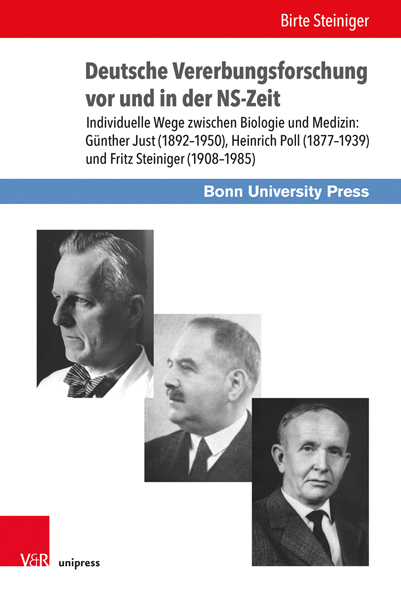 Deutsche Vererbungsforschung vor und in der NS-Zeit
Individuelle Wege zwischen Biologie und Medizin: Günther Just (1892–1950), Heinrich Poll (1877–1939) und Fritz Steiniger (1908–1985)


 Elisabeth Schwarzhaupt
Lebensbericht der Juristin, Kämpferin für Gleichberechtigung und ersten Bundesministerin. Mit unveröffentlichten Quellen von Elisabeth Schwarzhaupt

 Gesunde High Performance®
Mehr Erfolg, mehr Energie, mehr Zeit - mit Strategien aus Medizin, Neurowissenschaft, Sport und Wirtschaft









 Potentiale Elementarer Musikpädagogik in ihrer Wirkung auf Grundschulkinder
Eine empirisch-quantitative Studie an österreichischen Volksschulen



 Stark im Kopf
Gelassen bleiben, klar denken, gesund leben - Dein Kompass für mentale Stärke im Alltag

 Systemisch gesund und resilient durch den Alltag
100 Impulskarten für Coaching, Beratung und Therapie