
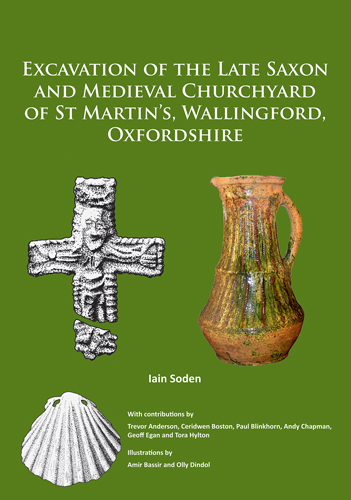
Excavation of the Late Saxon and Medieval Churchyard of St Martin’s, Wallingford, Oxfordshire
By (author) Iain Soden
Paperback (Published)
(January 2018)
ISBN: 9781784917661
8.07 x 11.46 inches
Price: $50.00
In stock
This volume presents the results of excavations by MOLA (Museum of London Archaeology) undertaken in 2003-4 at the former St Martin’s churchyard, Wallingford, Oxfordshire.
MOLA (Museum of London Archaeology) undertook excavations over 2003-4 at the former St Martin’s churchyard, Wallingford, Oxfordshire. St Martin’s, one of perhaps eight churches of late Saxon Wallingford, was located in a prominent position in the centre of the burh. No middle Saxon activity was found and the earliest remains consisted of a layer sealing the natural subsoil which contained a probable late Saxon lead cross. Earliest use of the churchyard has been dated to the late 10th to early 11th century by radiocarbon dating, and burials continued until the end of the 14th century, serving a dwindling parish population, before the cemetery rapidly fell out of use thereafter. No burials post-date 1412. Part of the cemetery has not been disturbed by the present development. The unexcavated areas and previous post-medieval and modern disturbances has meant the original size of the cemetery remains unknown. A late Saxon mortar mixer found on the site has added to a growing number of this distinctive early constructional feature. While its presence indicates the vicinity of the late Saxon church, no foundations of St Martin’s church appear to have survived cellar digging and quarrying for gravel that occurred in the early 18th century. Osteological analysis of 187 of the 211 excavated skeletons of the cemetery has depicted a lay population which was almost equally split between males and females, with only a slight bias towards males. Their distribution showed no observable cluster within the churchyard by age or gender. A high proportion of children is notable but newborns and very young children were comparatively rare. The significance of this is unclear since so many disarticulated remains were also present due to later disturbance. Both degenerative pathologies and inherited conditions affecting bone were noted, as were a high frequency of trauma, some of it violent. Generally the population could be shown to have led healthy early lives compared to other urban assemblages, although evidence of tuberculosis and iron deficiency suggest that living conditions and diet at the heart of medieval Wallingford were far from ideal. Within the excavated area of the cemetery, a number of the burials demonstrated known pre-Conquest burial rites and there are some aspects which may be peculiar to the area, suggesting local variations to common rites. Eight pre-Conquest burials had their heads supported mostly by stones, but one had his head supported by two disarticulated skulls. One 30-40 year old male was buried wearing a pierce scallop-shell, presumably a pilgrim badge from Santiago de Compostella. Four burials were interred in stone-built cists and these ranged from a c1 year old to adults of both sexes. A further six burials lay in stone-built cists without a cover. All post-Conquest burials were earth-cut examples.
- By (author) Iain Soden
Wallingford has recently benefitted from a period of intense archaeological and documentary research, the outcomes of which include Iain Soden's monograph on St Martin's churchyard. It records the most extensively excavated graveyard in the town, which was centrally located close to the intersection of the two main streets before it was lost to later development. The publication provides an important source for later Anglo-Saxon and medieval burial practises for the region.
— Grenville Astill
Similar Books
 «Solazoxa festa, stradolze e stracomplia»
Festschrift für Raymund Wilhelm zum 65. Geburtstag mit Beiträgen zu Diskurstraditionen und mittelalterlicher Philologie
Volume 249
 A Collaborative Tapestry in Honour of Shirley Ann Brown / Une fresque brodée en l’honneur de Shirley Ann Brown
The Bayeux Tapestry Seen by her Colleagues and Friends / La Tapisserie de Bayeux vue par ses collègues et amis

 Behind the Scenes of Medieval Roofs
An Overview of the Roofing Systems of Italian Churches
Volume 90

 Cahiers de recherches médiévales et humanistes – Journal of Medieval and Humanistic Studies
Volume 51







 Innovation and Medieval Communities
The Circulation of Ideas and Practices in and out of the Town (1200-1500)
Volume 63
 John Dunstaple Reading Boethius
John Dunstaple’s Annotations to Boethius’s “De institutione musica” in the Manuscript Oxford, Corpus Christi College Library, MS 118

 Medieval Debates on Foreknowledge: Future Contingents, Prophecy, and Divination
Acts of the XXVII Annual Colloquium of the SIEPM, Trento 12-15 September 2023
Volume 31

 Medieval Yeghegis, Armenia
History, Archaeology, Society. Local Multiplicities and Global Connections of a Rural Centre on the Silk Road(s)

 Nicholas of Lyra’s Commentaries on the Gospels of Matthew and Luke
Franciscan Exegesis in a Time of Crisis



 Power and Women in Southeast and Central Europe in Late Medieval and Early Modern Period (1300-1600)
Volume 10





 The Anglo-Norman Bible’s Books of Kings, a Critical Edition
(BL Royal 1 C III, fols 234r-274v)
Volume 37