
Diz vliegende bîspel
Ambiguity in Medieval and Early Modern Literature. Essays in Honor of Arthur Groos
Contributions by Andrea Schindler Contributions by Markus Stock Contributions by Bonnie Buettner Contributions by John Greenfield Contributions by Matthias Meyer Contributions by Christoph Huber Contributions by David H. Price Contributions by Volker Mertens Contributions by Maria Dobozy Contributions by Helmut Puff Contributions by Ingrid Bennewitz Contributions by Danielle Buschinger Edited by Marian E. Polhill Edited by Alexander Sager
Hardback (Published)
(July 2020)
ISBN: 9783847111573
6.34 x 9.25 inches
Price: $69.00
In stock
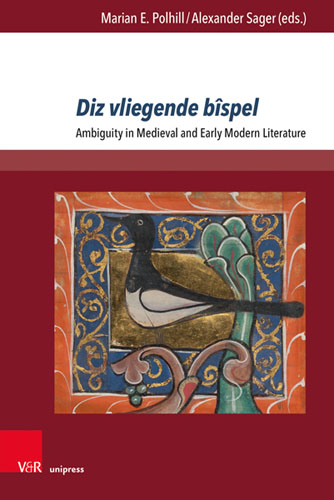
The famous expression diz vliegende bispel from Eschenbach’s Parzival is the volume’s watchword. In the poem the black and white plumage of the magpie represents it’s characteristic complexity, ambiguity, and ambivalence. Removed from it’s historical context it is also a figure of Arthur Groos’s wide-ranging intellectual flight. In addition to his work on medieval German verse narrative, he has made important contributions to courtly love poetry, medieval and early modern scientific literature, early modern German literature in general, and especially to opera. The essays honor him in all these areas.
The volume explores the theme of ambiguity in medieval and early modern literature in essays honoring the life and work of Arthur Groos, Avalon Foundation Professor in the Humanities at the Cornell University, USA, emeritus. The famous expression diz vliegende bispel from Eschenbach’s Parzival is its watchword. In the poem the black and white plumage of the magpie represents the characteristic complexity, ambiguity, and ambivalence of the novel. Removed from its historical context the expression is also a figure of Arthur Groos’ wide-ranging intellectual flight. In addition to his work on medieval German verse narrative, he has made important contributions to courtly love poetry, medieval and early modern scientific literature, early modern German literature in general, and especially to opera.
- Contributions by Andrea Schindler
- Contributions by Markus Stock
- Contributions by Bonnie Buettner
- Contributions by John Greenfield
- Contributions by Matthias Meyer
- Contributions by Christoph Huber
- Contributions by David H. Price
- Contributions by Volker Mertens
- Contributions by Maria Dobozy
- Contributions by Helmut Puff
- Contributions by Ingrid Bennewitz
- Contributions by Danielle Buschinger
- Edited by Marian E. Polhill
- Edited by Alexander Sager
Other Titles in this Series



 Kulturen des Manuskriptzeitalters
Ergebnisse der Amerikanisch-Deutschen Arbeitstagung an der Georg-August-Universität Göttingen vom 17. bis 20. Oktober 2002

 Grounding Community
Eckhartian Mysticism and Social Reform from the Late Middle Ages to the Fin de Siècle
Similar Books
 «Solazoxa festa, stradolze e stracomplia»
Festschrift für Raymund Wilhelm zum 65. Geburtstag mit Beiträgen zu Diskurstraditionen und mittelalterlicher Philologie
Volume 249
 A Collaborative Tapestry in Honour of Shirley Ann Brown / Une fresque brodée en l’honneur de Shirley Ann Brown
The Bayeux Tapestry Seen by her Colleagues and Friends / La Tapisserie de Bayeux vue par ses collègues et amis






 Ars Prophetica
Theology in the Poetry of Twentieth-Century Hebrew Poets Avraham Halfi, Shin Shalom, Amir Gilboa, and T. Carmi
 Balthasar Caymox of Nuremberg
Early Modern German Print Publishers: Popular Prints of the Seventeenth Century

 Behind the Scenes of Medieval Roofs
An Overview of the Roofing Systems of Italian Churches
Volume 90


 Beyond Sovereign Courts
Agents and Practices in Early Modern Spanish and Habsburg Diplomacy
Volume 3


 Cahiers de l’Association internationale des études françaises
J. M. G. Le Clézio - Enseigner les littératures francophones aujourd’hui - Récit de soi et expérience de l’illusion (XVIIe-XVIIIe siècles)
Volume 78
 Cahiers de littérature française
Les Métamorphoses du texte. Enjeux intertextuels et transpositions visuelles
Volume 25
 Cahiers de recherches médiévales et humanistes – Journal of Medieval and Humanistic Studies
Volume 51
 Cahiers de sémiotique des cultures
Ponctuation et sens. Nouvelles perspectives / Punctuation and meaning. New perspectives
Volume 6


 Circulation, Use, Impact
The Consumption of Architectural Books in the Early Modern Eastern Adriatic
Volume 1

 CompLit
Myth, Folklore and Magic in European Literatures. Critical and Contemporary Reconfigurations


 Councils, Conflicts, Correspondence
Urban Diplomacy in Reval (Tallinn) and Lübeck (c. 1470–1570)
Volume 67


 Dis/United States of Vulnerability
Literary and Cultural Transgressions in U.S. Poetry Since the 1960s
Volume 330

