
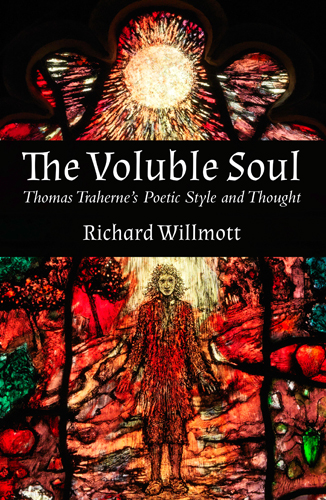
The Voluble Soul
Thomas Traherne's Poetic Style and Thought
by Richard Willmott
Paperback (No longer our product)
(November 2021)
ISBN: 9780718895693
9.17 x 6.1 inches
Price: $37.00
In stock
Hardback (No longer our product)
(June 2021)
ISBN: 9780718895686
9.17 x 6.1 inches
Price: $115.00
In stock
An in depth analysis of Traherne’s poetry from both literary and theological perspectives.
“The world’s fair beauty set my soul on fire.” In this first study of the full range of Traherne’s poetry Richard Willmott explains his ‘metaphysical’ poetry to all who are attracted by the beauty of his language, but puzzled by his meaning. He offers guidance both for the student of English, uncertain about Traherne’s theological ideas, and the student of theology, put off by seventeenth-century poetic conventions and diction. Using a wealth of quotation, he examines Traherne’s verse alongside that of a variety of his contemporaries, including Andrew Marvell, Lucy Hutchinson, Anne Bradstreet and Edward Taylor. Central to Traherne’s poetry and generous theology is his delight in the capacity of his soul to approach God through an appreciation of His infinite creation. This soul is ‘voluble’, not only because it can express its thoughts with fluency, but also because it can enfold within itself the infinity of God’s creation, taking in everything that it perceives, considering the latest scientific speculations about the atom and astronomy, but also looking clear-sightedly at Restoration society’s materialism and – in one startlingly savage satire – the corruption of the royal court.
Rirchard Willmoot read English at Cambridge and took an MA in European Studies (French Renaissance Drama) at UEA while teaching English at Norwich School; his dissertation examined seventeenth-century verse translations of Corneille. Subsequently Willmott taught at Manchester Grammar School and Brighton College (deputy head), and was head of the Dixie Grammar School. Since retiring to Hereford, Willmott has taught literature for the WEA (to adults) and have also been chairman of the Traherne Association for the last ten years, which has led him to further study of Traherne and the seventeenth-century context of his writing.
- By (author) Richard Willmott
"Thomas Traherne is an inspiring writer for our times and this is an excellent introduction to the main themes of his poems. More than this, Richard Willmott sets Traherne firmly in the context of his own age and considers not just those writers who might have influenced him directly but those who shaped the intellectual, scientific and spiritual context in which he wrote." Professor Richard Harries FRSL "It is wonderful to see an introduction to Traherne that demonstrates literacy in both poetry and theology. Alongside key Trahernian themes such as felicity, innocence and atomism, there is a surefooted discussion of Traherne's wider intellectual context, from the Psalms to Augustine to the metaphysical poets. Willmott draws on an extensive knowledge and long love of Traherne to construct a scholarly but accessible study that foregrounds the voice of Traherne himself, an act of intellectual humility and generosity worthy of commendation." Elizabeth S. Dodd, Sarum College "Richard Willmott is a worthy guide through the full breadth of Traherne's poetry, helping us to understand his artful and original articulation of his vision of the world and of God. Willmott is able to do what Traherne scholars and enthusiasts in the 20th century could not do, because of the wealth of more recently discovered manuscripts now available. Furthermore, he masterfully situates Traherne's poetry within the context of his geographical landscape, historical period, philosophy, theology, and language." David Buresh, editor of Waking Up in Heaven
—
Similar Books



 Ars Prophetica
Theology in the Poetry of Twentieth-Century Hebrew Poets Avraham Halfi, Shin Shalom, Amir Gilboa, and T. Carmi
 Balthasar Caymox of Nuremberg
Early Modern German Print Publishers: Popular Prints of the Seventeenth Century


 Beyond Sovereign Courts
Agents and Practices in Early Modern Spanish and Habsburg Diplomacy
Volume 3


 Cahiers de l’Association internationale des études françaises
J. M. G. Le Clézio - Enseigner les littératures francophones aujourd’hui - Récit de soi et expérience de l’illusion (XVIIe-XVIIIe siècles)
Volume 78
 Cahiers de littérature française
Les Métamorphoses du texte. Enjeux intertextuels et transpositions visuelles
Volume 25
 Cahiers de recherches médiévales et humanistes – Journal of Medieval and Humanistic Studies
Volume 51
 Cahiers de sémiotique des cultures
Ponctuation et sens. Nouvelles perspectives / Punctuation and meaning. New perspectives
Volume 6


 Circulation, Use, Impact
The Consumption of Architectural Books in the Early Modern Eastern Adriatic
Volume 1

 CompLit
Myth, Folklore and Magic in European Literatures. Critical and Contemporary Reconfigurations

 Councils, Conflicts, Correspondence
Urban Diplomacy in Reval (Tallinn) and Lübeck (c. 1470–1570)
Volume 67


 Dis/United States of Vulnerability
Literary and Cultural Transgressions in U.S. Poetry Since the 1960s
Volume 330


 European Drama and Performance Studies
Dramatisations politiques. Théâtre, politique et idéologie au XIXe siècle (1806-1914)
Volume 27


