
The Interaction of Art and Relics in Late Medieval and Early Modern Art
Edited by Livia Stoenescu
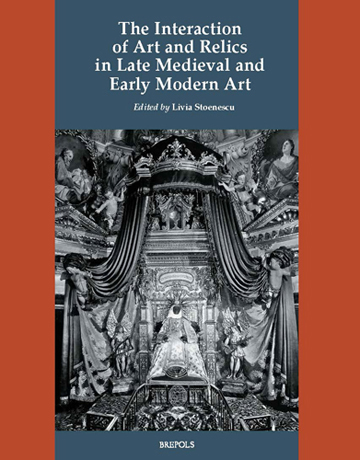
The collection of essays gathered in this volume investigates the interaction between art and relics as a distinct historical relevance for devotional art of Early Modernity and the Renaissance. Recent studies in the material culture of artifacts from these periods have drawn increasing attention to a sense of material tangibility derived from relics. Putting that conclusion into perspective, this edited collection focuses on the aesthetic meaning generated by a specific material culture of sanctity – one in which artists based their practice upon the nature, variety, and history of relics. Works of art that contained relics shared in the aura of the relics, defining themselves as non-substitutable signs, or signs that preserved the physical relationship to the immutable nature and origin of relics. As studied in this volume, funerary monuments, chapel decorations, altarpieces, liturgical objects, and sacred sites yielded an unordinary aesthetic meaning, one that captured and at the same time transmitted the histories linked to a relic. Each chapter emphasizes the specific history contained within works of art premised upon relics and thus forever embedded in the relics’ status as sacred originals.
The collection of essays gathered in this volume investigates the interaction between art and relics as a distinct historical relevance for devotional art of Early Modernity and the Renaissance. Recent studies in the material culture of artifacts from these periods have drawn increasing attention to a sense of material tangibility derived from relics. Putting that conclusion into perspective, this edited collection focuses on the aesthetic meaning generated by a specific material culture of sanctity – one in which artists based their practice upon the nature, variety, and history of relics. Works of art that contained relics shared in the aura of the relics, defining themselves as non-substitutable signs, or signs that preserved the physical relationship to the immutable nature and origin of relics. As studied in this volume, funerary monuments, chapel decorations, altarpieces, liturgical objects, and sacred sites yielded an unordinary aesthetic meaning, one that captured and at the same time transmitted the histories linked to a relic. Each chapter emphasizes the specific history contained within works of art premised upon relics and thus forever embedded in the relics’ status as sacred originals.
- Edited by Livia Stoenescu
Similar Books
 «Solazoxa festa, stradolze e stracomplia»
Festschrift für Raymund Wilhelm zum 65. Geburtstag mit Beiträgen zu Diskurstraditionen und mittelalterlicher Philologie
Volume 249
 A Collaborative Tapestry in Honour of Shirley Ann Brown / Une fresque brodée en l’honneur de Shirley Ann Brown
The Bayeux Tapestry Seen by her Colleagues and Friends / La Tapisserie de Bayeux vue par ses collègues et amis






 Balthasar Caymox of Nuremberg
Early Modern German Print Publishers: Popular Prints of the Seventeenth Century

 Behind the Scenes of Medieval Roofs
An Overview of the Roofing Systems of Italian Churches
Volume 90

 Beyond Sovereign Courts
Agents and Practices in Early Modern Spanish and Habsburg Diplomacy
Volume 3


 Cahiers de recherches médiévales et humanistes – Journal of Medieval and Humanistic Studies
Volume 51

 Circulation, Use, Impact
The Consumption of Architectural Books in the Early Modern Eastern Adriatic
Volume 1



 Councils, Conflicts, Correspondence
Urban Diplomacy in Reval (Tallinn) and Lübeck (c. 1470–1570)
Volume 67


 ENTANGLED AFRICA
Intra-African Relations Between Rain Forest and Mediterranean from Around 4,000 BCE to 1,500 CE



 Gold, Silver and Glass: Power Networks, Cultural Identities, Technology Transfers and Agency across the Old World (7th Century BC – 1st Century AD)
Proceedings of a Conference Held at the British Museum, 16–18 June 2023

