
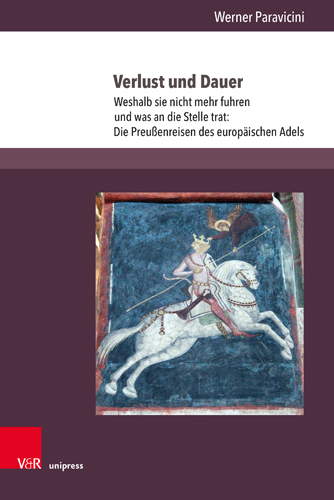
Verlust und Dauer
Weshalb sie nicht mehr fuhren und was an die Stelle trat: Die Preußenreisen des europäischen Adels. Teil 4
By (author) Werner Paravicini
Hardback (Published)
(December 2023)
ISBN: 9783847116561
6.34 x 9.33 inches
Price: $99.00
On back order
Nachdem der heidnische Grossfurst von Litauen katholischer Konig von Polen geworden war, versuchte der auf Heidenkampf gegrundete Deutsche Orden zunachst aus der Tatsache, dass Niederlitauen (Samaiten) noch heidnisch blieb, Kapital zu schlagen, bereitete nach der Niederlage 1410 bei Tannenberg zunachst die Revanche vor und schuf dann eine neue Legitimitat als Grundung und Heimstatte des deutschen Adels. Der europaische Adel aber wechselte einfach den Schauplatz seiner fur seinen Ehrhaushalt unentbehrlichen Kreuzzugsaktivitat.
The fourth and last volume of the study of the “Prussian Voyages” tells how it ended and which were the consequences. When in 1386/87 the pagan grand-duke of Lithuania became the catholic king of Poland, the Teutonic Order decided to continue nevertheless his combat against this pagan country, during a decade with considerable success. Only then the European chivalry turned against its true ennemy, the Osmanic expansion. A new legitimacy, Prussia thought as foundation and propriety of the German nobility, permitted the order to resist the attacks of it’s ennemies during the Council of Constance and caused once again German princes to come to Prussia in 1422, too late to turn the course of events. The Order refused serious engagement on other pagan fronteers, but the European chivalry did, voyaging to other places: Bohemia, Hungary and the Mediterranean. This new history of lost and regained legitimacy is based on intensive research. An overall conclusion of the four volumes is given. Documents, Additions and Indices will follow.
Prof. Dr. Werner Paravicini ist Honorarprofessor am Historischen Seminar der Christian-Albrechts-Universität zu Kiel. Von 1993 bis 2007 war er Direktor des Deutschen Historischen Instituts in Paris, Frankreich. Er ist Mitglied der Akademien in Göttingen, Brüssel und Paris sowie der Historischen Kommission bei der Bayerischen Akademie in München.
- By (author) Werner Paravicini
Other Titles in this Series
 Der Deutsche Orden und die Wahrnehmung der eigenen Handlungsspielräume
Vom Ersten Thorner Frieden (1411) bis zum Vertrag vom Melnosee (1422)

 Transottomanica – Osteuropäisch-osmanisch-persische Mobilitätsdynamiken
Perspektiven und Forschungsstand


 Polen und Deutsche in der Vormoderne (14.–18 Jh.)
Kontaktzonen, Nachbarschaft und gegenseitige Wahrnehmung
Similar Books
 «Solazoxa festa, stradolze e stracomplia»
Festschrift für Raymund Wilhelm zum 65. Geburtstag mit Beiträgen zu Diskurstraditionen und mittelalterlicher Philologie
Volume 249
 A Collaborative Tapestry in Honour of Shirley Ann Brown / Une fresque brodée en l’honneur de Shirley Ann Brown
The Bayeux Tapestry Seen by her Colleagues and Friends / La Tapisserie de Bayeux vue par ses collègues et amis

 Behind the Scenes of Medieval Roofs
An Overview of the Roofing Systems of Italian Churches
Volume 90

 Cahiers de recherches médiévales et humanistes – Journal of Medieval and Humanistic Studies
Volume 51







 Innovation and Medieval Communities
The Circulation of Ideas and Practices in and out of the Town (1200-1500)
Volume 63
 John Dunstaple Reading Boethius
John Dunstaple’s Annotations to Boethius’s “De institutione musica” in the Manuscript Oxford, Corpus Christi College Library, MS 118

 Medieval Debates on Foreknowledge: Future Contingents, Prophecy, and Divination
Acts of the XXVII Annual Colloquium of the SIEPM, Trento 12-15 September 2023
Volume 31

 Medieval Yeghegis, Armenia
History, Archaeology, Society. Local Multiplicities and Global Connections of a Rural Centre on the Silk Road(s)

 Nicholas of Lyra’s Commentaries on the Gospels of Matthew and Luke
Franciscan Exegesis in a Time of Crisis



 Power and Women in Southeast and Central Europe in Late Medieval and Early Modern Period (1300-1600)
Volume 10





 The Anglo-Norman Bible’s Books of Kings, a Critical Edition
(BL Royal 1 C III, fols 234r-274v)
Volume 37