
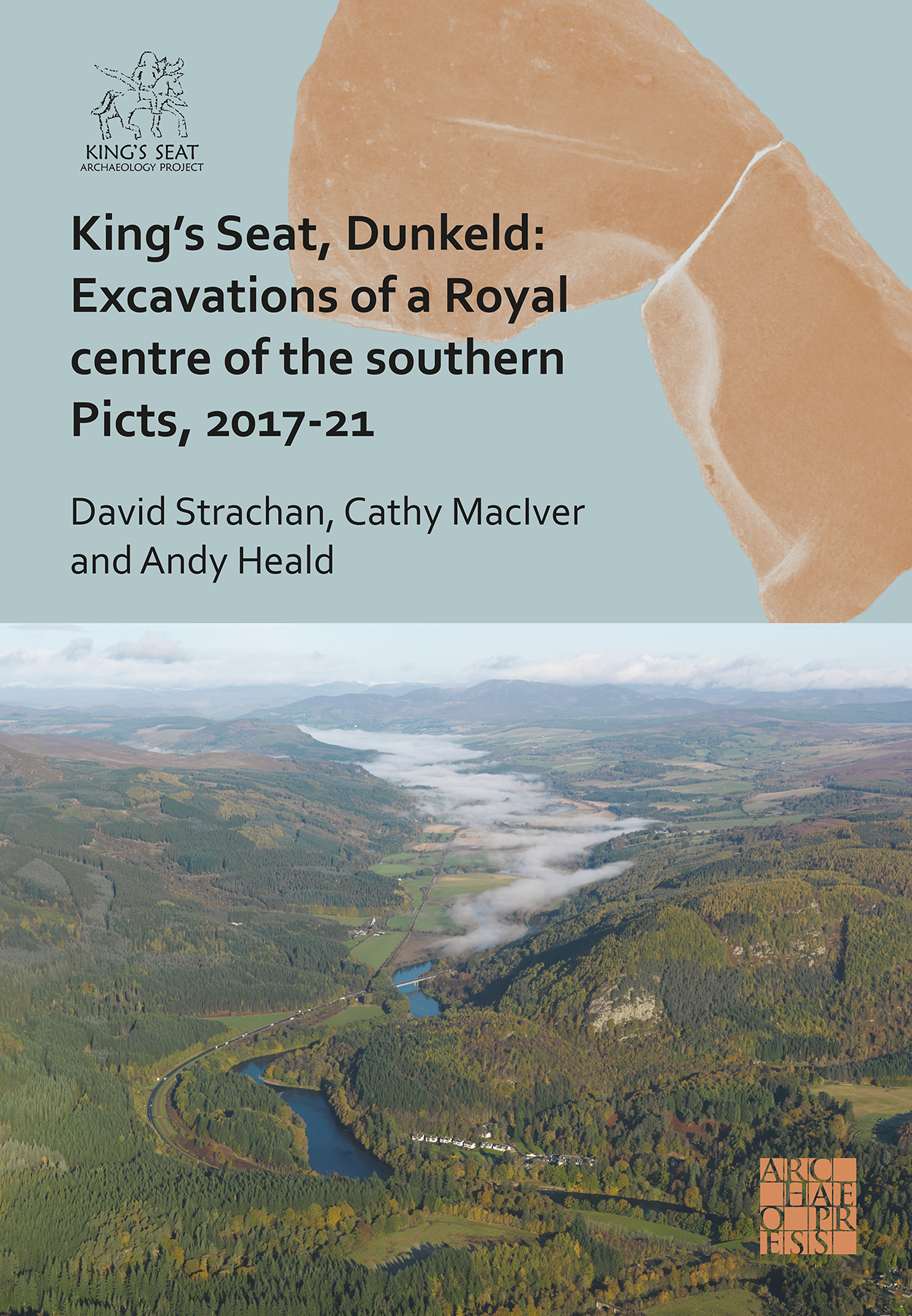
King’s Seat, Dunkeld: Excavations of a Royal Centre of the Southern Picts, 2017-21
By (author) David Strachan By (author) Cathy MacIver By (author) Andy Heald
Hardback (Published)
(November 2025)
ISBN: 9781805831174
8.07 x 11.46 inches
Price: $49.00
In stock
King’s Seat fort near Dunkeld, once lost to archaeology, was rediscovered in 2015 and revealed as a high-status Pictish royal site. Excavations uncovered metalworking, trade, and feasting evidence. Its later abandonment reflects shifts in power and religious influence, linking prehistory to medieval Scotland.
It is remarkable, given Dunkeld’s importance in medieval Scotland, that so little was known of King’s Seat fort until the 1950s. While proposed as a royal Pictish ‘nuclear’ fort in the 1980s, it was so heavily overgrown as to be effectively lost to archaeology until 2015, when the local history society instigated a programme of community archaeology to explore its story. Led by Perth and Kinross Heritage Trust, working with AOC Archaeology Group, this included excavation that revealed a high-status Pictish fort complex. Like the classic sites Dundurn and Clatchard Craig, it had a high-status summit citadel surrounded by a hierarchy of connected out-works on lower terraces. LiDAR data revealed a previously unknown south enclosure, more than doubling its total footprint and raising questions about the role of such sites and the nature of Pictish settlement. Controlling important routes from the north and west into the lower Tay region, King’s Seat was a Pictish ‘royal’ stronghold, estate, and production centre which was to attract an important early monastic foundation. While relatively short-lived, it produced evidence of specialist precious metalworking and trade and was the venue for feasting that saw the consumption of exotic luxuries such as Continental imports and glass vessels from Anglo-Saxon England. It was abandoned, rather than destroyed, perhaps as power passed to a lower site in a new architectural form, associated with the increasing power of the church and as larger polities developed. The relics of Columba were brought to Dunkeld in the 9th century, probably as much a result of tensions between Pictish royalty and the Gaelic church as the threat of Viking raids, before its ecclesiastical importance was eclipsed by
List of Figures List of Tables Acknowledgements List of Contributors Notes Introduction - David Strachan Background to the project Location: geology, topography and rivers King's Seat fort New discoveries: the southern enclosure and other information from airborne LiDAR data Project aims and research agenda The excavation results - Cathy MacIver Introduction The site and excavation methodology The excavation results Conclusions The small finds and animal bone - Ewan Campbell, Andy Heald, Andrew Morrison, Derek Hall, Dawn McLaren, Rob Engl, Daniel Bateman, Amy Halliday, and Lore Troalen Introduction E ware Later Medieval and later pottery Money-box Glass Copper alloy Lead Iron objects Non-ferrous metalworking Iron-working evidence Worked antler Chipped stone The coarse stone Unworked animal none Conclusions King's Seat in context: the early medieval of the area small - David Strachan Introduction Land use and land use change in the early medieval period Prehistoric and early medieval sites in the landscape Early medieval sculpture and portable antiquities in and around Dunkeld The historical background of King's Seat Discussion and conclusions - David Strachan, Cathy MacIver, and Andy Heald Introduction Upland and lowland relationships: defining the nature of settlements, buildings, royal sites and their locations, and the relationships between them Routeways: contact, communication, and control High-status sites Economic networks Material culture Periods of transition Conclusions: a royal seat and the capital of Atholl References Appendices Appendix A: Archaeological sites in the environs of Dunkeld and the wider area Appendix B: Early medieval sculpture from Dunkeld and its environs Index , List of Figures Introduction – David Strachan with a contribution by Łukasz Banaszek The excavation results – Cathy MacIver with a contribution by Derek Hamilton The small finds and animal bone – Ewan Campbell, Andy Heald, Andrew Morrison, Derek Hall, Dawn McLaren, Rob Engl, Daniel Bateman, Amy Halliday, and Lore Troalen King’s Seat in context: the early medieval of the area small – David Strachan with contributions by Richard Tipping, Mark A. Hall, and Oisín Plumb Discussion and conclusions – David Strachan, Cathy MacIver, and Andy Heald Appendices Appendix A: Archaeological sites in the environs of Dunkeld and the wider area Appendix B: Early medieval sculpture from Dunkeld and its environs
Index
List of Tables
Acknowledgements
List of Contributors
Notes
Background to the project
Location: geology, topography and rivers
King’s Seat fort
New discoveries: the southern enclosure and other information from airborne LiDAR data
Project aims and research agenda
Introduction
The site and excavation methodology
The excavation results
Conclusions
Introduction
E ware
Later Medieval and later pottery
Money-box
Glass
Copper alloy
Lead
Iron objects
Non-ferrous metalworking
Iron-working evidence
Worked antler
Chipped stone
The coarse stone
Unworked animal none
Conclusions
Introduction
Land use and land use change in the early medieval period
Prehistoric and early medieval sites in the landscape
Early medieval sculpture and portable antiquities in and around Dunkeld
The historical background of King’s Seat
Introduction
Upland and lowland relationships: defining the nature of settlements, buildings, royal sites and their locations, and the relationships between them
Routeways: contact, communication, and control
High-status sites
Economic networks
Material culture
Periods of transition
Conclusions: a royal seat and the capital of Atholl
References
David Strachan has over 35 years’ experience of curatorial field archaeology in Wales, England, and Scotland, working at both national and county level. As ‘county archaeologist’ with Perth and Kinross Heritage Trust over the last 25 of these, he has led several research projects, often delivered through community archaeology. These include the recovery of the Late Bronze Age Carpow logboat, excavation of early medieval longhouses in the uplands of Glen Shee, and Iron Age forts around the Tay estuary, also published by Archaeopress. Cathy MacIver is a Project Manager at AOC Archaeology Group and has worked in commercial archaeology since 2009, having managed numerous fieldwork projects. Recent excavations include extensive Romano-British settlements in England, multiple Scottish Iron Age and early medieval hillforts and later prehistoric settlement at Meigle. In addition to working with developers, Cathy has worked closely with HES and the Universities of Glasgow and Aberdeen on research and field school projects with a particular focus on prehistoric to early medieval sites. Andy Heald is the Managing Director of AOC Archaeology and has worked in Scottish archaeology for over 20 years, previously as a Curator of Early Historic and Viking collections at National Museums Scotland. He has a PhD in Non-Ferrous Metalworking in Iron Age Scotland and has published widely on artefacts of the first millennium BC and AD in national and international journals. Recent publications include Caithness Archaeology: Aspects of Prehistory and artefact reports in Clachtoll Broch. Andy is also the Chair of the Scottish Strategic Archaeology Committee.
- By (author) David Strachan
- By (author) Cathy MacIver
- By (author) Andy Heald
'The result is this thorough site report, which, in the spirit of a community-driven effort, is free to download from the Archaeopress website. Along with the usual presentation of the archaeology and small finds reports, there is a crucial chapter on the early medieval landscape and culture, placing the King’s Seat in its proper context for the results to be understood. This is archaeology at its best: community groups coming together to help preserve and promote our shared heritage.' – Kathryn Krakowka (2026): Current Archaeology Issue 432
—
Similar Books
 «Solazoxa festa, stradolze e stracomplia»
Festschrift für Raymund Wilhelm zum 65. Geburtstag mit Beiträgen zu Diskurstraditionen und mittelalterlicher Philologie
Volume 249
 A Collaborative Tapestry in Honour of Shirley Ann Brown / Une fresque brodée en l’honneur de Shirley Ann Brown
The Bayeux Tapestry Seen by her Colleagues and Friends / La Tapisserie de Bayeux vue par ses collègues et amis

 Behind the Scenes of Medieval Roofs
An Overview of the Roofing Systems of Italian Churches
Volume 90

 Cahiers de recherches médiévales et humanistes – Journal of Medieval and Humanistic Studies
Volume 51







 Innovation and Medieval Communities
The Circulation of Ideas and Practices in and out of the Town (1200-1500)
Volume 63
 John Dunstaple Reading Boethius
John Dunstaple’s Annotations to Boethius’s “De institutione musica” in the Manuscript Oxford, Corpus Christi College Library, MS 118

 Medieval Debates on Foreknowledge: Future Contingents, Prophecy, and Divination
Acts of the XXVII Annual Colloquium of the SIEPM, Trento 12-15 September 2023
Volume 31

 Medieval Yeghegis, Armenia
History, Archaeology, Society. Local Multiplicities and Global Connections of a Rural Centre on the Silk Road(s)

 Nicholas of Lyra’s Commentaries on the Gospels of Matthew and Luke
Franciscan Exegesis in a Time of Crisis


 Power and Women in Southeast and Central Europe in Late Medieval and Early Modern Period (1300-1600)
Volume 10





 The Anglo-Norman Bible’s Books of Kings, a Critical Edition
(BL Royal 1 C III, fols 234r-274v)
Volume 37