
Complementary Medicine in Healthcare
International Perspectives on Concepts and Normative Challenges
edited by Charlotte Buch, Alexander Kremling and Jan Schildmann

Paperback (Published)
(June 2024)
ISBN: 9783170445062
6.1 x 9.13 inches
Price: $62.00
In stock
Complementary medicine is a challenge for modern medical care, which is supposed to be based on science and evidence, but also forms part of a pluralistic society that attaches great importance to patient autonomy. There are currently several, partly contradictory trends. On the one hand, complementary medicine is becoming increasingly academicized, for example, by the establishment of professorships for >complementary medicine<. On the other hand, public and scientific pressure on legislators has increased to exclude measures that are often considered to be part of complementary medicine. One example is the exclusion of homeopathy from reimbursement by publicly funded health insurance companies. This volume encompasses multidisciplinary perspectives on the meaning and function of complementary medicine, with a special emphasis on contributions from France and Germany. In addition to systematic conceptual, historical and empirical analyses, the book provides case studies and contributions on practical questions.
Complementary medicine is a challenge for modern medical care, which is supposed to be based on science and evidence, but also forms part of a pluralistic society that attaches great importance to patient autonomy. There are currently several, partly contradictory trends. On the one hand, complementary medicine is becoming increasingly academicized, for example, by the establishment of professorships for >complementary medicine<. On the other hand, public and scientific pressure on legislators has increased to exclude measures that are often considered to be part of complementary medicine. One example is the exclusion of homeopathy from reimbursement by publicly funded health insurance companies. This volume encompasses multidisciplinary perspectives on the meaning and function of complementary medicine, with a special emphasis on contributions from France and Germany. In addition to systematic conceptual, historical and empirical analyses, the book provides case studies and contributions on practical questions.
- Contributions by Marion Baschin
- Contributions by Brenda Bogaert
- Contributions by Charlotte Buch
- Contributions by Judith Büntzel
- Contributions by Ada-Katrin Busch
- Contributions by Anna-Carina Hund
- Contributions by Andreas Kögel
- Contributions by Sara Kohler
- Contributions by Isabelle Mathier
- Contributions by Jérémy Rollin
- Contributions by Alexander Kremling
- Contributions by Özlem Bildik
- Contributions by Sandrine Bretonnière
- Edited by Alexander Kremling
- Edited by Charlotte Buch
- Edited by Jan Schildmann
- Series edited by Elmar Nass
- Series edited by Jürgen Zerth
Other Titles in this Series
 Versorgung gestalten
Interdisziplinäre Perspektiven für eine personenbezogene Gesundheitsversorgung
Volume 1




Similar Books





 Schloss – Gefängnis – Inferno
Historischer Abriss und ethische Aufarbeitung der NS-Krankenmorde in Erlangen



 Coaching und Beratung verboten?
Professionelle Unterstützung psychisch belasteter oder erkrankter Personen außerhalb der Heilkunde



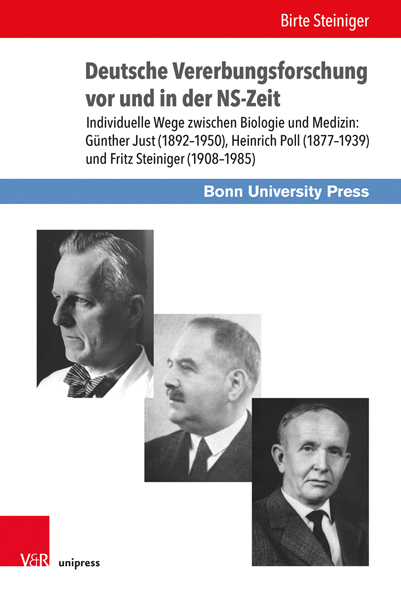 Deutsche Vererbungsforschung vor und in der NS-Zeit
Individuelle Wege zwischen Biologie und Medizin: Günther Just (1892–1950), Heinrich Poll (1877–1939) und Fritz Steiniger (1908–1985)


 Elisabeth Schwarzhaupt
Lebensbericht der Juristin, Kämpferin für Gleichberechtigung und ersten Bundesministerin. Mit unveröffentlichten Quellen von Elisabeth Schwarzhaupt

 Gesunde High Performance®
Mehr Erfolg, mehr Energie, mehr Zeit - mit Strategien aus Medizin, Neurowissenschaft, Sport und Wirtschaft









 Potentiale Elementarer Musikpädagogik in ihrer Wirkung auf Grundschulkinder
Eine empirisch-quantitative Studie an österreichischen Volksschulen


 Stark im Kopf
Gelassen bleiben, klar denken, gesund leben - Dein Kompass für mentale Stärke im Alltag
 Systemisch gesund und resilient durch den Alltag
100 Impulskarten für Coaching, Beratung und Therapie




 Trauma und Dissoziation durch organisierte Gewalt
Hilfreich behandeln und begleiten bei gezielt erzeugter Dissoziativer Identitätsstörung