
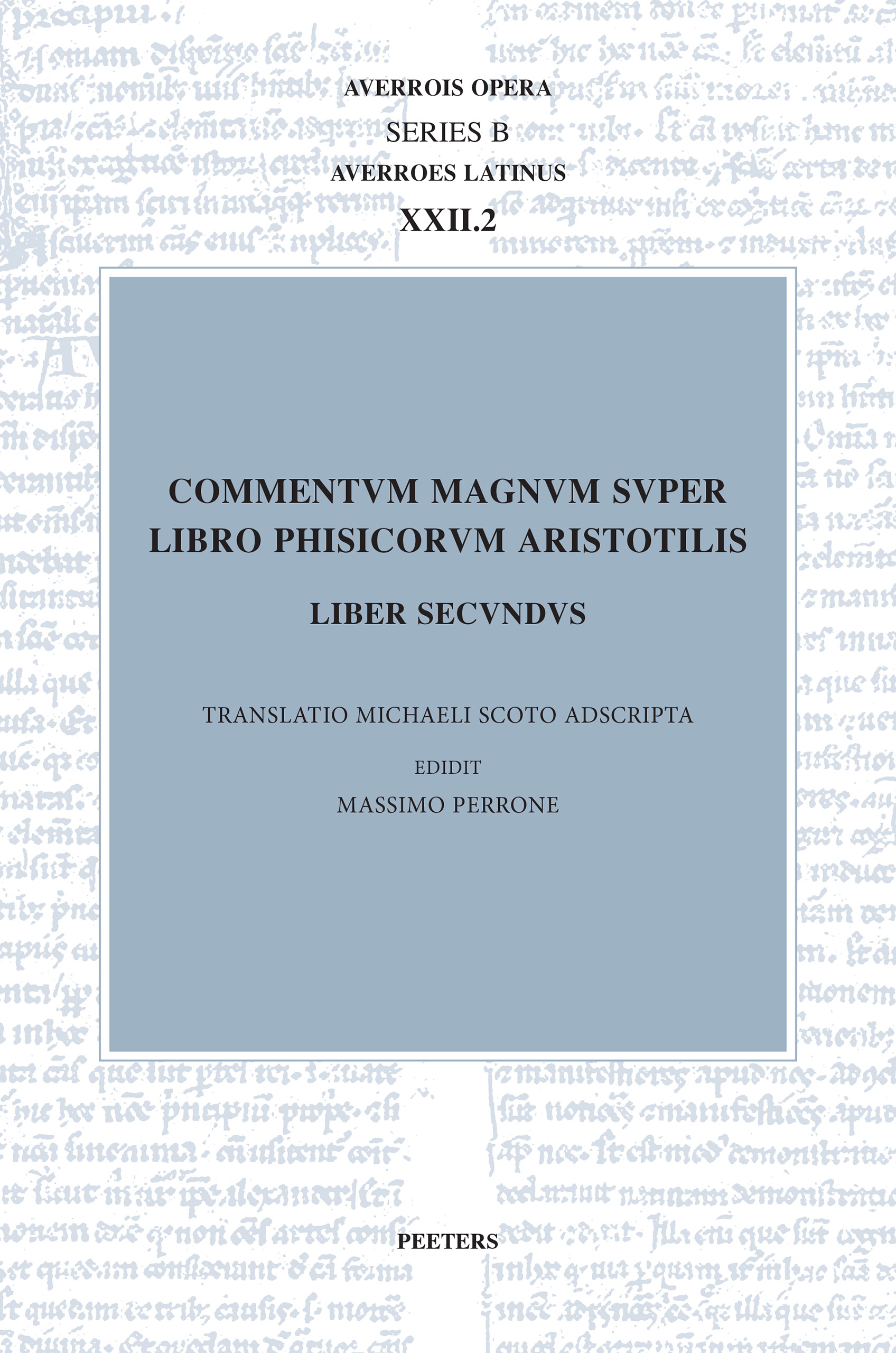
Commentum magnum super libro Phisicorum Aristotilis. Liber secundus
Translatio Michaeli Scoto adscripta
By (author) M. Perrone
PDF (Forthcoming)
(December 2026)
ISBN: 9789042957688
Price: $165.00
Ibn Rušd (1126-1198), commonly known in the Middle Ages as Averroes, commented on all the major works of Aristotle and profoundly influenced later Medieval and Renaissance philosophy. Notably, he wrote three works on the <i>Physics</i>: the Short, Middle, and Long Commentary. While only the Short Commentary survives in Arabic, the Middle and the Long Commentaries are preserved in Latin and Hebrew translations. Although Aristotle’s <i>Physics</i> had already been translated from Greek into Latin by James of Venice (12th century) and from Arabic by Gerard of Cremona (ca. 1114-1187), the new translation from Arabic accompanied by Averroes’s commentary gained wider circulation, as evidenced by the large number of manuscripts. This translation, which is generally attributed to Michael Scot (ca. 1175-1235), was likely produced at the court of Frederick II (1194-1250).
In his commentary on <i>Physics</i> II, Averroes explains Aristotle’s complex definition of nature and his fundamental theory of the four causes – material, formal, efficient, and final. Moreover, in discussing the concepts of necessity, contingency, and chance, Averroes criticises some of the basic assumptions of Avicenna’s metaphysics.
- By (author) M. Perrone
Other Titles in this Series
Similar Books
 «Solazoxa festa, stradolze e stracomplia»
Festschrift für Raymund Wilhelm zum 65. Geburtstag mit Beiträgen zu Diskurstraditionen und mittelalterlicher Philologie
Volume 249
 A Collaborative Tapestry in Honour of Shirley Ann Brown / Une fresque brodée en l’honneur de Shirley Ann Brown
The Bayeux Tapestry Seen by her Colleagues and Friends / La Tapisserie de Bayeux vue par ses collègues et amis

 Behind the Scenes of Medieval Roofs
An Overview of the Roofing Systems of Italian Churches
Volume 90

 Cahiers de recherches médiévales et humanistes – Journal of Medieval and Humanistic Studies
Volume 51







 Innovation and Medieval Communities
The Circulation of Ideas and Practices in and out of the Town (1200-1500)
Volume 63
 John Dunstaple Reading Boethius
John Dunstaple’s Annotations to Boethius’s “De institutione musica” in the Manuscript Oxford, Corpus Christi College Library, MS 118

 Medieval Debates on Foreknowledge: Future Contingents, Prophecy, and Divination
Acts of the XXVII Annual Colloquium of the SIEPM, Trento 12-15 September 2023
Volume 31

 Medieval Yeghegis, Armenia
History, Archaeology, Society. Local Multiplicities and Global Connections of a Rural Centre on the Silk Road(s)
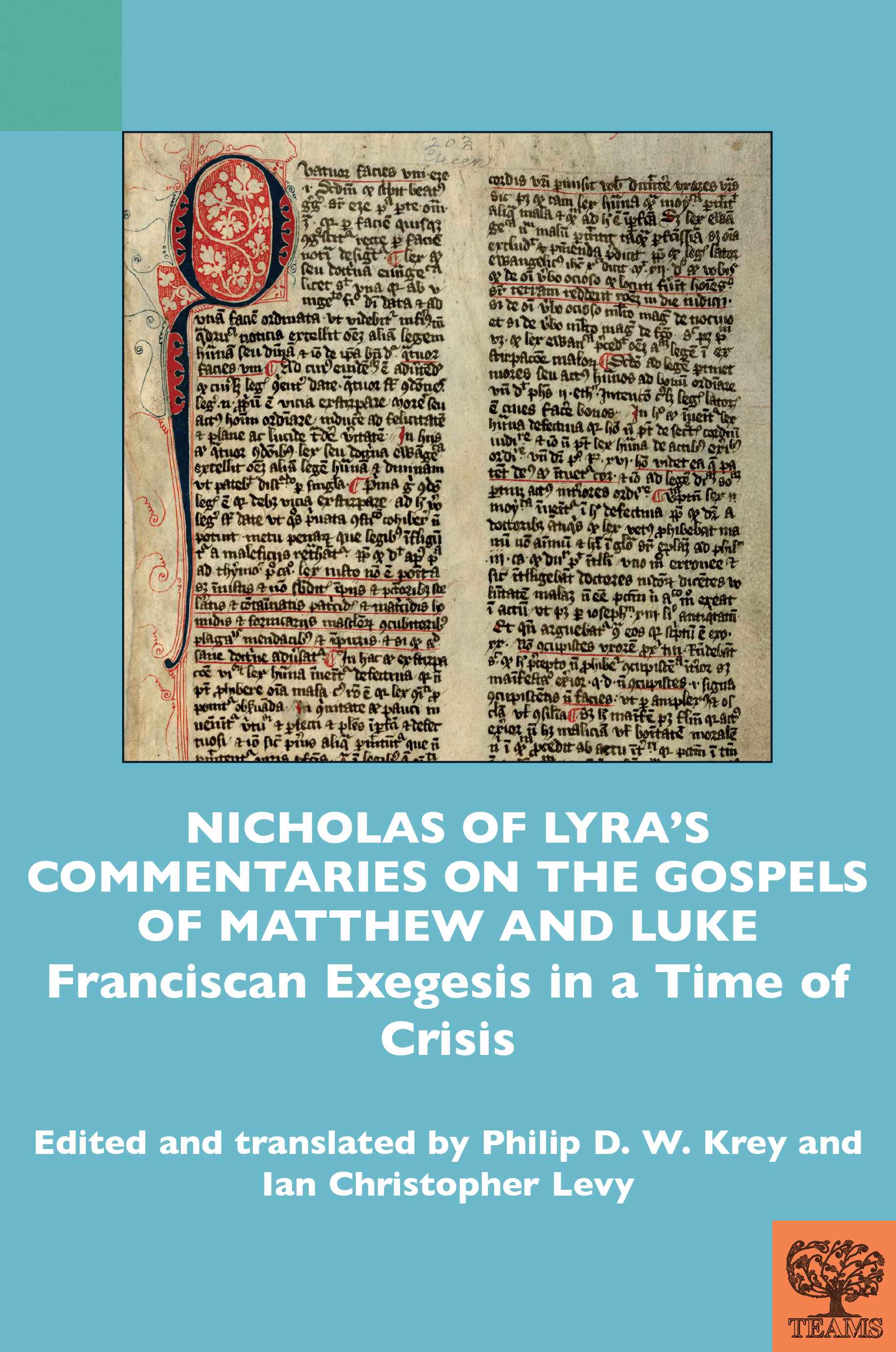 Nicholas of Lyra’s Commentaries on the Gospels of Matthew and Luke
Franciscan Exegesis in a Time of Crisis



 Power and Women in Southeast and Central Europe in Late Medieval and Early Modern Period (1300-1600)
Volume 10





 The Anglo-Norman Bible’s Books of Kings, a Critical Edition
(BL Royal 1 C III, fols 234r-274v)
Volume 37