
Römische Gläser des Landesmuseums Mainz
By (author) Gabriele Harter
Hardback (Published)
(May 2000)
ISBN: 9783895001512
8.66 x 12.4 inches
Price: $153.00
In stock
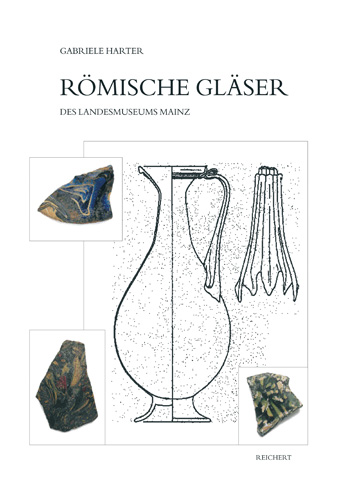
The significance of the Roman glass collection of the Landesmuseum Mainz lies in the great diversity of the material and in the fact that the objects, dated to the period between the early 1st and early 5th centuries A.D., come mostly from the area of ancient Mogontiacum (Mainz), a military garrison and the seat of the provincial government of Germania Superior. <br/>„Römische Gläser des Landesmueums Mainz“ presents, for the first time. all of the 1,364 objects in this important collection in catalogue format, including descriptions, line drawings, colour plates, black-and-white illustrations, maps, bibliographies and concordances. The author indetifies 124 different types of glass objects in the Mainz material, analysing these in great detail. In addition, a convenient summary of the current state of research into their dating, distribution, manufacturing methods and every-day use is provided. The archaeological context of the material is illustrated by a catalogue of 83 Roman graves from Mainz and Rheinhessen. The book benefits from an introductory chapter on the history of the collection, a summary of the history and topography of Mogontiacum, survey of the types and decorations of glassware from Roman Mainz, as well as a detailed glossary.
Mit “Romische Glaser des Landesmuseums Mainz” liegt erstmals ein Bestandskatalog der romischen Glasgefasse und -gerate des Landesmuseums Mainz vor. Beschrieben werden 1364 uberwiegend aus Mainz und Umgebung stammende Objekte, wovon etwa ein Drittel verhaltnismassig gut erhalten ist. Erganzend wurden 161 heute verschollene Glaser mit Fundortangabe Mainz in den Katalog aufgenommen sowie 16 im Romisch-Germanischen-Zentralmuseum aufbewahrte Glasgefasse aus Mainz.Dieser Katalog bildet die Grundlage fur Untersuchungen daruber, welche Glasformen und -dekore im Gebiet des Truppenstandortes und Verwaltungssitzes Mogontiacum vom ersten nachchristlichen Jahrhundert bis ins ausgehende 4./fruhe 5. Jahrhundert belegt sind und in welchen Bereichen des romischen Mainz (Militaranlagen, Lagervorstadt, zivile Ansiedlungen, Nekropolen) die Stucke zutage kamen. Vorangestellt ist ein kurzes Kapitel zur Geschichte der Glassammlung des Landesmuseums Mainz sowie ein allgemeiner Uberblick uber die Geschichte und Topographie von Mogontiacum, ferner ein Glossar mit Begriffsdefinitionen und Erlauterungen zu einzelnen Verarbeitungs- und Verzierungstechniken. Auf einem beigefugten Orientierungsplan sind die meisten der im Katalog und Text genannten modernen Strassen und Gebaude innerhalb des heutigen Stadtgebietes von Mainz verzeichnet.Bei den im Hauptteil der Arbeit behandelten romischen Glasern liessen sich insgesamt 124 Formen unterscheiden. Jeder Form ist ein eigenes Kapitel gewidmet, in dem sie definiert, der derzeitige Forschungsstand zu allgemeiner Datierung, Verbreitung, Herstellungstechnik und Verwendungsart referiert und gleichzeitig das im zugehorigen Katalogteil beschriebene Mainzer Material ausgewertet wird.An diese kommentierte Materialvorlage schliesst eine Zusammenstellung von 83 ausgewahlten romischen Grabfunden mit Glasbeigaben aus Rheinhessen an, von denen 66 innerhalb des heutigen Stadtgebietes von Mainz zutage kamen.Aufgrund der im Hauptteil gewonnenen Erkenntnisse wird abschliessend ein nach Perioden gegliederter Uberblick uber die im romischen Mainz vertretenen Glasformen und -dekore vorgelegt, getrennt nach den Funden aus Siedlungsbereichen und denen aus Nekropolen.Die meisten der im Westen des romischen Reiches gangigen Glasformen sind in Mainz vertreten. Das Spektrum reicht von fruhen, importierten Mosaikglas-Schalen bis zu spatantiken Trinkgefassen einheimisch-rheinischer Produktion.
- By (author) Gabriele Harter
Similar Books
 A Collaborative Tapestry in Honour of Shirley Ann Brown / Une fresque brodée en l’honneur de Shirley Ann Brown
The Bayeux Tapestry Seen by her Colleagues and Friends / La Tapisserie de Bayeux vue par ses collègues et amis


 Balthasar Caymox of Nuremberg
Early Modern German Print Publishers: Popular Prints of the Seventeenth Century


 Drunk the Potion, No Whit Charmed
The Doctrine of Pure and Perfect Souls from Iamblichus to Damascius

 Epiphanies of the Divine in the Septuagint and the New Testament
Fifth International Symposium of the Corpus Judaeo-Hellenisticum Novi Testamenti (CJHNT), 14-17 May 2015, Nottingham


 Language and Power in the Roman Empire and Early India
Hierarchy, Ambiguity, and the Art of Reading the Signs in Cosmopolitan Cultures
 Late Antique villae in the Balkans (3rd–7th c. AD): Current Research Questions and Perspectives
HAEMUS Companion to the Late Antique Balkans 1
Volume 4
 Legal Visuality
Exegesis, Ambiguity, and Dissimulation of the Donation of Constantine in the Early Modern Period
 Monastic Manuscripts from the Eastern Mediterranean (Sinai, Jerusalem, Antioch)
Production, Use, and Contexts
 Naples as Laboratory / Laboratorium Neapel
Style Options, Artistic Rivalry and Self Fashioning in Neapolitan Baroque Painting / Plurale Stilbildung, Kunstlerkonkurrenz und Self Fashioning in der neapolitanischen Barockmalerei

 Nurturing the Elite
Representations of Drinking, Eating, and Religious Vessels in Palmyrene Funerary Iconography
Volume 13


 Portraying the Individual in the Roman East
Local–Imperial Entanglements in Sculpture, Mosaics, and Paintings (First–Fourth Centuries AD)
Volume 18


 Technical Studies of Asian Art
Proceedings of the Seventh Forbes Symposium at the Freer Gallery of Art

 The Compositional History of the Book of Kings
An Analysis of the Evaluative Frameworks in 1 Kings 14–2 Kings 25



