
Rewriting the Middle Ages in the Twentieth Century
II, National Traditions.
Edited by Jaume Aurell Cardona Edited by Julia Pavon Benito
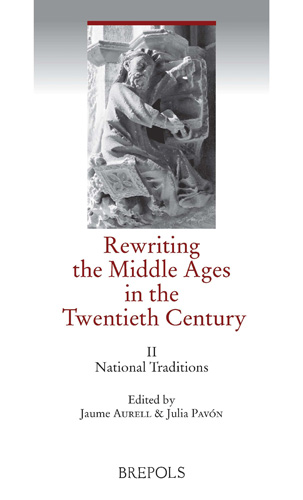
The first volume of Rewriting the Middle Ages in the Twentieth Century, published in 2005 by Brepols, gathered twenty profiles of key medievalists of the 20th century, and was preceded by an introduction on the evolution and current situation of medieval studies written by Jaume Aurell. Because of the excellent international reception of that volume, we continue this historiographical task by collecting in future volumes profiles of other 20th century medievalists. The second volume of the collection, centred on National Traditions, is focused on eighteen medievalists who have been significant in diverse countries in the development of both medievalism and national identity. Medievalism has been closely united to national traditions since its beginning, and this book contributes to our understanding of this phenomenon. Romantic intellectuals’ attraction to the medieval period largely explains the influence of medievalism in the formation of contemporary national identities, as from the 19th century, medievalists have also functioned as intellectuals present in the public debate. In the 20th century, important scholars of the Middle Ages, some of whom are studied in this volume, had already become authentic national chroniclers, consolidators of the identities of the countries to which they felt closely linked both intellectually and emotionally. They actively participated in debates that exceeded strictly academic limits, delving into a wide range of political and cultural issues. The range of the cultural and geographical origins of the medievalists profiled in this volume – from England, Spain, France, Germany, Russia, Portugal, Romania, Poland, Argentina, Bulgaria, United States, Belgium, Holland, and Turkey -best illustrates the global influence of medievalism in the construction, invention, and consolidation of national traditions. This focus, which perhaps (and apparently) contravenes the actual strength of the process of globalisation, is especially fascinating in the field of medievalism, because most of the modern nations – specially those in Europe and Asia – have found their justification, inspiration, and legendary and historical foundations in the Middle Ages. By reading the lives of these medievalists, we can better understand the development of intellectual history and our notions of developing cultural traditions.
The first volume of Rewriting the Middle Ages in the Twentieth Century, published in 2005 by Brepols, gathered twenty profiles of key medievalists of the 20th century, and was preceded by an introduction on the evolution and current situation of medieval studies written by Jaume Aurell. Because of the excellent international reception of that volume, we continue this historiographical task by collecting in future volumes profiles of other 20th century medievalists. The second volume of the collection, centred on National Traditions, is focused on eighteen medievalists who have been significant in diverse countries in the development of both medievalism and national identity. Medievalism has been closely united to national traditions since its beginning, and this book contributes to our understanding of this phenomenon. Romantic intellectuals’ attraction to the medieval period largely explains the influence of medievalism in the formation of contemporary national identities, as from the 19th century, medievalists have also functioned as intellectuals present in the public debate. In the 20th century, important scholars of the Middle Ages, some of whom are studied in this volume, had already become authentic national chroniclers, consolidators of the identities of the countries to which they felt closely linked both intellectually and emotionally. They actively participated in debates that exceeded strictly academic limits, delving into a wide range of political and cultural issues. The range of the cultural and geographical origins of the medievalists profiled in this volume – from England, Spain, France, Germany, Russia, Portugal, Romania, Poland, Argentina, Bulgaria, United States, Belgium, Holland, and Turkey -best illustrates the global influence of medievalism in the construction, invention, and consolidation of national traditions. This focus, which perhaps (and apparently) contravenes the actual strength of the process of globalisation, is especially fascinating in the field of medievalism, because most of the modern nations – specially those in Europe and Asia – have found their justification, inspiration, and legendary and historical foundations in the Middle Ages. By reading the lives of these medievalists, we can better understand the development of intellectual history and our notions of developing cultural traditions.
- Edited by Jaume Aurell Cardona
- Edited by Julia Pavon Benito
Other Titles in this Series
Similar Books
 «Solazoxa festa, stradolze e stracomplia»
Festschrift für Raymund Wilhelm zum 65. Geburtstag mit Beiträgen zu Diskurstraditionen und mittelalterlicher Philologie
Volume 249
 A Collaborative Tapestry in Honour of Shirley Ann Brown / Une fresque brodée en l’honneur de Shirley Ann Brown
The Bayeux Tapestry Seen by her Colleagues and Friends / La Tapisserie de Bayeux vue par ses collègues et amis

 Behind the Scenes of Medieval Roofs
An Overview of the Roofing Systems of Italian Churches
Volume 90

 Cahiers de recherches médiévales et humanistes – Journal of Medieval and Humanistic Studies
Volume 51








 Innovation and Medieval Communities
The Circulation of Ideas and Practices in and out of the Town (1200-1500)
Volume 63
 John Dunstaple Reading Boethius
John Dunstaple’s Annotations to Boethius’s “De institutione musica” in the Manuscript Oxford, Corpus Christi College Library, MS 118

 Medieval Debates on Foreknowledge: Future Contingents, Prophecy, and Divination
Acts of the XXVII Annual Colloquium of the SIEPM, Trento 12-15 September 2023
Volume 31

 Medieval Yeghegis, Armenia
History, Archaeology, Society. Local Multiplicities and Global Connections of a Rural Centre on the Silk Road(s)

 Nicholas of Lyra’s Commentaries on the Gospels of Matthew and Luke
Franciscan Exegesis in a Time of Crisis



 Power and Women in Southeast and Central Europe in Late Medieval and Early Modern Period (1300-1600)
Volume 10




 The Anglo-Norman Bible’s Books of Kings, a Critical Edition
(BL Royal 1 C III, fols 234r-274v)
Volume 37
