
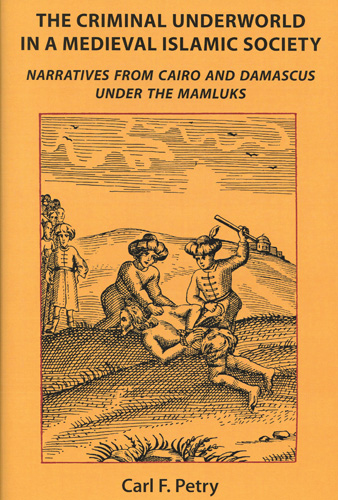
The Criminal Underworld in a Medieval Islamic Society
Narratives from Cairo and Damascus under the Mamluks
by Carl F. Petry
Paperback (Out of print)
(October 2016)
ISBN: 9780991573219
5.98 x 9.02 inches
Price: $39.95
On back order
Hardback (Out of print)
(December 2012)
ISBN: 9780970819987
6.1 x 9.09 inches
Price: $70.00
On back order
This study aims at disclosing the impact of criminal activity on society in the two largest cities of the Mamluk State
during the Mamluk Period in Cairo and Damascus (648 922H/ 12501517CE)
, as depicted by those who witnessed it at close range.
The narrative histories generated during the Mamluk Period in Cairo and Damascus (648 922H/ 1250-1517CE) addressed a wide range of domestic issues, in addition to their commentaries on imperial politics and international events. Topics such as the local economy, relations between sectarian communities, and the conduct of civil litigation under Sharia statutes were elaborated in minute detail, and have attracted the attention of contemporary historians. Less studied have been the chroniclers numerous references to criminal activity committed at all levels of society, from its elite military echelons to individuals or groups who occupied its margins. The latter elements, despite their demographic visibility, have in many instances evaded the notice of modern scholarship on medieval Islamic cultures. This study aims at disclosing their impact on society in the two largest cities of the Mamluk State, as depicted by those who witnessed it at close range. These local chroniclers pursued an agenda when they dwelled on the criminal acts they observed. Rather than offering simple decrials of wrongdoing, their comments collectively targeted the agents charged with policing social interaction and upholding public security. Disclosure of collusion in crime by those formally pledged to suppress it emerged as a covert, yet signal, objective of these chroniclers. The book examines this objective as it was discerned in more than a thousand incidents of criminal activity in Cairo and Damascus during the Late Middle Ages. The complicity it exposed provides insights that revise current views about the working of government under the Mamluks, and the perspectives of groups whose voices have gone largely unheard in the Historiography of pre-modern Islamic societies.
^BCarl F. Petry^b is the Hamad Bin Khalifa Al Thani Professor of Middle East Studies in the Department of History, Northwestern University. His publications include ^GThe Civilian Elite of Cairo in the Later Middle Ages^g and ^GProtectors or Praetorians? The Last Mamluk Sultans and Egypt’s Waning as a Great Power^g. He has edited and contributed to ^GThe Cambridge History of Egypt, vol. I: Islamic Egypt, 640-1517^g.
- By (author) Carl F. Petry
Other Titles in this Series
 Commemorating the Nation
Collective Memory, Public Commemoration, and National Identity in Twentieth-century Egypt
Volume 2


Similar Books
 «Solazoxa festa, stradolze e stracomplia»
Festschrift für Raymund Wilhelm zum 65. Geburtstag mit Beiträgen zu Diskurstraditionen und mittelalterlicher Philologie
Volume 249
 A Collaborative Tapestry in Honour of Shirley Ann Brown / Une fresque brodée en l’honneur de Shirley Ann Brown
The Bayeux Tapestry Seen by her Colleagues and Friends / La Tapisserie de Bayeux vue par ses collègues et amis

 Behind the Scenes of Medieval Roofs
An Overview of the Roofing Systems of Italian Churches
Volume 90

 Cahiers de recherches médiévales et humanistes – Journal of Medieval and Humanistic Studies
Volume 51

 Cities through Time
Glimpses into Urbanity and Community in Mediaeval to Modern West Asia and Egypt
Volume 1


 Cuneiform Artefacts from Archaeological Contexts: New Research on Ancient Iraq
Proceedings of a Conference Held at the Bavarian Academy of Sciences and Humanities, July 4–5, 2024
Volume 2





 From the Frontiers of the Empire to the Borders of the Nations
Borderland Security and Safety in the (post-)Ottoman Spaces (1700–1939)


 Global Gulf
Geo-Economic, Geo-Political, and Geo-Technological Transformation in Saudi Arabia, the United Arab Emirates, and Qatar



 Innovation and Medieval Communities
The Circulation of Ideas and Practices in and out of the Town (1200-1500)
Volume 63

 Islamic Rituals Beyond the Mosque
Historical Evolution of Prayer and Devotion in Physical Space and Cyberspace
 Ismail Hakki Bursevi’s translation of and commentary on Fusus al-Hikam By Muhyiddin Ibn ‘Arabi
Volumes 1-4
 John Dunstaple Reading Boethius
John Dunstaple’s Annotations to Boethius’s “De institutione musica” in the Manuscript Oxford, Corpus Christi College Library, MS 118

 Medieval Debates on Foreknowledge: Future Contingents, Prophecy, and Divination
Acts of the XXVII Annual Colloquium of the SIEPM, Trento 12-15 September 2023
Volume 31

 Medieval Yeghegis, Armenia
History, Archaeology, Society. Local Multiplicities and Global Connections of a Rural Centre on the Silk Road(s)
 Monastic Manuscripts from the Eastern Mediterranean (Sinai, Jerusalem, Antioch)
Production, Use, and Contexts


 Nicholas of Lyra’s Commentaries on the Gospels of Matthew and Luke
Franciscan Exegesis in a Time of Crisis
