
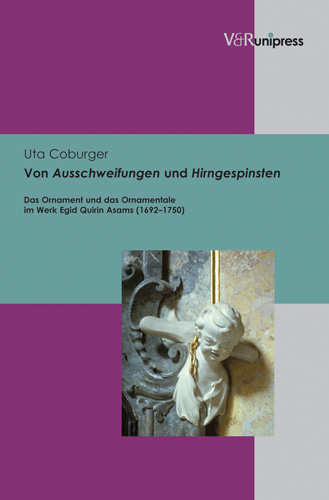
Von Ausschweifungen und Hirngespinsten
Das Ornament und das Ornamentale im Werk Egid Quirin Asams (1692–1750)
By (author) Uta Coburger
Hardback (Published)
(June 2011)
ISBN: 9783899718096
6.46 x 9.69 inches
Price: $113.00
On back order
Egid Quirin Asams bedeutungsvolle Ornamente.
English summary: Are Egid Quirin Asams ornaments really debauchery and woolgatherings? The study of Uta Coburger presents for the first time the different forms of the ornament in the work of the Bavarian artist. The analysis explores first the sources: he was compiling Italian influences with the fashionable French Ornament and used Augsburg ornamental prints or emblematic motifs as patterns. Finally the stylish art of the Munich Court can be detected as a source of his inspiration. These reflections in style or motif are the background of further thoughts to the complexness of ornament. Though out his career Asam was inventing and creating imaginative ornaments more and more. These ornamental forms are infused with christian symbolism and rhetoric structures and enlarges the concetto of the sacred decors. His sensibility stands alone in the art of the 18th Century. Asam was showing that ornament can carry meaning and reflects not only his artistic power but also his religious intention. The analysis of the ornaments function and content explains its basic role in the work of Asam: The ornament which used to be seen in its only decorative sense becomes a highly complex reality beyond pattern on a wall. German description: Sind Egid Quirin Asams Ornamente wirklich Ausschweifungen und Hirngespinste? Uta Coburgers Studie fasst erstmals die Formen des Ornaments im Werk des bayerischen Kunstlers zusammen. Bereits seine Motivquellen sind vielgestaltig: Er kompilierte italienische Einflusse mit franzosischer Ornamentmode, verwandte Augsburger Ornamentstiche ebenso wie emblematische Motive als Vorlagen und orientierte sich manchmal gar an der Munchner Hofkunst. Diese stil- und motivgeschichtliche Betrachtung bildet die Grundlage fur weiterfuhrende kultur- und geistesgeschichtliche Uberlegungen zum Ornament. Der Kunstler kreierte zunehmend phantasievolle Ornamente, die in der Kunst des 18. Jahrhunderts singular sind. Diese Ornamentformen sind von christlicher Symbolik und rhetorischen Strukturen durchdrungen und erweitern das Concetto einer Kirchenausstattung massgeblich. Das Ornament wird zum Bedeutungstrager und man erkennt nicht nur Asams kreatives Potenzial, sondern auch seine religiose Intention. So zeigt die hier vorgenommene Lesart die zentrale Rolle des Ornaments im Schaffen Asams und hebt das schmuckende Ornament weg von seinem Dasein als Muster auf der Wand.
Dr. Uta Coburger studierte Kunstgeschichte, Archäologie und Kunstpädagogik und wurde 2007 promoviert. Sie arbeitet als wissenschaftliche und kuratorische Referentin der Direktion Kunst- und Kulturgeschichte an den Reiss-Engelhorn-Museen Mannheim.
- By (author) Uta Coburger
Similar Books
 A Collaborative Tapestry in Honour of Shirley Ann Brown / Une fresque brodée en l’honneur de Shirley Ann Brown
The Bayeux Tapestry Seen by her Colleagues and Friends / La Tapisserie de Bayeux vue par ses collègues et amis



 Balthasar Caymox of Nuremberg
Early Modern German Print Publishers: Popular Prints of the Seventeenth Century


 ENTANGLED AFRICA
Intra-African Relations Between Rain Forest and Mediterranean from Around 4,000 BCE to 1,500 CE


 Gold, Silver and Glass: Power Networks, Cultural Identities, Technology Transfers and Agency across the Old World (7th Century BC – 1st Century AD)
Proceedings of a Conference Held at the British Museum, 16–18 June 2023


 Legal Visuality
Exegesis, Ambiguity, and Dissimulation of the Donation of Constantine in the Early Modern Period
 Listening to the Swan Song
More-than-Human Beings and Sounds in Literature and Culture Through the Ages


 Monastic Manuscripts from the Eastern Mediterranean (Sinai, Jerusalem, Antioch)
Production, Use, and Contexts

 Naples as Laboratory / Laboratorium Neapel
Style Options, Artistic Rivalry and Self Fashioning in Neapolitan Baroque Painting / Plurale Stilbildung, Kunstlerkonkurrenz und Self Fashioning in der neapolitanischen Barockmalerei

 Nurturing the Elite
Representations of Drinking, Eating, and Religious Vessels in Palmyrene Funerary Iconography
Volume 13


 Portraying the Individual in the Roman East
Local–Imperial Entanglements in Sculpture, Mosaics, and Paintings (First–Fourth Centuries AD)
Volume 18


 Technical Studies of Asian Art
Proceedings of the Seventh Forbes Symposium at the Freer Gallery of Art


