
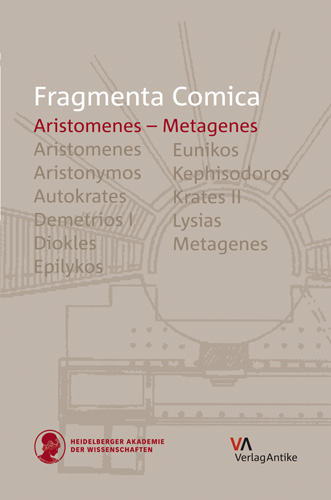
FrC 9.2 Aristomenes – Metagenes
Edited by Christian Orth Translated by Christian Orth
Hardback (Published)
(September 2014)
ISBN: 9783938032701
6.34 x 9.25 inches
Price: $150.00
In stock
“German text.Contents: Aristomenes; Aristonymos; Demetrios I; Diokles; Epilykos; Eunikos oder Ainikos; Kephisodoros; Krates II; Lysias; Metagenes.”
English summary: The series Fragmenta Comica will provide a complete commentary on the fragments of Greek comedy. The aim of the commentary is twofold: on the one hand, it is meant to make accessible these mostly rather challenging texts from a number of different perspectives. On the other hand, it should help in the reconstruction the plays where this is possible, as well as in achieving a literary-historical classification of the authors. The fragments and testimonia will be translated. The results obtained in the commentary will be integrated into general surveys published in the Studia Comica series: on comedy and comedy techniques such as parody and satire as well as on its political function. The project is planned to take fifteen years to complete. German description: Die Reihe Fragmenta Comica wird die vollstandige Kommentierung der Fragmente der griechischen Komodie bieten. Ziel der Kommentare ist es, einerseits die in der Regel schwierig zu verstehenden Texte unter allen moglichen Gesichtspunkten zu erschlieaen, andererseits, wo dies moglich ist, eine Rekonstruktion der Stucke zu versuchen und eine literaturgeschichtliche Einordnung der Autoren vorzunehmen. Die Fragmente und Testimonien werden ubersetzt. Die in den Kommentaren erzielten Ergebnisse sollen in allgemeine Studien einflieaen, die in den Studia Comica veroffentlicht werden: zur Komik und komischen Techniken wie Parodie, Satire sowie zur politischen Funktion. Prof. Dr. Bernhard Zimmermann leitet die Forschungsstelle Kommentierung der Fragmente der griechischen Komodie an der Heidelberger Akademie der Wissenschaften. Die Arbeitsstelle des Projekts ist am Seminar fur Klassische Philologie der Universitat Freiburg angesiedelt. Ein Weblog berichtet aktuell uber den Fortgang des Projekts, das auf 15 Jahre ausgelegt ist. Das Projekt ist international vernetzt und arbeitet mit Zentren zur Erforschung der fragmentarisch erhaltenen griechischen Literatur in Italien, Groabritannien und den USA zusammen.
PD Dr. Christian Orth lehrt an der Albert-Ludwigs-Universität Freiburg und ist Mitarbeiter der Heidelberger Akademie im Projekt »Kommentierung der Fragmente der griechischen Komödie«.
- Edited by Christian Orth
- Translated by Christian Orth
Other Titles in this Series




Similar Books



 Ars Prophetica
Theology in the Poetry of Twentieth-Century Hebrew Poets Avraham Halfi, Shin Shalom, Amir Gilboa, and T. Carmi


 Cahiers de l’Association internationale des études françaises
J. M. G. Le Clézio - Enseigner les littératures francophones aujourd’hui - Récit de soi et expérience de l’illusion (XVIIe-XVIIIe siècles)
Volume 78
 Cahiers de littérature française
Les Métamorphoses du texte. Enjeux intertextuels et transpositions visuelles
Volume 25
 Cahiers de recherches médiévales et humanistes – Journal of Medieval and Humanistic Studies
Volume 51
 Cahiers de sémiotique des cultures
Ponctuation et sens. Nouvelles perspectives / Punctuation and meaning. New perspectives
Volume 6



 CompLit
Myth, Folklore and Magic in European Literatures. Critical and Contemporary Reconfigurations

 Contesting Labeled Identities
The Sociology of Gentilics in Biblical and Northwest Semitic Literature


 Dis/United States of Vulnerability
Literary and Cultural Transgressions in U.S. Poetry Since the 1960s
Volume 330
 Drunk the Potion, No Whit Charmed
The Doctrine of Pure and Perfect Souls from Iamblichus to Damascius


 Epigraphic “Shades” from Hellenistic Thrace
Contextualizing Inscriptions in Greek from Thracian Tombs

 Epiphanies of the Divine in the Septuagint and the New Testament
Fifth International Symposium of the Corpus Judaeo-Hellenisticum Novi Testamenti (CJHNT), 14-17 May 2015, Nottingham


 European Drama and Performance Studies
Dramatisations politiques. Théâtre, politique et idéologie au XIXe siècle (1806-1914)
Volume 27


