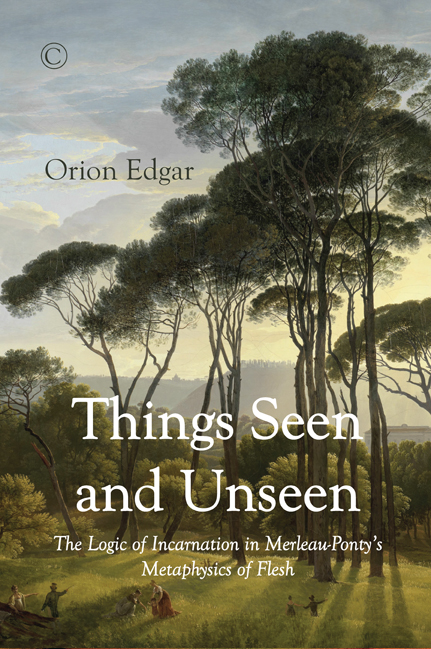
Things Seen and Unseen
The Logic of Incarnation in Merleau-Ponty's Metaphysics of Flesh
by Orion Edgar
Paperback (No longer our product)
(September 2016)
ISBN: 9780227175941
5.98 x 9.02 inches
Price: $41.00
On back order
An illuminating study of the theological roots of the writings of the French philosopher Maurice Merleau-Ponty, and their fruitful implications for contemporary Christian thought.
The philosophy of Maurice Merleau-Ponty was developing into a radical ontology when he died prematurely in 1961. Merleau-Ponty identified this nascent ontology as a philosophy of incarnation that carries us beyond entrenched dualisms in philosophical thinking about perception, the body, animality, nature, and God. What does this ontology have to do with the Catholic language of incarnation, sacrament, and logos on which it draws? In Things Seen and Unseen, Orion Edgar argues that Merleau-Ponty’s philosophy is dependent upon a logic of incarnation that finds its roots and fulfillment in theology, and that Merleau-Ponty drew from the Catholic faith of his youth. Merleau-Ponty’s final abandonment of Christianity was based on an understanding of God that was ultimately Kantian rather than orthodox. As such, Merleau-Ponty’s philosophy suggests a new kind of natural theology, one that grounds an account of God as ipsum esse subsistens in the questions produced by a phenomenological account of the world. This philosophical ontology also offers Christian theology a route away from dualistic compromises and back to its own deepest insight.
Orion Edgar (PhD, Nottingham) is Curate at Pershore Abbey, Worcestershire.
- By (author) Orion Edgar
"Merleau-Ponty's philosophy is at last beginning to receive the attention it so richly deserves. It remains one of the most fertile sources in recent thought for reshaping the way we think about knowledge, time, and embodiment - a reshaping made all the more urgent by the political and ecological disasters of our times. It is also a style of thought with obvious theological resonance, a question that has long been in need of the kind of careful, insightful, and creative attention that Orion Edgar provides in this really admirable study, which brings Merleau-Ponty's analyses of bodily existence together with central themes of the Christian imagination - incarnation and sacrament - in a deeply original and fruitful way." Rowan Williams, former Archbishop of Canterbury, Master of Magdalene College, Cambridge "This is, quite simply, the most magnificent account of Merleau-Ponty's phenomenology ever written. Edgar brings to life, in the fullest possible terms, the genius of Merleau-Ponty - the church should be truly grateful." Conor Cunningham, Associate Professor in Theology and Philosophy, Department of Theology; Co-Director, Centre of Theology and Philosophy, University of Nottingham "In this sophisticated first monograph, Orion Edgar reexamines the philosophy of Merleau-Ponty from the perspective of the Catholic faith that always lapped at the edges of his thought. Once Merleau-Ponty's notions of 'flesh' and 'depth' (in particular) are thus freshly illuminated, his striking relevance for a contemporary theology of the incarnation becomes apparent. Edgar's analysis is both philosophically insightful and theologically rich, and this study makes a significant contribution to Merleau-Ponty scholarship." Sarah Coakley, Norris-Hulse Professor of Divinity, University of Cambridge "Things Seen and Unseen is a welcome and elegant contribution to the recovery of Merleau-Ponty's 'incarnational' phenomenology for theology. It will be read with value by those interested in theological aesthetics and philosophy of religion as well." Janet Soskice, Professor of Philosophical Theology, Faculty of Divinity, University of Cambridge "In this erudite and articulate book, Edgar offers an embodied account of human existence in terms of hunger, dependence, desire, and intersubjectivity. He does so by means of a sincere and subtle development of Merleau-Ponty's ontology. As such, he fleshes out the deep philosophical meaning of incarnation that has relevance for both epistemology and Christian theology. He diagnoses and overcomes the dualisms that still haunt the contemporary imagination. We do not realize how Cartesian we are."Philip Goodchild, Professor of Religion and Philosophy, University of Nottingham "Things Seen and Unseen confirms the significance of Maurice Merleau-Ponty as one of the principal philosophical voices deserving contemporary theological attention. It also confirms Orion Edgar's significance as a voice in Christian philosophical theology. The Veritas series has its genesis in the Radical Orthodoxy movement and, since its beginnings, that movement has pointed to, and explored, the centrality of mediation to the Christian intellectual vision. This book is a further substantial contribution." Andrew Davison, Faculty of Divinity and Corpus Christi College, University of Cambridge "We should be extremely grateful to Edgar for opening a significant new field of research, which it can only be hoped others will enter." David Grumet, Religion and Theology, Vol. 24, Issue 2, 2017
—
Similar Books


 Drunk the Potion, No Whit Charmed
The Doctrine of Pure and Perfect Souls from Iamblichus to Damascius
 Éthique, politique, religions
Superstition (XVIIe - XXIe siècles). Sémantique, histoires et cultures


 La Lettre clandestine
La littérature philosophique clandestine, ses éditeurs et ses éditions
Volume 34
 Libertinage et philosophie à l’époque classique (XVIe-XVIIIe siècle)
Athéisme, Modernité et Sécularisation / Atheism, Modernity and Secularization
Volume 23


 Political Thought and Eleventh-Century Populism
The Meek, the Many, and the Meritorious during the Age of the Gregorian Reform
Volume 38


 The Latin Hermes in Translation
Asclepius, Glosses on Trismegistus, Book of Six Principles of Things, Book of 24 Philosophers
Volume 50



 ‘Emergente Evolution’?
Fallstudien zur philosophischen Rekonstruktion und schopfungstheologischen Rezeption eines naturalistischen Paradigmas
Volume 40
 Al-Ğābirīs Genese und Kritik der Arabischen Vernunft
On Genesis and Critique of Arab Reason by Muḥammed ʿĀbid al-Ğābirī


 Das Dasein und das isolierte Subjekt
Die Frage der philosophischen Selbstinterpretation des Menschen bei Heidegger


 Der Geist des Menschen und die originäre Erfahrung der Zerbrechlichkeit
Eine philosophisch-theologische Grundlegung nach Edith Stein im Dialog mit der medizinischen Anthropologie und der existentiellen Psychologie