
Gotthold Ephraim Lessings ›Emilia Galotti‹ im Kulturraum Schule (1830–1914)
Edited by Carsten Gansel Edited by Birka Siwczyk
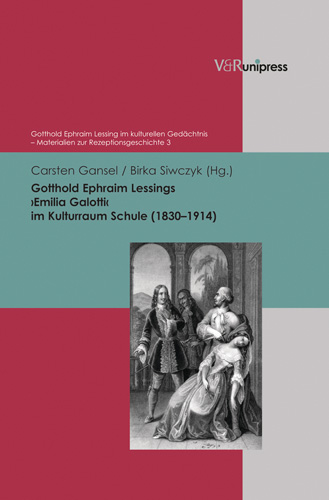
Hardback (Published)
(July 2015)
ISBN: 9783847103837
6.34 x 9.33 inches
Price: $82.00
In stock
Dass G. E. Lessing so stark im kulturellen Gedachtnis verankert ist, war nur moglich, weil bestimmte Instanzen die Konservierung und Pflege der Bestande ubernahmen. Bei Lessing hat besonders die Schule eine grosse Rolle bei der Inthronisierung im Kanon und mithin im kulturellen Gedachtnis gespielt. Dieser Band gibt Einblicke in die Rezeption von Emilia Galotti zwischen 1838 und 1904 und ermoglicht Ruckschlusse uber das Verhaltnis von Gymnasium und Universitat. Im Mittelpunkt steht die Schulprogrammschrift, eine literaturwissenschaftlich bislang wenig beachtete Publikationsform.
English summary: Gotthold Ephraim Lessing has been a special part of German cultural memory since the beginning of the 19th century. This was only possible because it was ensured that his literary estate was preserved and cared for. In Lessing’s case, it was schools especially which played a salient role in the enthronement of the poet in the German canon and thus in Germany’s cultural memory. The role of the classical grammar school in this process has only sporadically been documented until now. This volume comprises edited contributions on Lessing’s “Emilia Galotti”. They offer an insight into the reception of this play between 1838 and 1904 and enable us to draw conclusions on relations between grammar school and university. The main focus of the volume is on school curricular programmes, which have hitherto received little attention by literary scholars. German description: Gotthold Ephraim Lessing gehort seit Beginn des 19. Jahrhunderts zu jenen Autoren, die im kulturellen Gedachtnis in besonderer Weise verankert sind. Dies allerdings war nur moglich, weil es Instanzen gab, die die Konservierung und die Pflege der Bestande ubernahmen. Im Fall von Lessing hat insbesondere die Institution Schule eine herausragende Rolle bei der Inthronisierung des Dichters im Kanon und mithin im kulturellen Gedachtnis gespielt. Erst durch individuelle Wahrnehmung, durch Wertschatzung und Aneignung in der Institution Schule wurde Lessing zu einem Kanonautor. Die Rolle des Humanistischen Gymnasiums in diesem Prozess ist bislang nur vereinzelt erfasst worden. Dieser Band ediert Beitrage zu Lessings Emilia Galotti (1772). Sie geben Einblicke in die Rezeption dieses Stucks zwischen 1838 und 1904 und ermoglichen Ruckschlusse uber das Verhaltnis von Gymnasium und Universitat. Im Mittelpunkt steht die Schulprogrammschrift, eine literaturwissenschaftlich bislang wenig beachtete Publikationsform.
Prof. Dr. Carsten Gansel lehrt Neuere deutsche Literatur und Literatur- und Mediendidaktik an der Universitat Giessen. Birka Siwczyk ist als wissenschaftliche Mitarbeiterin an der Arbeitsstelle fur Lessing-Rezeption Kamenz tatig.
- Edited by Carsten Gansel
- Edited by Birka Siwczyk
Other Titles in this Series


Similar Books



 Ars Prophetica
Theology in the Poetry of Twentieth-Century Hebrew Poets Avraham Halfi, Shin Shalom, Amir Gilboa, and T. Carmi


 Cahiers de l’Association internationale des études françaises
J. M. G. Le Clézio - Enseigner les littératures francophones aujourd’hui - Récit de soi et expérience de l’illusion (XVIIe-XVIIIe siècles)
Volume 78
 Cahiers de littérature française
Les Métamorphoses du texte. Enjeux intertextuels et transpositions visuelles
Volume 25
 Cahiers de recherches médiévales et humanistes – Journal of Medieval and Humanistic Studies
Volume 51
 Cahiers de sémiotique des cultures
Ponctuation et sens. Nouvelles perspectives / Punctuation and meaning. New perspectives
Volume 6


 CompLit
Myth, Folklore and Magic in European Literatures. Critical and Contemporary Reconfigurations


 Dis/United States of Vulnerability
Literary and Cultural Transgressions in U.S. Poetry Since the 1960s
Volume 330


 European Drama and Performance Studies
Dramatisations politiques. Théâtre, politique et idéologie au XIXe siècle (1806-1914)
Volume 27


 La Lettre clandestine
La littérature philosophique clandestine, ses éditeurs et ses éditions
Volume 34


 La Revue des lettres modernes
« Afin que rien ne meure ». Le deuil dans et de l’œuvre de Marguerite Duras
Volume 9

