
Women, Gender, and Sex in the End-Time
Household Roles in 1 Corinthians 7
by Judith M. Gundry

Hardback (Published)
(August 2025)
ISBN: 9783161526169
6.06 x 9.09 inches
Price: $150.00
In stock
In this book, Judith Gundry explains Paul’s teaching on procreation in 1aCorinthiansa7 in the light of ancient views about the household and Paul’s own eschatology, and in contrast to the biblical view that human beings were created “male and female” to “be fruitful.”
In 1 Corinthians 7 Paul advises not marrying, unless one “burns.” No exception is made for marrying to have children. Judith Gundry seeks to explain Paul’s striking departure from biblical teaching on marriage and procreation as obligations based on being created “male and female” to “be fruitful and multiply.” She argues that 1 Corinthians 7 is best read in the light of ancient texts on marriage and procreation to establish and perpetuate households. In Greco-Roman antiquity, the household was essential not only to the future of the cosmos and welfare of the state, but also to individual men facing their own mortality. Men married to establish households and obtain legitimate children as heirs to carry on their names and family lines. This required women to bear children, and children to perform duties in honor of their parents. The household thus determined social roles. But from a Jewish apocalyptic or early Christian perspective, things looked different. The resurrection of the dead had begun, suggesting a diminished purpose for marriage. The eschatological distress was impending, implying that affliction rather than blessing would befall procreators. The ideal of concord was unattainable in communities divided into competing households. Some had already joined celibate communities where members pursued contemplation or mutual service, rather than heirs and individual households. Judith Gundry shows that Paul’s directives and advice in 1 Corinthians 7 compare well with such perspectives. Paul’s advice to prefer celibacy – for those who could avoid sexual immorality – was a recommendation of childlessness over abundant fertility. His warning to the married about affliction in the impending distress was an attempt to spare them the awful consequences of procreation in the end-times. His instruction to husbands to curtail sex with their wives hinted at giving up the conventional use of wives to obtain heirs, and instead having nonprocreative sex. His allowance of sexual abstinence in marriage by mutual agreement “for a suitable time” alluded to an ancient contraceptive method. His description of Christ-believers’ children as “consecrated” to God undercut their significance for perpetuating households. Gundry concludes that being created “male and female” (hence, sexual differences) mattered to Paul without entailing the obligation to procreate and other gender-specific roles integral to the household. This view is contradicted in the later Pauline tradition (Colossians, Ephesians, and the Pastoral Epistles), where the household again plays a key role.
- By (author) Judith M Gundry
Other Titles in this Series


 Reading the First Century
On Reading Josephus and Studying Jewish History of the First Century
Volume 300


 Divine Kingdom and Kingdoms of Men / Gottesreich und Reiche der Menschen
Studies on the Theology of the Septuagint Volume II / Studien zur Theologie der Septuaginta Band II
Volume 432

 Leiblich vermitteltes Leben
Vorstellungen vom Uberwinden des Todes und vom Auferstehen im fruhen Christentum
Volume 501
 Der Ratschluss Gottes
Erzählanalytische Untersuchungen zu einem theologischen Zentralmotiv des lukanischen Doppelwerks
Volume 527
 Kontexte des Johannesevangeliums
Das vierte Evangelium in religions- und traditionsgeschichtlicher Perspektive


 Die vier Evangelien und das eine Evangelium von Jesus Christus
Studien zu ihrer Sammlung und Entstehung
Volume 224

 Paulus und die kaiserzeitliche Epistolographie
Kontextualisierung und Analyse der Briefe an Philemon und an die Galater
Volume 276
 Ethische Normen des frühen Christentums
Gut - Leben - Leib - Tugend. Kontexte und Normen neutestamentlicher Ethik / Contexts and Norms of New Testament Ethics. Band IV
Volume 313

 The Eucharist – Its Origins and Contexts
Sacred Meal, Communal Meal, Table Fellowship in Late Antiquity, Early Judaism, and Early Christianity. Volume I-III
Volume 376

 Der eine Gott, der durch alle ist
Epheser 4,6 im Kontext antiker Diskurse uber Gott und die Welt
Volume 445

 Paulus im Kontext des Diasporajudentums
Judenchristliche Lebensweise nach den paulinischen Briefen und die Debatten um 'Paul within Judaism'
Volume 511

 Gemeinde ohne Tempel /Community without Temple
Zur Substituierung und Transformation des Jerusalemer Tempels und seines Kults im Alten Testament, antiken Judentum und frühen Christentum

 Paul’s Anthropology in Context
The Image of God, Assimilation to God, and Tripartite Man in Ancient Judaism, Ancient Philosophy and Early Christianity
 Die Septuaginta – Texte, Theologien, Einflüsse
2. Internationale Fachtagung veranstaltet von Septuaginta Deutsch (LXX.D), Wuppertal 23.-27. Juli 2008
Similar Books


 Athanasius of Alexandria, Epistula ad episcopos Aegypti et Libyae
Old Slavonic Version and English Translation
Volume 261


 Cyril of Alexandria’s Christological Exegesis
Explorations of Partitive Exegesis in the Dialogues on the Trinity
Volume 70


 Epiphanies of the Divine in the Septuagint and the New Testament
Fifth International Symposium of the Corpus Judaeo-Hellenisticum Novi Testamenti (CJHNT), 14-17 May 2015, Nottingham


 Extracanonical Traditions and the Holy Land
Texts, Rituals, and Material Culture in Late Antique Palestine
 From Joseph to Jesus
The Joseph Narrative as a Compositional Template from Old Greek Esther to the Gospel of Luke
Volume 125




 Paradise Lost in Transmission
The Return to Eden in the Apocalypse of Peter within Its Ethiopic and Early Christian Contexts



 Punning in Odd or Elegant Constructions in Jeremiah
The Convergence of Linguistics, Rhetoric, and Textuality in the Hebrew Text of Jeremiah

 Shame in the Worlds of the Hebrew Bible and Akkadian Texts
A Linguistic Study and Its Implications
Volume 33

 Tabernacle, Table, Ark, and Text
Richard of Saint Victor on the Interpretation of Scripture
Volume 67
 The Anglo-Norman Bible’s Books of Kings, a Critical Edition
(BL Royal 1 C III, fols 234r-274v)
Volume 37
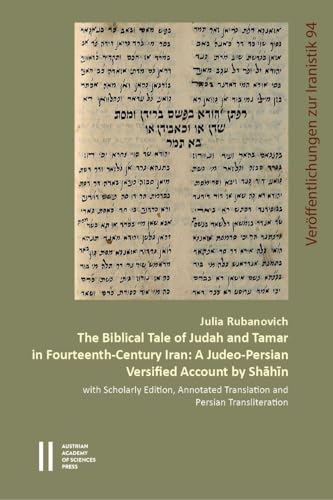 The Biblical Tale of Judah and Tamar in Fourteenth-Century Iran
A Judeo-Persian Versified Account by Shāhīn with Scholarly Edition, Annotated Translation and Persian Transliteration
Volume 94, 951
 The Body
Lived, Cultured, Adorned: Essays on Dress and the Body in the Bible and Ancient Near East in Honor of Nili S. Fox