
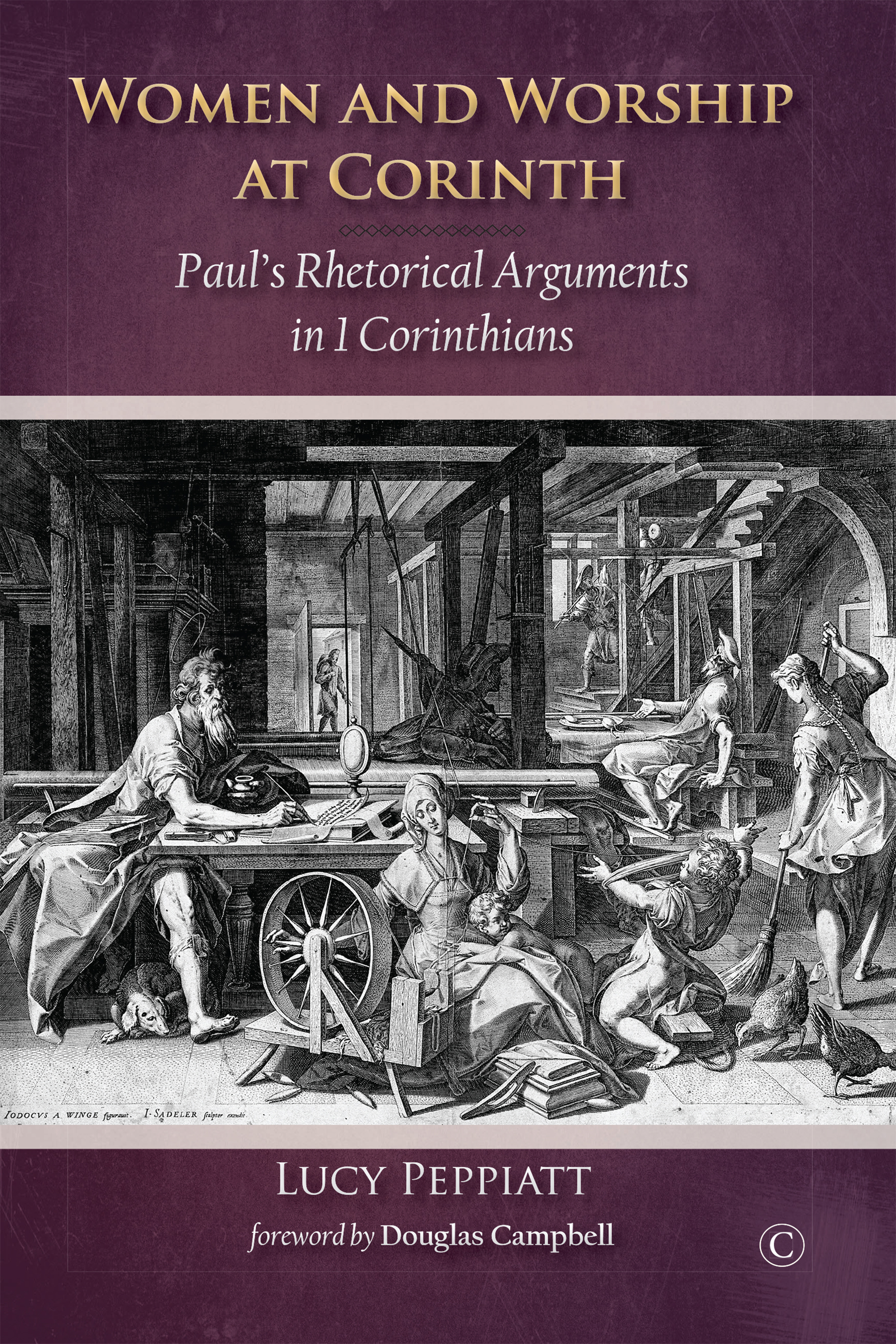
Women and Worship at Corinth
Paul's Rhetorical Arguments in 1 Corinthians
by Lucy Peppiatt
Paperback (No longer our product)
(April 2017)
ISBN: 9780227176429
5.98 x 9.02 inches
Price: $29.00
In stock
A new reading of Paul’s First Epistle to the Corinithians, offering an alternative to traditional misogynistic interpretations.
Paul’s arguments in 1 Corinthians 11-14 – from the role of women in public worship, to the value of speaking in tongues and prophecy for the unbeliever – have long posed challenges to the lay reader and scholar. Despite numerous explanations offeredover the years, these passages remain marked by inconsistencies, contradictions, and puzzles. Lucy Peppiatt offers an interpretation in which she proposes that Paul was in conversation with the Corinthian male leadership concerning their domineering, superior and selfish practices, which included coercing women to wear head coverings, lording it over the ‘have-nots’ at the Lord’s Supper, and ordering married women to keep quiet in church. Peppiatt’s bold arguments not only bring internal coherence to the text, but also paint a picture of the apostle gripped by a vision for a new humanity ‘in the Lord’, resulting in his refusal to compromise with the traditional views of his own society. Instead, Paul tells the Corinthians to become morelike Christ, to make ‘love’ their aim, and to restore dignity and honour to women, outsiders, and the poor.
- By (author) Lucy Peppiatt
"Peppiatt sheds new light on texts in 1 Corinthians that concern the thorny issue of Paul and women. She brings together exegetical skill, theological insight, and a vital concern for the historically contingent nature of Paul's argumentation, to offer a genuinely original and constructive analysis. So often the language of 1 Cor 11:2-16 and 14:33-35 proves to be a stumbling block for readers of Paul. Peppiatt, in ways which will inevitably be contentious, paves a plausible way out of the interpretive difficulties."-Chris Tilling, St. Mellitus College, London"Peppiatt offers a reading of Paul's advice on head coverings, women, and authority in the church. Her persuasive account of 1 Cor 11:2-16 rescues Paul from those who appeal to him in support of misogynistic theologies and confirms Paul's radical critique, rather than endorsement, of patriarchal culture. I commend it highly."-Murray Rae, University of Otago, Dunedin, New Zealand
—
Similar Books




 Cyril of Alexandria’s Christological Exegesis
Explorations of Partitive Exegesis in the Dialogues on the Trinity
Volume 70


 Extracanonical Traditions and the Holy Land
Texts, Rituals, and Material Culture in Late Antique Palestine
 From Joseph to Jesus
The Joseph Narrative as a Compositional Template from Old Greek Esther to the Gospel of Luke
Volume 125


 Nicholas of Lyra’s Commentaries on the Gospels of Matthew and Luke
Franciscan Exegesis in a Time of Crisis

 Punning in Odd or Elegant Constructions in Jeremiah
The Convergence of Linguistics, Rhetoric, and Textuality in the Hebrew Text of Jeremiah


 Reformed Covenantal Eudaimonism
Wilhelmus à Brakel (1635–1711) on Highest Good, Virtue, and Law
Volume 87


 The Biblical Tale of Judah and Tamar in Fourteenth-Century Iran
A Judeo-Persian Versified Account by Shāhīn with Scholarly Edition, Annotated Translation and Persian Transliteration
Volume 94, 951
 The Body
Lived, Cultured, Adorned: Essays on Dress and the Body in the Bible and Ancient Near East in Honor of Nili S. Fox







 The Therapeutae as the Best Paradigm for the Contemplative Life
A Contextual Reading of Philo of Alexandria's De Vita Contemplativa

